Table of Contents
light pollution
- see also:
- websites:
 |  |
light pollution
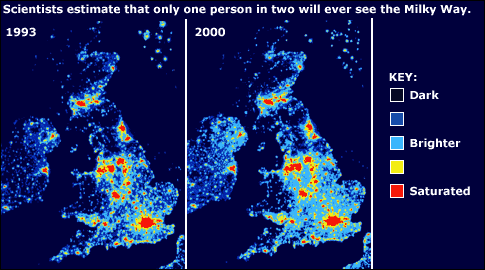
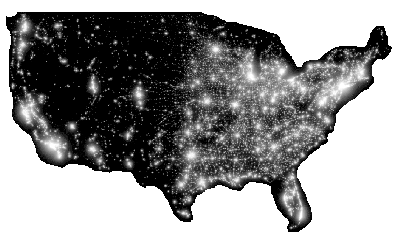
- if the air around us was completely clean and pure, free of all dust, pollutants and light, this issue wouldn't be so crucial. But that's sadly not the case. All the dust and pollution that is suspended in the air scatters light in all directions.
- the primary sources of light are street/city lights (eg. outdoor building lighting) and the moon (full moon being the worst).
- light pollution reduces the detail and brightness of sky objects.
- light pollution can be easily seen by the lighting up of clouds at night
- also included in the table is the approximate exposure in a digital camera (after dark frame subtraction) at f/4 800ISO pointed at the zenith that results in a luminosity histogram peak at 50% (ie. mean value is 128 in 8 bit channel).
- alternatively you can measure sky glow by counting stars in constellations
| limiting visual magnitude | zenith sky brightness | Unaided eye capabilities |
|---|---|---|
| 3.5 (urban) | 25-50x | Milky Way is completely invisible; 0.6 minutes exposure; |
| 4.5-5.0 (suburban) | 7-10x | Milky Way and Zodiacal light invisible. Typical conditions found in suburbs of major cities. Passing clouds are easily seen due to being lit up from surrounding lights. 1.5-2.4 minutes exposure; |
| 5.1-5.5 | 5-7x | The indistinct Milky Way faintly visible only near the zenith. Zodiacal light invisible. M31, the Andromeda Galaxy, is barely discernible. 2.4-3.8 minutes exposure; |
| 5.6-6.0 (outskirts) | 4-5x | clouds are brighter than the sky because they are lit from below. The Milky Way is now more easily seen, but lacks detail. M13, the Great Hercules globular star cluster can now be just glimpsed when near the zenith. The Zodiacal light is still invisible. The Milky Way from Auriga through Orion still invisible. 3.8-6.0 minutes exposure; |
| 6.1-6.5 (rural) | 2-3x | The Milky Way is now obvious and some detail can be glimpsed. The Zodiacal light is now barely visible, but not obvious. The Milky Way from Auriga through Orion is faintly visible. There is still noticeable sky-glow along the horizon due to distant towns and cities. NB. the Sydney sky-glow is visible even 700km inland! eg. Eastern/central Oregon; 6.0-9.5 minutes exposure; eg. Clonbinane, 68km north of Melbourne |
| 6.5-7.0 (dark sky rural) | 1-2x | the sky is packed with stars, the Milky Way is a mass of swirling, jumbled detail and any clouds appear blacker than the sky itself. Sky brightness mainly due to natural sky glow. Much structure is visible in the Milky Way. The Zodiacal light is an obvious cone of light. The major constellations are less obvious due to “noise” caused by the large number of faint stars now visible. Passing clouds appear as dark moving masses as they block the natural skyglow or the Milky Way. A few sources of sky-glow are still visible. eg. western USA, New Mexico, 9.5-15 minutes exposure; eg. in Victoria, Australia: Hall's Gap, Horsham, Nagambie |
| >7.1(darkest skies) | 1x | Incredible! The Milky Way contains an enormous amount of structure all the way to the horizon and you can easily see your way around by it's light. The Zodiacal light now encircles the entire ecliptic. There are no sources of sky-glow along any part of the horizon. Many meteors are visible. >15 minutes exposure; eg. in Victoria, Australia: Murchison, Ouyen, Heathcote |
- see also:
- The International Dark Sky Association - light pollution issues


light pollution and distance from urban centres:
- Merle Walker developed an equation (Walker's equation) to estimate amount of light pollution based on sky glow around a number of cities in California in late 20th century - before attempts to limit light pollution were implemented:
- I = 0.01Pd-2.5
- where:
- I = increase in sky glow level above natural background
- eg. I=0.02 means a 2% increase; I=1.00 means a 100% increase - ie. a doubling
- P = population
- d = distance to centre of city in km
- equation seems to best fit where average lumens per person is 500-1000.
- large cities eg. pop = 1 million, emit higher levels per capita so may need to increase the estimate
- significant sky degradation begins at increases of 10% above natural background, this occurs at:
- 10km from city of 3,000
- 25km from city of 30,000
- 50km from city of 180,000
- 100km from city of 1 million
- 200km from city of 5 million
- thus effect of distance on fall off of light pollution is:
- distance in km: 10 20 30 40 50 60 80 100
- light level: 316 56 20 10 6 4 2 1
- for Melbourne with pop. 2.5m:
- distance in km: 10 20 30 40 50 60 80 100
- I: 158 28 10 5 3 2 1 0.5
- to determine distance of a site from a city of known coords using a GPS:
- distance in km = 12756.274 x sin-1 sqrt[sin2 ((latcity - latsite)/2) + cos latsite x cos latcity x sin2 ((longcity - longsite)/2) ]
- where lat = latitude in radians (southern hemisphere is negative) & long = longitude in radians (west is negative)
- NB. convert degrees to radians by: radians = (pi/180) x degrees
natural sky glow
- The Australian Outback, the coast northwest of Perth, the Chilean observatory sites, and isolated places in the US Southwest, plus many others have sky brightness negligibly different from the natural background, which sets a fundamental (and more-or-less inescapable) limit on how dark a site can be.
- The moonless night sky at a remote location far from any man-made light pollution is, however, still not completely black. To most people who are fully dark adapted, it appears a dark gray, but it may also have some faint color.
- The dark night sky is illuminated by a natural skyglow that is composed of four parts:
- Airglow is the brightest component and is caused by oxygen atoms glowing in the upper atmosphere which are excited by solar ultraviolet radiation. Airglow gets worse at solar maximum. Airglow can add a faint green or red color to the sky background. The color may be vivid if there is a strong aurora occurring.
- Interplanetary dust particles reflect and scatter sunlight and make up the zodiacal light and gegenschein.
- At night starlight is scattered by the atmosphere, just as sunlight is during the daytime. Air molecules scatter short blue wavelengths more, which is why the daytime sky is blue. The night sky also has a very faint blue component from scattered starlight.
- Countless stars and nebulae in our own galaxy also contribute to the brightness of the night sky, most easily seen in the form of the Milky Way.
- Despite the fact that many folks have not seen the zodiacal light, much less the gegenschein or zodiacal band, it is the main contribution to the natural sky brightness even the ecliptic poles.
- The night-airglow varies considerably due to solar activity on the time scale of minutes/hours as well as over the 11-year solar cycle, and can greatly compromise the darkness at a site on any particular night.
- The zodiacal light, zodiacal band, and gegenschein are prominent features of the night sky at true-dark sites. They are not tests of visual acuity, but of sky brightness.
- The night-airglow is also easy to see at dark sites, at least where there is little scattered light from atmospheric dust and aerosols. There are many reported visual sightings of the rippled structure in this phenomenon, looking like banded very thin altocumulus clouds. This light is visible mostly from a forbidden line of ground-state oxygen which emits at 5577A, where most light-pollution filters have their red cutoff.
- The widely accepted value for sky brightness at the zenith at a site completely free of man-made light sources and near solar activity minimum is V mag. 22.0 per square arcsecond = mag. 13 per square arcminute. In other words, a perfect site has a sky brightness equivalent to having a mag. 22 star in every square arcsecond box (hardly bigger than the star image itself) over the entire sky.
- Where there's no light pollution the limiting magnitude is usually assumed to be 6.5, though some people can see fainter. Under such conditions, the sky is packed with stars, the Milky Way is a mass of swirling, jumbled detail and any clouds appear blacker than the sky itself.
astrophotography in areas of light pollution:
- light pollution spectra:
- high pressure sodium lamps have narrow peaks between 570, 583, 600, and 617nm
- coiled fluorescent lamps have mercury peaks at 365, 405, 436, 546, 577, and 617nm
- high intensity tungsten-halogen outdoor lamps often have a broad spectrum esp. from 500-750nm:
- 3000K filament has peak at 900nm rising steadily from 300nm thus main impact is > 600nm
- 4000K filament has peak at 700nm rising steadily from 250nm thus main impact is > 500nm
- 5000K filament has peak at 480nm thus main impact is 400-600nm
- neon peak at ~640nm
- natural airglow occurs at 558 and more weakly at 630nm.
- car headlights are broadband and cannot be blocked
- full moon:
- stargroups are still possible without filtering, H-alpha objects are fine with H-alpha filter, galaxies are difficult to impossible.
- nebula emission spectra:
- OIII at 496 & 501nm producing a teal blue-green color but is transmitted in both blue & green filters (esp. planetary nebulae)
- H-alpha at 656-658nm producing a red color
- H-beta at 486nm, hence blue
- cyanogen at 511 & 514nm (esp. comet gas tails)
- light pollution filters (these only enhance nebulae and make stars dimmer!):
- see also http://www.astronexus.com/node/4
- problems:
- results will not be as good as going to a dark sky site!
- expensive $US185 upwards
- do not block all light pollution
- may not be as effective for visualising broadband objects such as stars
- a filter that substantially improves views of star clusters, galaxies, or reflection nebulae does not exist as these reflect light across the spectrum and filters blocking light pollution will necessarily make these dimmer.
- may require increased exposure times
- some filters are not available any larger than 2“ - see Pertti's tests using 48mm (2”) filters on Canon lenses via step-down rings here
- using a series of step-down filters (eg. 77-72-62-52-48mm) actually decreased aberrations but loses a further 1-2 stops of aperture (the EF 200mm f/2.8 becomes about f/4.2).
- may have problems with digital cameras as most block H-alpha regions so using a filter that primarily only allows H-alpha will result in very long exposure times
- quantum efficiency at H-alpha band is 25% with SBIG ST2000XM, higher with ST10 but only a few percent to Canon 300D.
- require high quality multicoated optic systems to minimise internal reflections they produce as they reflect non-transmitted light rather than absorbing it
- cause colour shifts towards the edge of image in wide field images as curved lenses refract light differently as narrowband filters are tuned to specific wavelengths by carefully controlling the thickness of layers of dielectric material on glass. Because the effective thickness changes when the filter is tilted, the wavelength tuning will also change.
- if using a front-mounted filter which sits on the camera body (usually a Canon), cannot use EF-S lenses.
- SBIG CFW-8 & CFW5C filter wheels:
- Assume the dominant light pollution is from high pressure sodium street lamps. Design a “gap” between the red and green filters to eliminate sodium light pollution as much as possible. Keep the blue and green filters as efficient as possible.
- ie. both the red & green filters have a more narrow spectrum than usual to create a gap coinciding with the sodium lamps, however, the strongest emission at 570nm is allowed to pass at 80% transmission via the green filter and does little to block the mercury emissions.
- the main problem with RGB filter sets is the poor transmission of 480-550nm & thus the important OIII line is not captured well, hence many are migrating to CMY filter sets for “true color” or Ha-OIII-? filter sets for dramatic false colour images
- combining this with the IDAS filter:
- blue filter now blocks the 430nm mercury line
- green filter now blocks the 540nm mercury line but unfortunately still lets in the strong 570nm sodium line
- red filter still allows, although at lower transmission, the 620nm mercury & sodium emissions
- IDAS filter by Hutech:
- works well with mercury-vapor lights
- can be used in front of the RGB filters but will also affect the luminance channel exposure
- it blocks narrow spectral lines from mercury, sodium and neon lamps, leaving reasonable color balance among the RGB filters, but at the expense of nearly twice the imaging time.
- transmits 400-430nm, 450-540nm, 570-590nm, 600-620nm, 640-700nm and thus blocks most of the mercury, sodium and neon emissions.
- many prefer the IDAS-LPS because the color balance is almost unchanged. It is less efficient in heavy light pollution but this is the price to pay for color fidelity. Color balance, it can be managed easily in Photoshop with the grey pipet or doing a custom with balance with a DSLR using a piece of white paper. But if a color is dropped by the filter (like h-alpha for example), no color balance will get it back.
- 2“ (48mm) filter can be used at prime focus or on the front of lenses via step-down rings
- can be used easily at focal lengths 50mm and higher without significant colour banding
- Astronomik UHC:
- filter factor 10-14;
- minimum usable focal length without colour banding is 70mm.
- narrow band Ha & OIII filters which are good for the emission nebulae, but better for visual than photo use:
- require at least a 4” telescope
- H-alpha filters:
- no good for most digital cameras as they have IR filter that blocks H-alpha
- 3nm bandwidth - only for f/ratios slower than f/4 else S/N reduces near the edge of image
- 10nm bandwidth - allows more stars to be imaged
- Lumicon H-alpha:
- blocks everything < 640nm
- OIII filters:
- Many emission nebulae and most planetary nebulae will look remarkably better through an OIII filter.
- as the OIII filter discriminates against all other wavelengths, the background image is considerably dimmer, even more than a narrow-band filter, thus it is more suitable for telescopes 6-inches and larger.
- Lumicon OIII:
- good for visual astronomy of nebulae in light polluted areas
- does a better job enhancing planetary nebula and some emission nebula than the Ultrablock or UHC
- bandpass 11nm; optimum exit pupil 2-5mm light polluted & 3-7mm dark sky
- Thousand Oaks LP-3 Oxygen III
- OIII + Hb filters “narrowband”:
- most useful for observing emission or planetary nebulae.
- the background field of view becomes rather dim, but target objects still stand out well and actually appear brighter because of the added contrast.
- Lumicon UHC (the latest version) and Orion UltraBloc:
- poor color balance (because color spectrum is strongly filtered) thus greens become blue
- suitable for visual usage of emission nebula (better contrast) such as Orion, Lagoon
- filter h-alpha
- very narrow h-beta (less dark blue)
- not recommended as a light pollution filter but great for viewing nebulae
- bandpass 24nm; optimum exit pupil 1-4mm light polluted & 2-6mm dark sky
- Thousand Oaks Lp-2 narrowband
- see http://www.thousandoaksoptical.com/nebula.html transmission charts
- OIII + cyanogen filters:
- Lumicon Comet filter
- H-beta filters:
- Lumicon H-beta filter - good for visual of Horsehead, Cocoon nebs;
- bandpass 9nm; optimum exit pupil 3-7mm light polluted & 4-7mm dark sky
- has a limited use. It enhances only a few emission such as the California and IC 434 making the horsehead easier to see. It will also enhance some very faint emission nebula. Many people call the H-beta the horsehead filter because in many cases it is the only way to see the horsehead nebula.
- Thousand Oaks LP-4 H-beta
- see http://www.thousandoaksoptical.com/nebula.html transmission charts
- OIII+H-alpha+H-beta+NII filters:
- Hutech IDAS NBN-PV:
- transmits 470-510nm & 650-690nm
- Hutech IDAS LPS-V3:
- filter factor ~6
- broadband filters:
- The real use for broadband filters is to enhance some reflection nebulas, HII regions (nebula) in galaxies such as M101 and M33 and astrophotography of nebulas only. It doesn’t produce dramatic results but can help. You will not use a broadband filter much, a narrowband filter is better for nebulae.
- can be used on any size telescope
- Meade broadband #511B:
- transmits 460-530nm & 630-750nm, blocking more spectra than the IDAS LPS although allowing some neon through and better transmission > 700nm
- Lumicon DeepSky:
- blocks < 450nm, 540-650nm
- bandpass 90nm; optimum exit pupil 0.2-2mm light polluted & 1-4mm dark sky
- better color balance, suitable for astrophoto on any objects, allow h-alpha band & wider h-beta band(blue)
- similar to the Astronomic UHC
- Celestron LPR:
- works well for hi-pressure sodium lights
- The transmittance graphic of the Celestron LPR is very similar to an Astronomik UHC filter. It is suitable for photographic use in severe light polluted skies.
- thus greens become more blue but not as much as for the Lumicon UHC
-
- filters out < 480nm, 500-530nm, 570-620nm, 730-750nm
- good for light pollution but allows neon, tungsten-halogen;
- good for reducing blue scatter & when used with Baader IR cut filter removes all unfocused light which is essential for good digital images
- used also as a moon filter & in solar astronomy with a sun filter
- good for viewing Red Spot on Jupiter & details on Mars
- reduces chromatic aberration in refractors
- Orion Skyglow Broadband:
- cheap ($US60) filters out 300 – 480 nm and 530 – 630nm
- but reduces light transmission and makes viewing of 6th magnitude star fields difficult in an 8“ telescope
- “The detail this simple filter affords when viewing emission nebulae is worth the money alone. Normal viewing of the Orion Nebula without the filter is fascinating, but viewing this nebula with the filter in-place is truly astonishing. You can spend hours studying its inner detail, the filaments and brightness contrasts. The Orion Nebula comes alive and you feel fortunate that is marvelous sight is within our astronomical backyard. ”
- Thousand Oaks Lp-1 broadband
- Wratten 44 photographic filter (cyan or “minus red”) or B+W 470:
- filters out 200-430nm and 560-730nm
- may only be available in gelatin
- used photographically to reproduce spectral response of very old orthochromatic B&W film
- as these are absorption filters, they are not as efficient at transmitting light (40% vs 90%) as interference filters as used above
- NB. As filter bandpass decreases, optimum exit pupil size tends to increase. To determine the best eyepiece focal length to use with a given filter, simply multiply the optimum Exit Pupil value shown above by your telescope's focal ratio
- NB. The narrower the bandpass, the higher the rejection of light pollution and the blacker the skies. However, a narrower bandpass also means fainter star images.
- see also:
- http://www.pbase.com/samirkharusi/image/48558817 - discussion on filters +/- modded digital SLRs
- monochrome CCD cameras with 3 step filter imaging
- stacked, short exposure images
- image processing to minimise light pollution effects:
- best to do your gradient removal on the individual (combined) channels prior to any other processing. For example, create your master “red”, green, blue, etc…remove gradients..than normalize..then do the color combine.
- suggestion by DeHaven good for stars but this will not help show nebulae or comet trails:
- a) take original image and make a copy of it
b) take copy and paste it into original image
c) take second layer and:- use a median filter to get rid of the stars (If you don't, a bright star will cause a hump in your gaussian filtered
image that is difficult to get rid of. One can then use a less broad gaussian) - use Gaussian Blur to COMPLETELY blur out any and all details
- d) combine these layers using the difference mode and transparency at 100%
e) save file
f) repeat with all images shot
g) combine and align all edited images using free transform and
linear burn
- a sophisticated yet easy to use Photoshop plug-in to remove gradients is available at http://www.rc-astro.com/resources/GradientXTerminator/index.html - free 30day trial