photo essay

...now browsing by tag


Short photo essay – Darwin in the dry season

Thursday, July 2nd, 2009

Last week I had the opportunity to grab a few days in Darwin, Northern Territory – one of the hottest and most humid cities in Australia – fortunately though, it was in the middle of the “Winter” dry season when temperatures are still in the low 30deg C range but conditions are much less humid and more bearable that the wet season.

As I only had a very brief stay and no opportunity to get to the main tourist attractions of Litchfield National Park (~2hr drive from Darwin) and Kakadu National Park (~4hr drive from Darwin), I decided to check out Darwin itself – a small city of some 120,000 population with a large 20-40 year old backpacker population which dominates the city, especially in the balmy evenings at the many open air pubs and cafes.

The local indigenous people were generally very friendly (although I did not try taking their photo without permission) and I was fortunate to learn much more of their culture, particularly their kinship system. Perhaps Western society could learn a thing or two from them!

I had planned to take a Panasonic GH-1 Micro Four Thirds camera along with me but this has still not hit the shelves in Australia!

I thus decided to take my Canon 1DMIII with my new Lens Baby Composer and a couple of other lenses – but this may be the last trip I take it with me – its just too heavy and too obvious that it becomes more of a liability and thus less capable as a street cam – I will probably stick with my Micro Four Thirds and Four Thirds Olympus gear for future travel unless I have a specific need for the Canon.

I couldn’t leave Darwin without a pic of a reptile, and rather than just take the usual old crocodile shots, I decided for something a bit different – a cute lizard:

lizard

There is no Photoshop applied to any of these images in this essay, just a bit of time choosing the correct lens focal length and position to get the background and composition just perfect.

Next was a trip to the famous Mindil Beach Markets which are open Thursday and Sunday nights each week. Thousands flock to these markets to try out the large variety of food stalls and then sit on the beach to watch the sunset, while the locals keep any stray crocodiles away.

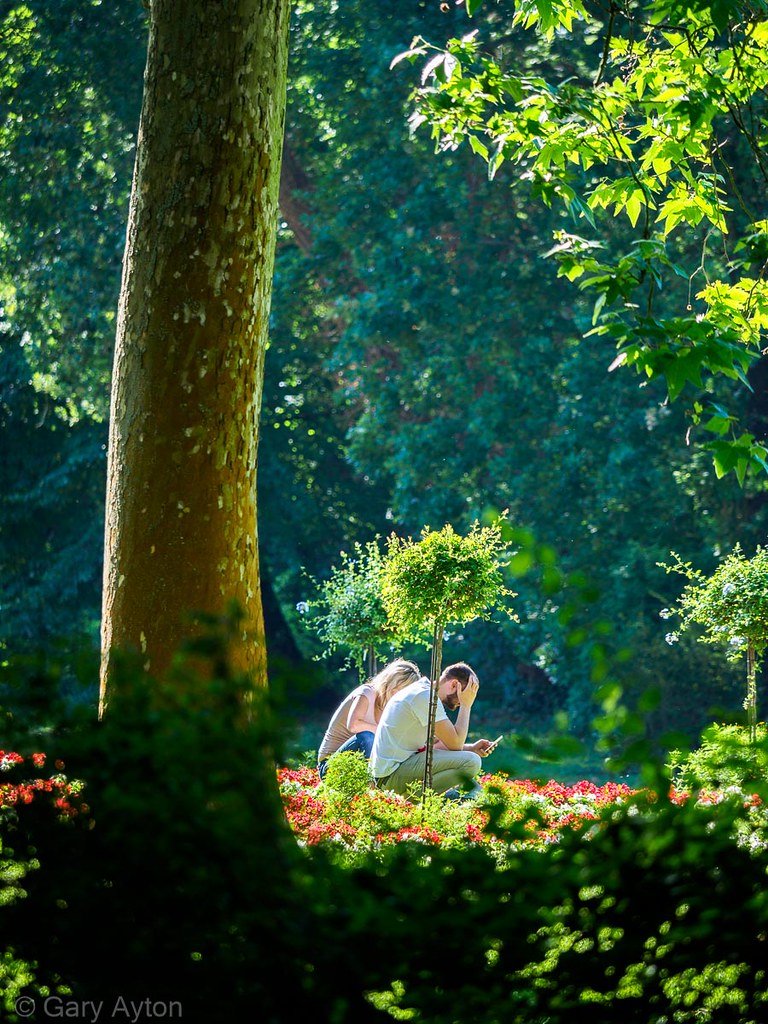
Again, I didn’t want to join the thousands of others taking “normal” sunset shots, so I thought I would experiment to see what the Lens Baby could do (please click on the image to view a larger version to appreciate the Lens Baby effect – it is NOT just a depth of field effect BUT rather everything in the central zone is sharp – the guy’s hat and the clouds, while the surrounding areas blur rapidly):

Mindil beach 1

Here is another sunset shot, this time with the 50mm f/1.8 II lens focusing on one of the many Mindil Beach food staff chefs – perhaps cooking up a kebab of crocodile – which, by the way, tastes like a bland form of chicken.

cooking

For the photographers out there, don’t expect Darwin itself to offer many unique photographic opportunities – you will need to plan to get out of the city and spend 2 or 3 days in Kakadu, or at least a day trip to Litchfield. If you are into bird photography, I believe there are some local areas accessible by boat which may fulfill your needs as long as you don’t get taken by a large salty – salt-water crocodiles can be enormous – check out the one in crocodile cove attraction in Darwin!

Photo essay – Victorian bushfires 6 and 7 weeks after the devastation

Saturday, March 28th, 2009

Whilst most of us were not directly affected by the bushfires, we all have been horrified by the images that came from that day and the many eye witness accounts of lucky survival, and of those less fortunate.

The outpouring of empathy and compassion has meant many of us have donated hundreds if not thousands of dollars or, in many cases our free services to help rebuild the lives of those affected.

Understandably, the locals from the bushfire regions still in the grief phase from their losses are often polarised or at least have ambivalent emotions at the prospect of “outsiders” coming to their towns now that most of the roads have been opened to the public.

On the one hand, those lucky enough to still have ongoing businesses in the region are desperate for tourists to get back there so they can manage through these difficult times, as well as wanting the visitors to see for themselves how severely devastated the region was, and that it wasn’t just media hype.

Others, who are going through anger, blame or perhaps guilt phase of their grief reaction and who have little to directly benefit from outsider’s presence, may have a less than appreciative attitude to them even though these same people may have made personal financial contributions well in excess of what was expected. Many just want to be left alone, others apparently seem embarassed that their property is now a unsightly mess, while others have concerns that unscrupulous outsiders may want to exploit the conditions, steal from the damaged properties or just be disrespectful.

A local female photographer’s efforts to bring photo-tourists to the region provided they spend money there has highlighted the range of emotions currently evident towards the presence of tourists.

After posting this blog, The Age newspaper reported on a local who lost everything in the fire but decided to exhibit some of her burnt relics including a car which raised further emotions as to if it was too soon, or were the benefits in helping people come to terms with the tragedy more important.

But this event still remains as one of the most terrifying natural events in Australia’s history and warrants respectful documentation.

So with this background a friend and myself made two visits to the region over the past 2 weeks, ensuring we spent money there, and to be conservative, we decided not to photograph when others were around and only to take a couple of shots of actual house ruins, ensuring we did not trespass on any private property, while concentrating on the effect of the fire on the previously majestic rain forests which once were full of life.

If you want to see the human face of the tragedy, see ABC TV’s photo stories, videos, etc as I have purposely avoided this aspect to ensure I did not offend those still emotionally fragile in their grief.

It was interesting to see how differing intensities of the fires caused significantly different scars on the landscape.

The worst firestorms where even aluminium engine blocks melted, left the areas looking like a moonscape, barren grey ground with black trees – many of which had fallen – almost no leaves, no wildlife to be seen or heard even at 7 weeks apart from ants – and eeerily, not even the sound of a bush fly. The intensity of the fire will mean that it may take years before the chemistry of the top soil is restored.

NB. you can click on any of these images to see the larger versions.

firestorm

but in many areas, some of the trees had survived and were sprouting new growth, although the tree ferns were too incinerated to survive.

new growth at 6weeks

While in the tall wet sclerophyll forests where the destruction was similar, quite curiously, some of the Eucalypts seem spared (perhaps < 5%) despite adjacent trees being burnt from the bottom to their tops (for those not understanding the scale of these tall mainly 70 year old trees (the region was destroyed in the 1939 fires), the segments shown are probably ~50-80m tall in the image – to understand our forests more see my page here) – although we can expect new seedlings to start soon, it will take another 70 years for this forest to look like it was before the fire – and that assumes climate change does not prevent our current drought from breaking – Mountain ash do not regenerate after bush fires but they do produce seedlings and if there is adequate rainfall and no major bushfires, these will reach 100m tall and mature over 100-300 years.

black poles

While the majority of gullies were still barren at 7 weeks with no green to be seen, after some 80km of gravel roads, I found one gully with a dry creek bed where the tree ferns had sprung back to life:

tree ferns

and new shoots miraculously appearing from the ash:

shoots

“Fall leaves”:
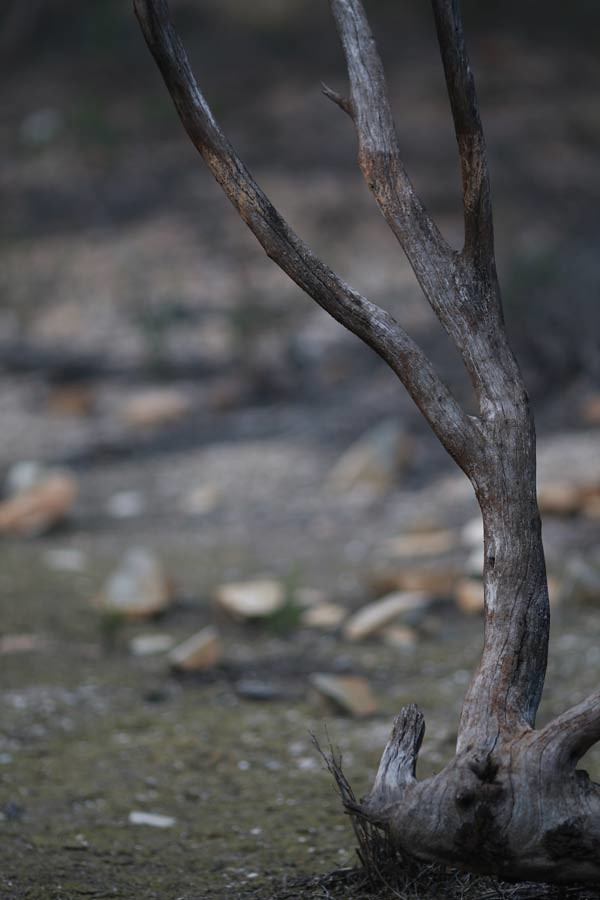
Although it is early Autumn in Victoria now, our evergreen Eucalypt forests do not change foliage color significantly – but in the bushfire regions where not all the leaves were incinerated, the remaining foliage had died leaving many areas with trees like this and their forest floor littered with the falling dead leaves contrasted with the ash.

dead foliage

Some of the forests had an amazing but deadly beauty – I must have spent 10 minutes under the massive tree trunk balanced precariously, just ready to fall on my head without realising it was there (see image below). Tragically a fire fighter assisting with the clean up soon after the fires died from a falling tree – and this is a real risk to those who would venture there before the clean up is finished. See here:

falling tree

This particular forest near Toolangi was the only one where I heard a fly passing by, and the odd bird, while the bull ants were re-building their nests.

The fires tragically killed 173 people, and over 2000 houses were lost – but after visiting the once majestic forests where, in the worst affected, NOTHING survived apart from perhaps some ants – the deathly silence makes it easy to understand that over the extent of these fires, it is estimated that several million individual animals were killed or will perish because of the fires.

During the fires, even those who lost everything rushed injured wild life to aid suggesting to some that human spirit even in adversity is strongly linked to the welfare of animals.

After visiting the fires, I can’t help but feel for all those who were lost – both human and animal – just as when the planet Alderaan is destroyed in Star Wars – A New Hope, and Obi-Wan senses “a great disturbance in the Force, as if millions of voices cried out in terror and were suddenly silenced”. Please don’t take this as me being flippant, it’s just that this overwhelming sadness is what I feel when I’m there and this is what I thought of.

It is indeed a strange feeling one gets in the forests as your mind tries to put everything in its rightful place and imagine those creatures that once lived here only a few weeks ago.

It may be that some species unique to the area may have become extinct or close to it – hope is being held for the survival of Victoria’s state emblem – the lead beater possum which was only found in these areas.

If this has inspired you to go, please be respectful of the locals and their property, they need their space and need to feel secure, but the businesses also need you to keep them going, and above all, do not harm the fragile bush and be safe – Australian gum trees are well known for dropping large branches without warning, and now that risk is perhaps a 100-fold.

and this is a similar type of forest to what was devastated, they will be missed:

otways

20 minutes of photography – rural dreams – a little photo essay

Monday, March 16th, 2009

I have created a short little photo essay derived from 10 minutes of urban photography last weekend and 10 minutes of rural photography this weekend.

Why only 10 minutes this weekend when I had 4 days down the coast with all my cameras?

Well, it started as a leave pass from my long suffering wife that I could go down the coast by myself for a photography trip for a few days…

but as time got closer, she decided that she could really do with getting away from it all as well and it was great to have her company…but….

whilst driving along en route and a small tornado appeared (we don’t get to see many here), I was under strict instructions – no Gary, you don’t need to stop the car and photograph it, and no, we are not going storm chasing, we are having a lovely weekend together.

at the destination on the coast, the sea fog had set in and it was almost dinner time and the local restaurants were soon to close…

I made quick decision, a 30min or so drive by myself up into the hills to get 10min of shots in a location I had scouted a year before.

My wife was happy to stay at the motel as I drove along the winding, wet road through the coastal hills and rainforests until I reached my destination, one of my favorite farm regions which I had always dreamed about but money, realities of life and family duties would mean I would never attain.

I quickly eye-balled a few shots that would fit my little theme all within 100m of each other, set my camera on manual exposure to combat the fog, then raced back down the hill to be ready for dinner.

As it turned out, it poured rain so heavily and consistently over the next 2 days that, combined with certain expectations, my inspiration for photographic creativity never returned.

So here is my little photo essay derived from the two weekends….

click on the door to enter:

door