Olympus OM-D E-M5 Micro Four Thirds camera ISO 3200 image detail seems comparable to Canon 5D MII, Nikon D3s and easily beats Samsung NX200

Written by Gary on March 17th, 2012

Dpreview.com have published their studio tests of the exciting new Olympus OM-D E-M5 Micro Four Thirds camera and not only confirms how much the image quality has improved over the previous sensors in the Olympus cameras but when looking at the ISO 3200 jpegs, the E-M5 has MORE image detail than most of the other cameras available for comparison, including the APS-C dSLRs and even the Canon 5D mark II and Nikon D3s.

Now of course, the stated Olympus ISO appears to be 2/3EV higher than actual tested ISO, but even given this observation, the image quality has substantially improved to at least be in the ball park with the current larger sensors and that is an impressive achievement and shows that the 2x crop sensor is a perfect compromise in size giving adequate image quality for 90% of us whilst provinding high quality, compact, cost effective lenses – to me this is the perfect travel and social photography kit.

Don’t take my word for it, check the tests out yourself and see how much more detail the E-M5 has at those high ISO levels with not much more noise, and this means one can use NR and still have a good amount of image detail present unlilke the smudged loss of details provided in some of the other cameras.

Olympus USA has also announced a rebate scheme where buyings of this new camera can apply to get one of three optional accessories for free – the OM adapter, the weatherproof Four Thirds adapter or the FL-300R flash – see here.

Olympus Australia has announced their pricing at $A1299 for the body – some 30% premium to US pricing but hopefully they too will be adding free bonuses – perhaps the grip as the European distributor has offered – here’s hoping!


Olympus OM-D E-M5 Micro Four Thirds camera high ISO capabilities

Written by Gary on March 13th, 2012

The exciting new Olympus E-M5 camera not only brings together everything most people need in a compact camera but now adds much better high ISO and dynamic range performance which will further negate the need for carrying larger cameras around such as dSLRs.

Robin Wong has had the opportunity to pplay with a pre-release E-M5 and he is very excited with its high ISO and dynamic range performance as well as its image stabilisation.

He has examples of its high ISO performance here, in addition, see also his example videos on his blog site.

Now when and where can I buy this camera which is slated to be released in the US on April 16th for $999 body only?

If that is not exciting enough, the E-M5 could be matched with the rumoured Panasonic GH-3 later this year which is said to at last offer a global electronic shutter and hopefully weather-proofing. This will make a very nice complimentary camera to the E-M5, or if this is too large, there is always the Olympus PEN series to entice you with a nice pancake lens for compact size.


New cameras compared – Olympus OM-D E-M5 vs Canon 5D Mark III vs Nikon D800

Written by Gary on March 3rd, 2012

In the past few weeks 3 exciting new cameras have been announced, all 3 of them have feature sets which many would have only dreamed of a couple of years ago, so how do they compare on paper:

The specs compared:

Firstly, what they have in common:

  • weatherproofed, magnesium alloy body construction
  • 100% viewfinder coverage
  • 1080i HD H.264 video (up to 29min 59secs per clip)  with audio level control and optional stereo mic inputs
  • SD/SDHC/SDXC memory card support
  • timelapse recording (Olympus and Canon via cable, Nikon in-built)
  • wired remote control (and wireless via optional propietary or 3rd party wired devices)
  • remote TTL flash support (Canon adds radio wireless TTL flash support previously only available on Canon/Nikon via Pocketwizards)
  • HSS/SuperFP high speed sync flash
  • multi/spot/centre-weighted metering
  • AE bracketing 2,3,5,7 frames
  • WB bracketing
  • self timer
  • aperture priority, shutter priority, programmed auto,  manual exposure modes
  • live view (always Live view on the Olympus and automatically switches from screen to EVF; Live View clunky on Canon and Nikon due to presence of mirror)
  • similar shutter ratings of ~150,000 frames (although I believe the Olympus is rated at 100,000 frames)
  • AF assist lamp
  • optional external battery portrait mode grips
Olympus OM-D E-M5
Canon 5D Mark III Nikon D800
Price body only $US999  $US3499  $US2999
Weight 425g/15oz 950g/33.5oz 900g/31.8oz
Size 122 x 89 x 43 mm (4.8 x 3.5 x 1.69″) 152 x 116 x 76 mm (5.98 x 4.57 x 2.99″) 146 x 123 x 82 mm (5.75 x 4.84 x 3.23″)
Sensor 16mp Live MOS Micro Four Thirds size (17.3 x 13mm)  4:3 aspect 2x crop factor 22.3mp full frame (36x24mm) 36.3mp full frame 76.5Mb RAW files!! (36x24mm), 25mp 1.2x crop mode or 15mp DX mode
LCD 3″ OLED, 614K dot 3:2 tiltable, touch. Usable even in bright sun. Just touch subject for near-instantaneous AF and shutter release.
3.2″ 1040K dot fixed LCD, not touch 3.2″ 921K dot LCD fixed, not touch
HD video 1080i 60i (30p); 20 or 17mbps quality; Art filters; Echo mode; 5EV IS for all lenses; C-AF possible; stereo mic; 2x digital zoom; no live video out? no timecode;
1080 30p/25p/24p with i-frame, SMPTE time code, OIS, no C-AF; mono mic; moiré-reduction; uncompressed live video out is only 720p; 60fps only in 720p; no swivel or tilt screen; 1080 30p/25p/24p 8bit 4:2:2 live HDMI out, OIS, no C-AF; mono mic; 60fps only in 720p; no swivel or tilt screen; 36mp sensor may degrade HD video quality due to need for more binning/line skipping; videographers should avoid the D800E as there is no anti-alias filter.
shutter speeds 60sec – 1/4000th sec 30sec – 1/8000th sec 30sec – 1/8000th sec
Burst rate 9fps (AF 1st frame only); 4.2fps C-AF; 3.5fps AF +IS; 6fps with full C-AF x 18 RAW
4fps in FX mode or 6fps in DX mode with full C-AF but requires external battery otherwise it is 5fps.
Lens artefact correction to jpegs  automatically for many dedicated lenses including distortion and lateral CA. Installed via firmware automatically.  automatically for up to 29 Canon lenses for both axial and lateral CA. User must download and install the profiles.  no?
Camera shake aids  industry leading 5 axis 5EV works with all lenses and in movie mode and in EVF; no need for mirror lock up as no mirror optical IS in some lenses; requires cumbersome mirror lockup for critical work at slower shutter speeds or high lens magnifications (macro or super telephoto) but cannot do mirror lockup and self timer together. optical IS in some lenses; requires cumbersome mirror lockup for critical work at slower shutter speeds or high lens magnifications (macro or super telephoto) but cannot do mirror lockup and self timer together.
Manual focus aids Fast, easy 5EV IS stabilised magnified view poor MF aids, magnified view Live Mode cumbersome, no IS support  poor MF aids, magnified view Live Mode cumbersome, no IS support
S-AF fastest and most accurate AF for slow moving subjects; face detect AF; Eye detect AF – can AF on left, right or nearest eye – superb for portraiture/fashion photography!
Average AF speed requires microcalibration for each lens for accuracy; Face detect AF even in phase contrast AF? Average AF speed requires microcalibration for each lens for accuracy; Face detect AF even in phase contrast AF. Sensors work to -2EV light levels.
C-AF 35pt 3D tracking even at f/8 lenses BUT tracking is currently only for slow moving subjects and is unreliable 61pt (41 cross pts incl. 5 double cross pts) very good tracking (phase contrast) but not as highly featured as the Canon 1D X which has a dedicated DIGIC 4 processor for AF and a 100K pixel metering system to support it. Subject-based configuration presets to at last make C-AF configuration easier. BUT NO AF with lenses f/8 or smaller (as with the Canon 1D X)!! 51pt very good tracking(phase contrast); 1 cross and 10 horizontal sensors active at f/8.
ISO range 200-25,600, auto ISO can set upper and lower limit. (no iISO as on Panasonic); 50-102,400, autoISO allows minimum shutter speed as well as ISO limits. autoISO works in M mode.
50-25,600, 5-level focal-length sensitive autoISO
Max. bulb duration 8min including Timed Bulb and Live Timed modes with intermittent visual assessment of image during exposure!
8min?  8min?
flash No built-in flash but bundled compact unit, 1/250th sync, can set slowest shutter speed to use when flash fires in an auto mode.
No built-in flash, 1/200th sync Built-in pop-up flash, 1/250th sync
White balance presets 12 + 1 CWB 6 + 1 CWB 12 + 5 CWB
Scene modes, Art 23 scene modes including 3D Stereo, plus Art Filters Picture Styles None
Exposure compensation +/- 3EV +/- 5EV +/- 5EV
Multiple exposures  yes 2 frames RAW  yes  no?
Viewfinder supports dual axis levels, grid lines, live histogram with histogram of AF region included, image stabilisation for any lens, magnified view mode, aspect ratio view, shutter speed/aperture simulation, art filter effects view, contrast control graph, AF selection
electronic overlay: grid lines, AF selection, customizable warning exclamation mark. AF selection, dual axis levels.
 other compact high quality lens system optimised for video;nice, simple ergonomic controls lower noise at high ISO; narrower DOF possible; fast AF for super telephoto lenses; in-camera HDR; top panel LCD; pro level sports AF features;
high resolution images but large file sizes; narrower DOF possible; fast AF for super telephoto lenses; top panel LCD; pro level sports AF features;
 tilt/shift  easier MF but 2x crop factor; can convert any Nikon lens to a shift lens; can convert most full frame lenses to tilt lenses; can use Canon, Nikon and Olympus OM shift lenses. Widest tilt-shift is only 28mm in 35mm terms (eg. using a Nikon 14mm lens with an adapter).  live mode MF cumbersome but 17mm and 24mm tilt-shift available  live mode MF cumbersome but 24mm tilt-shift available
 connectivity/ extra cards  USB 2.0; opt Bluetooth;  USB 2.0; wifi/Bluetooth; CF card; opt. GPS;  USB 3.0; wifi; CF card; opt. GPS;

Summary of pros and cons:

Olympus OM-D E-M5

  • great value for money
  • compact quiet non-intrusive system with lovely compact and movie optimised lenses delivering adequate image quality and narrow depth of field capabilities for most people
  • industry leading image stabilisation and manual focus solutions
  • fastest, most accurate AF for stationary or slow-moderately moving subjects with option for near-instantaneous AF and exposure just by touching the subject on the touch screen
  • tiltable OLED touch screen
  • lots of visual aids in the viewfinder including being able to activate image stabilised magnified live view easily for ANY lens
  • fast 9fps burst rate albeit with AF only on 1st frame and no IS (a very reasonable 3.5fps for full AF and IS or 4.2fps with AF and no IS)
  • 1/250th sec flash sync with new flashes
  • adequate HD video for most people with some very nice special effect options , unique built-in IS which works on every lens which means perhaps the end of having to work out how to use and carry big expensive camera stabilisation rigs whilst walking and video – the main downside is no 25p/24p mode and no live HDMI out capability
  • ability to use almost any lens ever made including Leica, Canon and Nikon as well as Olympus Four Thirds and OM lenses
  • much easier to use camera and flash system than the Canon or Nikon cameras (flashes are simpler but just as versatile, while the absence of a mirror greatly simplifies the user interface and the many Scene modes and Art filters makes use easier and much more fun and easier creativity is possible)
  • Timed BULB and Live BULB mode makes night time shots on tripods much easier and more fun.
  • smaller and less expensive tripods and backpacks possible
  • less expensive high quality wide aperture prime lenses
  • ability to hand hold longer telephoto field of view lenses with ease
  • underwater housing
  • C-AF may not be adequate for fast moving subjects
  • no WiFi file transfer (only optional Bluetooth transfer to phones of web-sized images)
  • no GPS option at present
  • no radio wireless TTL flash at present (I would think Pocket Wizards would be seriously looking into Olympus support to expand their market now that Canon have entered into their niche)
  • more noise at high ISO but most should be using low ISO anyway
  • DxOMark tests show the new Micro Four Thirds lenses such as 12mm f/2.0, 25mm f/1.4, and 45mm f/1.8 offer comparable optical quality to the full frame pro equivalents (see recent posts), at much less weight, size and cost.
  • jpegs will display on iPhoto on the new iPad3 unlike those from the Canon or Nikon which are too big (iPhoto can only handle up to 19mp)
  • unbeatable as a compact minimally intrusive, light weight travel or social photography kit

Canon 5D Mark III:

  • perhaps the best implementation of a relatively affordable full frame dSLR yet
  • lovely optical viewfinder with fast phase contrast detect AF for moving subjects
  • sensible 22mp sensor promises a much better compromise of resolution, dynamic range, and image noise as well as file storage size compared to the Nikon D800
  • full frame sensor allows even shallower DOF possibilities than the Olympus but for many inexperienced users this just creates more difficulties
  • radio remote TTL flash but flash sync only 1/200th sec could be a deal breaker for strobists and fashion/wedding photographers
  • full use of the wonderful range of Canon L lenses at the designed uncropped field of view – but they are expensive, big and heavy, and the older ones may not be adequate optically.
  • optional GPS
  • 25p/24p HD video but no 60i for slow-mo movies and only mono mic
  • 1/8000th sec allows wide aperture shots in bright sunlight without having to resort to ND filters or polarising filters
  • Digic 5+ processor (same as in the 1D X) is 17x faster than the Digic 4 processor in the Canon 5D Mark II
  • like the Canon 1D X though it cannot AF with lenses at f/8 or smaller so you cannot use an f/4 super telephoto lens with a 2x teleconverter!!!
  • jpegs will NOT display on iPhoto on the new iPad3 as exceed the iPhoto limit of 19mp
  • fantastic, versatile, general purpose full frame dSLR just a pity flash sync is a bit slow and you can’t AF with f/8 lens combos.

Nikon D800:

  • 36mp full frame dSLR but perhaps Canon has the better sensor compromise
  • 25mp 1.2x crop mode
  • lovely optical viewfinder with fast phase contrast detect AF for moving subjects
  • can be used with DX lenses in cropped mode – but what DX lenses are worth using?
  • full frame sensor allows even shallower DOF possibilities than the Olympus but for many inexperienced users this just creates more difficulties
  • 1/250th sec flash sync and radio remote TTL flash but only via 3rd party PocketWizard devices
  • full use of the wonderful range of Nikon F lenses at the designed uncropped field of view – but they are expensive, big and heavy, and the older ones may not be adequate optically.
  • optional GPS
  • intervalometer built in
  • 25p/24p HD video but no 60i for slow-mo movies and only mono mic but importantly for some, it does have live HDMI out
  • 1/8000th sec allows wide aperture shots in bright sunlight without having to resort to ND filters or polarising filters
  • fantastic option for wedding/fashion/landscape photographers who may benefit most from 36mp and will generally use them at low ISO and the high flash sync is a nice bonus compared to the Canon 5D MIII
  • full frame or 1.2x crop jpegs will NOT display on iPhoto on the new iPad3 as exceed the iPhoto limit of 19mp
  • 6fps 15mp DX mode may be very handy for sports photographers as they effectively gain 1.5x crop telephoto field of view whilst keeping file sizes down, plus they can use f/4 lenses with a 2x teleconverter and still get AF.

Final thoughts:

My old Olympus E510 Four Thirds dSLR was capable of making nice 20″x30″ prints, and this new Olympus E-M5 is purported to have substantially higher image quality than the old E510, and now that the E-M5 has most of the features and more that the semi-pro full frame dSLRs have, one has to seriously consider, do they need to pay 3x as much and carry twice the weight and size of a full frame dSLR?

Very few photographers print larger than 20″x30″ if they print anything at all.

The professionals will tend to migrate more to medium format for their landscape and studio work, while the Canon 1D X and Nikon D4 may suit them best if they are sports photographers.

The main issues that really kill image resolution are AF accuracy, camera shake and optical quality, and it is on the 1st 2 of these issues that the Olympus E-M5 has significant advantages over the full frame dSLRs whilst at least being comparable and at times better wide open on optical quality given their  lenses don’t need to cover such a large sensor.

The biggest problem in not getting the photo at all is not having the camera with you – and with this issue, small size counts for a lot – and it is here again that the Olympus wins hands down.

For most of us, the Olympus E-M5 will address our needs very nicely indeed and save us a LOT of money and bulk.

Those who already have lots of pro level Canon or Nikon glass,  wedding photographers, or those who need to shoot fast moving subjects or very low light moving subjects regularly, or want radio remote TTL flash, will look forward to the new Canon 5D Mark III or Nikon D800.

Each of these cameras offer a high level of video features but differ on the details, so the very serious videographers will want to wait until more examples of their video capabilities are exposed, and then also compare them with the likes of the hackable Panasonic GH-2 (a GH-3 is expected to be announced in September), or perhaps a Sony NEX 7.


DxOMark tests show the Micro Four Thirds PanaLeica DG 25mm f/1.4 compares well with the Canon and Nikon 50mm f/1.4 lenses on a full frame dSLR

Written by Gary on March 1st, 2012

DxOMark have just tested the Panasonic Leica-DG 25mm f/1.4 lens for Micro Four Thirds and it does well against the Canon and Nikon 50mm f/1.4 lenses, even though this Micro Four Thirds version is not as sharp as the incredibly sharp Four Thirds version (the Panasonic Leica D 25mm f/1.4 lens).

Of course the depth of field wide open will only be similar to that at f/2.8 on these full frame lenses but otherwise performance is not too different, as they have similar light gathering and the local blurring of an f/1.4 lens, indeed the increased DOF wide open can be used to advantage for environmental portraits in low light.

Brief summary of the tests:

  • sharper wide open and a f/2.0
  • much less vignetting
  • more distortion (1.5%) and CA but still well controlled

The full frame kits have the advantage of the benefits of a full frame sensor but when used on the new Olympus OM-D E-M5 the Panasonic lens effectively gains 5EV of 5-axis image stabilisation.

Following the earlier tests on the Olympus 12mm and  45mm lenses, this further supports the iage quality available in Micro Four Thirds without the weight size and expense of dSLR systems.


Olympus OM-D E-M5 Micro Four Thirds camera with the world’s fastest autofocus – watch this video

Written by Gary on February 21st, 2012

Just a year or two ago nobody in their right minds would have suggested that a mirrorless camera would be the world’s fastest autofocus camera beating even a Canon or Nikon dSLR.

Micro Four Thirds has come of age.

Well, Panasonic made great in roads into AF speed with their Panasonic GH2 and G3, then Olympus did even better with their E-P3, E-PL3 and E-PM1 becoming the world’s fastest AF cameras, and now we have an even faster camera, the Olympus OM-D E-M5 which not only has the fast AF but is weatherproof, robust metal body, looks great, has a unique 5 axis 5 EV built-in image stabiliser which works with any lens and during movie mode, a built-in EVF, flash sync 1/250th sec,  and can shoot 9fps (4.2fps with continuous AF). All this and it has fantastic image quality thanks to some very nice lenses – see previous 2 posts.

But seeing is believing perhaps, so check out this video on Youtube:

I think this is one very exciting camera, and I can’t wait for it to be available in April.

With the Olympus 12mm f/2.0 comparing very well with Canon or Nikon 24mm f/1.4 lenses on  a full frame dSLR, and the Olympus 45mm f/1.8 lens comparing very well with the Canon 85mm f/1.8 and Nikon 85mm f/1.4G on full frame dSLRs, why would you buy a cropped sensor dSLR instead of this OM-D E-M5?


DxOMark lens tests show the Micro Four Thirds Olympus 45mm f/1.8 portrait lens seems sharper with less vignetting and distortion than a Nikon 85mm f/1.4G on a Nikon D700, at 1/5th the weight and price!!

Written by Gary on February 18th, 2012

DxOMark has tested the Micro Four Thirds Olympus 45mm f/1.8 lens on a Panasonic GH-2 and shows that despite its very compact and light size and sub-$400 price tag, it seems sharper and with less vignetting and distortion wide open than a much more expensive, heavier and larger Nikon AF-S Nikkor 85mm f/1.4G at f/1.4 or f/2.0 on a Nikon D700 full frame.

See also my wiki comparison of a range of “85mm portrait lenses”

Let’s look at the test results compared to the Nikon AF-S Nikkor 85mm f/1.4G on a full frame 12mp Nikon D700 dSLR:

  • at f/1.8, corner sharpness is similar, but central sharpness is better than the Nikkor lens at f/1.4 or f/2.0
  • at f/4-f/8 overall sharpness and centre sharpness is better than the Nikkor lens at the same aperture
  • degree of distortion is half that of the Nikkor lens although distortion level is low
  • vignetting is about half that of the Nikkor lens at f/1.4-2.0 compared to the Olympus lens wide open at f/1.8 but vignetting becomes comparable at f/2.8 on each lens
  • CA is well corrected on both lenses
  • Nikkor lens uses expensive, large, 77mm filters while the Olympus lens uses tiny, cheap, 37mm filters
  • Olympus lens is optimised for movies and fast contrast detect AF whereas the Nikkor lens is not.
  • when used on an Olympus OM-D, you gain 5 stops of 5 axis image stabilisation which is not available for the Nikkor lens on a Nikon camera.
  • Olympus lens allows faster more accurate AF for slow moving subjects with option of subject eye detection when used on an OM-D or E-P3 or E-PL3 camera
  • Olympus lens focuses to 0.5m whereas the Nikon focuses only to 0.85m
  • the Nikkor lens weighs 5x as much and is almost twice as long and 5x the price!!

There does not appear to be anything much in favor of the super expensive Nikkor lens, except that being used on a full frame sensor provides 3 significant advantages:

  • improved dynamic range and high ISO performance
  • f/1.4 aperture allows better capabilities for capturing moving subjects in low light
  • f/1.4 aperture on a full frame dSLR allows for shallower depth of field and even better ability to blur the background and blur the region around the subject

Nevertheless, for most situations, the Olympus lens will give sufficient ability to blur the background and give shallow depth of field to function very nicely indeed as a portrait lens, even if its depth of field is similar to f/3.5 or so when using the Nikkor lens on a full frame camera.

At 1/5th the weight and cost, thank you very much Olympus, I know which option I will take on my travels and for parties, and family photos in the park!

If you really want shallower depth of field at this focal length on a Micro Four Thirds camera, you can always resort to the Cosina Voigtlander Nokton 50mm f/0.95 lens, although it is manual focus, bigger, and more expensive than this lovely Olympus lens.

If you want an even sharper lens with macro capability, one can always use the incredibly sharp Olympus Four Thirds ZD 50mm f/2.0 macro lens via an adapter – and then you can also use the Olympus Ring Flash as a fill-in flash for your portraits.

But before we leave this lens, let’s look at how it compares with the Canon EF 85mm f/1.8 lens on a Canon 5D Mark II full frame dSLR:

  • the Canon lens is sharper at all apertures – partly due to the higher resolution sensor, but even when used on a 5D Mark I it still seems marginally sharper.
  • the Olympus lens has less distortion and almost half the amount of vignetting wide open and at f/2.8, but a touch more CA wide open
  • the Canon lens uses a 58mm filter, and weighs just under 4x as heavy, and 50% longer but is priced at a similar price point
  • I must admit, my personal experience of the Canon lens seems a lot worse than these tests indicate when looking at the CA levels which to me are quite problematic wide open on the Canon lens.
  • the Canon lens is an older design which does not have circular aperture blades and thus the Olympus lens should have nicer bokeh stopped down
  • Olympus lens is optimised for movies and fast contrast detect AF whereas the Canon lens is not.
  • when used on an Olympus OM-D, you gain 5 stops of 5 axis image stabilisation which is not available for the Canon lens on a Canon camera.
  • Olympus lens allows faster more accurate AF for slow moving subjects with option of subject eye detection when used on an OM-D or E-P3 or E-PL3 camera.

The DxOMark tests on the Canon lens surprisingly beats both the Olympus and the much more expensive Nikkor lens, although it has been known for its sharpness but significant CA.

That said, the Olympus combination of movie capability and 5EV IS along with 1/5th the weight makes it a compelling choice for travel when compared with either the Canon or the Nikkor lenses.

So now we have at least 4 compelling autofocus lens scenarios where Micro Four Thirds competes admirably for even full frame options let alone APS-C dSLR options, and at a much more compact, light and cost effective kit beautifully designed for travel – I can’t wait for the Olympus OM-D E-M5 to get to market to make the most of these lenses.

Oh… the other great autofocus lenses for Micro Four Thirds available now are:

  • Olympus 12mm f/2.0 wide angle discussed in the previous post
  • Panasonic 20mm f/1.7 pancake lens – the brilliant party lens
  • Panasonic 25mm f/1.4 lens – high quality wide aperture standard lens

Coming later this year are the Olympus 75mm f/1.8 which will be very high on my wish list, the Olympus 60mm f/2.8 1:1 macro and the f/2.8 zoom lenses from Panasonic.

Very exciting times to be a photographer not wanting to carry around large lenses and cameras, and the lens tests so far show these easily beat the smaller Nikon 1 lenses in terms of image quality, while the larger sensor of the Micro Four Thirds will provide enough ability to blur the background which the Nikon 1 system will struggle to achieve.

Oh, and I don’t compare it with the tests on a Nikon DX dSLR or a Canon APS-C dSLR as I just don’t see much point in owning a cropped sensor dSLR now that Micro Four Thirds cameras AF faster than them with comparable image quality at low ISO, plus you get the 5EV 5 axis IS for any lens when using the Olympus OM-D camera.

But there are still good reasons to buy full frame dSLR to compliment a Micro Four Thirds kit for those wanting to push the boundaries of shallow DOF, high ISO, or higher dynamic range photography, or for those who need more than 20mp to print larger than 20″ x 30″ prints. Well-heeled Canon full frame dSLR users may want to consider the extremely expensive slow AF but superb Canon EF 85mm f/1.2 lens if they really want to push the boundaries.

ps.. Sony NEX users have the option of the Sony E 50mm f/1.8 lens but this has not been tested by DxOMark yet and it has a field of view of only a 75mm lens in 35mm camera terms which is quite a bit too short for a portrait lens which historically has been 90-100mm focal length in 35mm terms and it is designed to be a cheap $120 consumer lens. Thus NEX users are out of luck in a true high quality autofocus portrait lens at this stage unless they resort to the much larger Sony alpha lenses.


DxOMark lens tests – the Micro Four Thirds Olympus 12mm f/2.0 lens compares well with a Canon 24mm f/1.4L II lens and seems to beat the Nikon 24mm f/1.4G lens, both of which are 5 times heavier and more than twice the price

Written by Gary on February 17th, 2012

 43rumors.com posted a blog post highlighting the  DxOMark lens test of the Olympus m.ZD 12mm f/2.0 lens has revealed some interesting findings further confirming Micro Four Thirds can achieve high image quality results comparable in resolution to even full frame pro lenses on a APS-C or full frame camera.

“With its extraordinary sharpness for a micro 4/3 lens, the Olympus M. Zuiko Digital ED 12mm f/2.0 is a winner.

Pitted against the Nikon 1 NIKKOR 10mm f/2.8, this Olympus 12mm holds an overwhelming advantage. Even more impressive is the fact that this lens can compete with much bigger lenses, such as the Canon 24mm L-series mounted on a 7D.

In short, it really does seem that a high-quality, fully micro 4/3 camera-lens combination is perfectly capable of replacing an APS-C combination — and the Olympus M. Zuiko Digital ED 12mm f/2.0 is a particularly high-quality micro 4/3 lens!”

So I decided to look a little deeper.

Their tests show that it has “remarkable sharpness in the centre, although less so in the corners, with minimal vignetting or CA but significant distortion of 2.5% on a Panasonic GH-2 which may require software correction”.

Their overall lens test score (which suggests similar quality maximum print size and is determined by the lens, camera resolution and sensor noise) for this lens on a GH-2 was 19 at f/2.0 which just beat the Canon EF 24mm f/1.4L II pro lens on a Canon 7D at f/2.8 – this seems a strange comparison to me given that field of view is 36mm not the 24mm of the Olympus lens, and the aperture is stopped down 2 stops. It was much, much better than the Nikon 1 Nikkor 10mm f/2.8 lens which is a 27mm equivalent field of view lens.

So let’s look at how the Olympus lens compares with a Canon EF 24mm f/1.4L II pro lens on a full frame 20mp Canon 5D Mark II dSLR:

  • Olympus lens at f/2.0 is sharper in the centre 1/3rd than the Canon lens at f/1.4 or f/2.0 but corners are less sharp (check out the Field Maps under Measurements – Resolution)
  • at f/2.8 on each lens, the sharpness levels across the frame a fairly similar
  • the Olympus lens has much less vignetting but more distortion (2.5%) – this seems to differ from photozone.de tests so there may be a lens sample issue to explain this or perhaps distortion is corrected on Olympus cameras whereas DxOMark scores are based upon uncorrected RAW files.
  • the Olympus lens at f/2.0 has marginally less CA across the frame than the Canon lens at f/1.4 or f/2.0
  • Canon lens uses a large, expensive 77mm filter, while the Olympus lens uses a petite, cheap 46mm filter
  • the Canon lens weighs 5 times as much and is well over double the price of the Olympus lens
  • when used on the Olympus OM-D, the Olympus lens gains 5EV 5 axis image stabilisation which partly compensates for the better high ISO performance of a full frame sensor

Now lets compare it to a Nikon AF-s Nikkor 24mm f/1.4ED G on a Nikon D700 full frame dSLR:

  • Olympus lens at f/2.0 is much, much sharper in central 2/3rds and perhaps comparable in the corners at ANY aperture of the Nikon lens (check out the Field Maps under Measurements – Resolution)
  • Olympus lens has much more distortion
  • Olympus has much less vignetting at f/2.0 than the Nikon at f/1.4 but comparable at f/2.0
  • Olympus lens at f/2.0 has less CA across the frame than the Nikon lens at f/1.4 or f/2.0
  • Nikon lens uses a large, expensive 77mm filter, while the Olympus lens uses a petite, cheap 46mm filter
  • Nikon lens is 5x heavier, twice as long and about 2.5x the price – from these resolution results I would feel really bad carrying that around when there is a much lighter, cheaper sharper option.
  • it is of course possible that the difference between a 16mp GH-2 and a 12mp D700 requires some adjustment to these resolution tests for direct comparison, however DxOMark states that in the case of resolution tests, results are normalized (stretched for a cropped sensor) to a 24x36mm output, which would lower the resolution score of a lens measured on a cropped sensor vs a full frame sensor.
  • I must admit I am not sure I understand why a 2010 Nikon designed lens at that price could be worse at wide apertures than a much smaller, cheaper lens on a sensor a quarter the size, but perhaps the tests using a 24mp full frame which show that this lens produces much better edge to edge sharpness across the frame from f/5.6-11 than either the Olympus or Canon explains what this lens was optimised for – and it wasn’t low light shooting at wide apertures but landscapes and architecture at mid-apertures.

The Olympus lens is also optimised for movies, and the OM-D image stabiliser will also work during movie mode, but is not weatherproofed like the pro lenses.

The Canon and Nikon lens with its f/1.4 aperture will be better suited to low light moving subjects and will allow more local blurring adjacent to the subject, while the full frame sensor will allow higher ISO and also smaller apertures to be used before diffraction limitations impair resolution.

There are good reasons why professionals will still want the Canon 24mm f/1.4L II lens on a full frame dSLR, but it is very reassuring that for most purposes, the Micro Four Thirds kit will give comparable, and in some circumstances, better results at a much lower price point and a much smaller, lighter package.

There are no comparable quality lenses at 24mm field of view in the other mirrorless camera systems such as Sony NEX or Samsung NX, and there are no comparable f/2.0 or faster 24mm field of view equivalent lenses available on the Canon APS-C or Nikon DX systems.

This Olympus lens is another great reason to consider Micro Four Thirds along with the other fantastic little prime lenses such as the Panasonic 20mm f/1.7 – again there is NO COMPARABLE lens for other mirrorless or dSLR systems!

You know which one I will be taking on my travels!!!

More on Micro Four Thirds lenses and on comparisons of lens availability for the different mirrorless camera systems.


A few thoughts on cameras and where most of us may be heading

Written by Gary on February 15th, 2012

Let me state again for clarity, I am not a commercial photographer, I do not shoot weddings, sports, and I don’t print my images any larger than 20″ x 30″ and even then, I do these rarely.

I do however take my photography as very serious fun which has re-shaped the way I view the world.

In 2007, I had the opportunity to acquire two very different and thus complimentary dSLR camera systems with the relatively new Live View technology which I considered critical for digital photography, in particular, for accurate manual focus of tilt shift leneses, etc.

Olympus Four Thirds:

A budget, relatively compact, entry-level Four Thirds Olympus E510 dSLR which from memory gave 10mp images, up from my 7.5mp Olympus E330, and for the 1st time in a SLR of any type, had built-in image stabilisation in the camera which could also be used with legacy manual focus lenses.

This camera became my main camera due to its compact size and weight, and I was lucky enough to have superb Four Thirds lenses to match it – ZD 7-14mm, Leica-D 25mm f/1.4,  ZD 50mm f/2.0 macro (perhaps the sharpest mass produced lens to date) and the unique ZD 50-200mm f/2.8-3.5 SWD lens with EC-20 2x teleconverter. With these lenses and the kit lenses, I had 35mm equivalent coverage of 14-800mm field of view, plus macro plus portrait lens.

Canon 1D Mark III pro dSLR:

As fantastic as the Olympus kit was, it had some deficiencies which the 10mp Canon 1D Mark III would hopefully address – lower noise at high ISO, fast burst rate to 10fps, continuous AF, weatherproofed body, fast flash sync, and 1.3x crop sensor allowing better ability to blur the background and gain shallower depth of field with the Canon pro lenses.

To maximise the benefits of the Canon system for my needs whilst keeping the size down as much as possible, I decided against the big, heavy but almost mandatory 70-200mm f/2.8L IS lens, and instead went for a mix as follows: 17mm, 45mm and 90mm tilt-shift lenses, 24-105mmL IS, 85mm f/1.8, 135mm f/2.0, 1.4x teleconverter.

What did I learn?

The prints from each system at low ISO were close enough to identical in terms of image quality (but obviously not depth of field and background blurring capability), and indeed, these sensors were all I really need in terms of sensor image quality as I rarely need to shoot at high ISO.

For portraits, the Olympus ZD 50mm f/2.0 lens or the Olympus ZD 50-200mm f/2.8-3.5 lens gave adequate depth of field to ensure I get all I need in focus – such as ear to tip of nose. Wider aperture lenses are mainly for full length shots, and for this, the cheap manual focus Rokinon 85mm f/1.4 of a Four Thirds or Micro Four Thirds body could give almost identical imagery as the much bigger, heavier, and more expensive Canon 135mm f/2.0 lens on the Canon 1D Mark III.

Having a camera that shoots at 10fps does not mean each of those frames will be in accurate focus, far from it, and worse, the Canon 1D Mark and similar pro cameras really need to be used very frequently for continuous AF so that the user can learn the complexities of the function settings so that the AF system can be optimised for their subject matter. This is not a simple matter, particularly when shooting fast moving subjects with shallow depth of field lenses.

The Olympus flash system is far more intuitive to use than the Canon system but unfortunately there is much less 3rd party support for it t present such as Pocket Wizard radio remote TTL flash which currently is only available for either Canon 0r Nikon.

As long as you are using high quality wide aperture lenses, the potential down sides of a cropped sensor such as Four Thirds or Micro Four Thirds can be minimised, particularly if the body has built-in image stabilisation to help avoid the need for high ISO.

Technology has moved rapidly in the 4 years since 2007, and we can expect even more progression over the next decade, so that investing in a 2x cropped sensor system such as Micro Four Thirds is unlikely to be a risk, as it already gives adequate image quality and this can only get better.

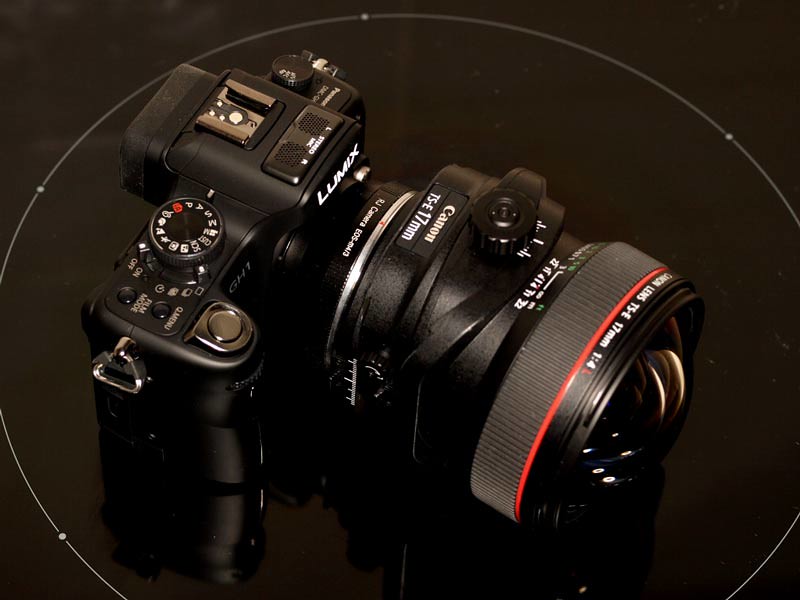
Thus for the past 2 years, 90% of my photos have been taken with a Micro Four Thirds camera, the Panasonic GH-1 because I loved its even more compact size, its ability to take high quality HD video, flip out LCD screen, and the absence of the mirror means magnified live view manual focus with legacy lenses just becomes so much easier. The Panasonic Lumix 20mm f/1.7 pancake lens combined with this camera is a fantastic walk about, indoors and party lens – just combine it with an Olympus FL-36 flash bounced off a wall or ceiling and you are in party photography heaven. No big intimidating dSLR system but fantastic quality easy portraits.

BUT there was one problem:

As good as this and the other early Micro Four Thirds cameras were (and ANY other contrast detect AF camera such as Sony NEX, or Samsung) they all suffered a major issue – relatively slow autofocus.

Panasonic and then Olympus addressed slow AF speed in their 3rd generation of cameras, most now also with touch screens, to the point the Olympus E-P3 was able to AF faster on a stationary subject than any other camera including pro dSLRs from Canon or Nikon when it was released – an amazing feat considering how immature contrast detect AF technology is compared to the old tried and true but inaccurate, phase contrast AF technology in dSLRs.

Enter the Olympus OM-D E-M5:

2011 would be a year Olympus corporate would rather forget, but 2012 was now a time to finally produce a camera worthy of the enthusiasts and semi-pros, and put all these wonderful new technologies together into one weathersealed, metal body for the first time – enter the exciting new Olympus OM-D E-M5.

I have written a post on the announcement and its features, but I will summarise again the features that make this a compelling camera to me over the other options such as dSLRs, Panasonic, Sony, Nikon or Samsung:

  • image quality of the sensor will be in excess of MY needs – see above – many will argue the fine details of which camera does better high ISO, but it is a mute point for most of us – it doesn’t matter 90% of the time!
  • designed for the enthusiast photographer who wants FULL control of the camera – customisable function buttons, large control dials, fast flash sync 1/250th sec
  • weatherproofed, compact, light metal robust body which looks good
  • superb range of compact, affordable, high quality lenses under $1000 including 12mm f/2.0, 20mm f/1.7, 25mm f/1.4, 45mm f/1.8, 45mm f/2.8 macro, 60mm f/2.8 macro, 75mm f/1.8, 100-300mm compact super telephoto, and many more – this, plus the 5EV 5-axis built-in image stabiliser is why Micro Four Thirds will be better than Sony or Samsung or Fuji for some time yet for most of us – versatility = fun.
  • 9fps burst rate or 4.2fps with AF is adequate for most of us, especially as the 10fps on my Canon 1D Mark III didn’t AF properly anyway.
  • very nice built-in electronic viewfinder which automatically switches between the lovely touch sensitive OLED tilt screen.
  • remote TTL flash via the bundled little flash unit (Panasonic do not support remote TTL flash)
  • Super-FP HSS flash at shutter speeds to 1/4000th sec.
  • high quality HD video that will be good enough for most of us photographers and for the 1st time, the in-built image stabiliser will be able to be used during movie mode which may help reduce the need for carrying large bulky stabilisers.
  • image stabiliser can be activated with half-press shutter to make it easier to manually focus a magnified view – now this should be brilliant for those of us who love our legacy lenses.
  • weatherproofed Four Thirds adapter so you can maintain weatherproof status when using those superb Four Thirds pro lenses.
  • optional fully functional grips will make it easier for portrait mode, particularly using large lenses, and the extra battery may help your movies ending prematurely.
  • 2x crop factor means the sensor is just large enough to allow adequate blurring of backgrounds and shallow depth of field when using wide aperture lenses
  • 2x crop factor also means lenses can be made smaller and with higher quality edge-to-edge of the frame.
  • the partnership with Panasonic adds much to the Micro Four Thirds system and significantly reduces risk.
  • tilt or shift adapters are available to turn legacy lenses such as Nikon lenses into tilt or shift lenses – a far cheaper option than on dSLRs.
  • it is expected Birger will produce an adapter that will allow aperture control and AF with Canon EF and EF-S lenses – presumably it will work with this camera as well as the Panasonic GH series.
  • underwater housing option available.

Summary:

The Olympus OM-D series is likely to be THE solution for many of us and makes a fantastic travel companion with just a few small lenses – no longer do we need to lug around heavy, large camera kits to get the shots we want on our travels.

If the OM-D series is too big for your occasion, then you could look at its smaller PEN series cameras such as the Olympus E-PL3 or E-PM1, particularly when used with the more compact pancake lenses.

Some of us will still want the benefits offered by a full frame sensor in pushing the boundaries of dynamic range, high ISO performance, megapixels, or shallow depth of field, and thus will put up with the cost, weight and size of full frame dSLR camera kits.

Professionals will increasingly head towards medium format digital cameras.

With the advent of the OM-D and the iPhone and the like, it seems there is little point in buying cropped sensor dSLRs or low image quality point and shoot cameras unless there was a specific need.


Seems Canon and Nikon watching on the sidelines while their leadership in camera sales burns and threatening to be totally taken over by Micro Four Thirds

Written by Gary on February 10th, 2012

No one doubts that Nikon and Canon are the 2 joint leaders by a long shot in the pro dSLR marketplace.

Until June 2009, this was the situation with their consumer level dSLRs as well.

Then out of the blue, Panasonic and Olympus radically changed the game with their hugely successful Micro Four Thirds system.

This is particularly the case for sales in Japan if the data from these charts are to be believed.

In early 2009, Nikon and Canon shared ~75% of total dSLR sales, Olympus struggled with 5% with their Four Thirds system and Sony was averaging about 10%.

Once Olympus joined Panasonic in the Micro Four Thirds system in mid 2009, the pair increasingly cannibalised Canon and Nikon dSLR sales in Japan to the point that by August 2011, Canon and Nikon had roughly equal share of only 40% of all dSLR/mirrorless sales, while Olympus and Panasonic now shared a whopping 30% of these sales, and in terms of units sold according to lens mount, Micro Four Thirds hit the lead in Japan in mid-2011 with over 30% of unit share, compared with Canon EF at 20% and Nikon F at under 25%! The initial surge in the Sony NEX sales has dwindled from their peak of 20% to fall to 12%, although not helped by the Thailand floods which has delayed their NEX 7 model.

No wonder lens manufacturers started jumping on the Micro Four Thirds band wagon in late 2011!!

Mirrorless cameras account for 45% of all dSLR/mirrorless camera sales in Japan by Sept 2011 – this was not even remotely thought of in 2008!

Canon and Nikon seem to be caught out by this demand for high image quality, large sensor, quiet, compact cameras with small lenses which mirrorless have brought to the marketplace and captured the attention of a public who had their appetites wet with point and shoots but deciding they wanted more image quality but not the bulk of dSLRs.

Nikon has finally entered the mirrorless marketplace but their choice of sensor size which severely limits ability to blur the background seems strange as it is unlikely to attract their dSLR users nor the ladies moving up from point and shoots.

Canon is still to enter the mirrorless market and one wonders if they have left their run too late to stop the Micro Four Thirds juggernaut – a force that will only grow ever stronger now that they have finally created a metal bodied, weatherproofed, awesome camera with an amazing built-in IS which works in movie mode, 9fps, flash sync 1/250th sec, remote TTL flash and the fastest AF available.

We have Panasonic using their expertise in the video market to create great video quality Micro Four Thirds cameras, while Olympus builds on its OM and Four Thirds experience to develop nice photographers cameras such as the newly announced OM-D E-M1 which I expect will sell like hot cakes when it is available in April 2012.

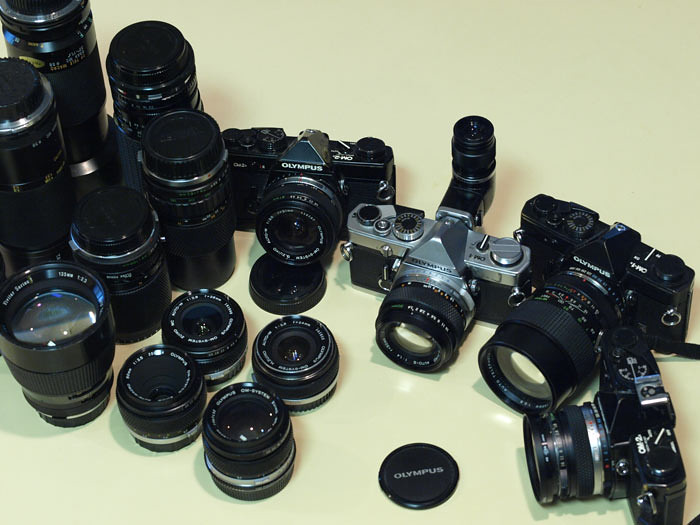
The sheer versatility of the Micro Four Thirds system with lens adapters for almost any lens ever made and they become image stabilised when used on an Olympus body, and when used with shift or tilt adapters, become shift or tilt lenses – this is just not a possibility with dSLRs unless you use the massive medium format or large format lenses.

But in the end it may be the vast array of lovely compact lenses available in Micro Four Thirds mount such as 7-14mm f/4, 12mm /2.0, 20mm f/1.7, 25mm f/1.4, 45mm f/1.8, 60mm f/2.8 macro, 75mm f/1.8 which all come in under $1000 and offer fantastic image quality which will mean that MFT’s will be a force to be reckoned with over the next few years.

Why would most people bother even considering a dSLR in this environment if it is not full frame or for sports / professional use?

Canon and Nikon are likely to be increasingly squeezed in the top end as more and more professionals move to medium format systems to distance themselves further from the non-professionals and to stay competitive in a difficult market.

Sure the new Nikon D800 will shoot 36 megapixels, but it won’t be the same quality imagery as a 50mp medium format and this is where Canon and Nikon may find themselves stuck between a rock and a hard place.

Their only “safe place” lies in the photojournalism, wedding and sports arenas but that will not be enough for them so Canon will be forced into the mirrorless market as well whether it likes it or not.

Mirrorless cameras are bringing the fun and the image quality to the masses and it is hard to see the momentum faltering!

I bought my 1st mirrorless in mid 2009, will be buying the OM-D E-M5 in April and I can’t see myself buying a dSLR ever again, unless I upgrade my Canon 1D Mark III to a full frame version one day.

Micro Four Thirds sales in Australia would be far stronger if Panasonic and Olympus Australia changed their ridiculous pricing strategies which tend to price their products 30% higher than US prices encouraging Australians to buy their cameras and lenses overseas. Please guys, with the $A higher than parity with the $US there is no excuse for this.

Take for example Panasonic Australia, the much loved Panasonic 20mm f/1.7 pancake lens retail price in Australian stores is $A599 (down from the $A799 RRP on Panasonic’s website in 2009), but Australians can have it delivered to their home from overseas for $340 brand new in a box – even allowing for 10% GST the Australian RRP is just ridiculous!

All very fascinating and exciting for us enthusiast photographers who can reap the spoils of the fight – no longer do we have a duopoly!


Olympus announce their exciting new mirrorless camera – the OM-D E-M5 – at last an Olympus mirrorless with built-in EVF – how does it compare to the Panasonic GH-2 and Fuji Pro X-1?

Written by Gary on February 8th, 2012

See Olympus website and the press release pdf and for a nice preview, see pekkapotka

This is indeed a very exciting camera!

Please also check out the preview on dpreview.com where this image is located:
dpreview.com

To me, it brings the mirrorless camera genre into real contention as a serious, versatile camera system designed with photographers in mind whilst still offering what appears to be high enough movie mode specs for most of us.

This camera for the 1st time introduces a weatherproofed robust body to the mirrorless genre and the 1st to offer such a highly effective image stabilisation system which has been re-designed to allow use during movie mode, and will be of great benefit in use of those excellent prime lenses now available as well as legacy lenses such as using a Canon 135mm f/2.0L lens on it – this will be absolutely awesome!

I am very happy they have added the tilt out OLED touch screen which will be indispensible, and you can even add the PEN external electronic viewfinders if you want to look down through a viewfinder.

The flash capabilities far exceed anything Panasonic make with remote TTL flash, flash sync of 1/250th sec for the new flash, and full range of manual flash outputs, plus I presume the TTL flash will work well with legacy lenses which is certainly not the case with my Panasonic GH-1.

The high ISO quality seems usable for web sized images up to ISO 6400 and perhaps ISO 12,800 according to these images, but I suspect I would not use it past ISO 800-1600 – see these images, and as usual with Olympus cameras, I would turn the in camera NR down and use software NR instead. We will have to wait until Olympus finishes tweaking firmware to see how good image quality really is at higher ISO levels. As long as the image quality is as good as my GH-1 I will be happy – and there is good reason to expect it will be significantly better.

95% of my shots I do at ISO 400 or less (even on my Canon 1D Mark III) so I don’t care much for high ISO as if I need high ISO, the lighting is usually lousy anyway and I would use my own lighting to remedy the quality as well as quantity of light – an exception of course is astrophotography or sports under lights. If high ISO quality is very important to you, get a full frame dSLR such as a Canon 1D X or Nikon D4 (not the 36mp D800!).

What is missing from the E-M5 – nothing that would be a show stopper!

  • wireless remote control – must use cabled remote (RM-UC1)
  • intervalometer ???
  • GPS
  • USB 3.0
  • flip out and swivel screen as with the GH-2 – but then the tilt screen may be more functional for enthusiasts
  • oversized sensor as with GH-2 appears not to be in this model
  • built-in flash but it is bundled with a small weatherproof flash
  • AVCHD video and 24fps filmic mode but the 20Mbps .MOV video will be adequate for most – if you want the best video, get the GH-2 or wait for the GH-3
  • uncompressed live video out
  • flash sync only 1/180th sec for older flashes
  • peaking functionality for manual focus confirmation
  • in-camera HDR
  • AE bracketing may be a little limiting for some
  • 1/8000th sec shutter speed – but then only pro dSLRs have this
  • ISO 100 – oh well, guess I will be using ND filters or polarising filters in bright sunlight with those fast primes
  • 40fps 4Mp mode – not sure I would use this but the GH-2 has this
  • C-AF with Four Thirds lenses – maybe this will come with a phase contrast adapter
  • 100mm f/2.0, 150mm f/2.8, and 200mm f/4 lenses – I’m sure Olympus are working on these!

I loved my Olympus E-510 and this camera is smaller, faster, better image quality, weatherproofed and far more feature-laden, so I for one will not be complaining of lack of the above features – this camera is aimed at the enthusiast photographer who wants fun without being over-burdened with large heavy lenses or big tripods – and that is me! I am just worried my daughters will try to take it off me!

There is so much to love about this extremely well thought out camera – mark my words, I will be buying one – I just hope Olympus Australia do not do the usual sting and charge us Australians a ridiculously over-priced amount! The landscape grip seems essential but the portrait one I can do without. And those new lenses (75mm f/1.8 and 60mm macro) to match the 12mm f/2.0 and 45mm f/1.8 have me salivating!!!!

The new Fuji Pro X-1 as nice as the sensor may be, and as nice as the aperture and shutter speed controls and hybrid OVF/EVF are, seems sadly compromised by only having 3 prime lenses, no IS, no remote TTL flash, no dust sensor, minimal movie mode control, and minimal manual focus support.

The Nikon D800 with its 36mp, 70Mb+ files is sure to give great images but it is not going to be a fun camera like the E-M5, and I like to have fun with my photography!

First a comparison with the GH-2 and Fuji Pro X1:

Panasonic
GH-2
Olympus OM-D E-M5 Fuji Pro X1
Price at Amazon.com $US999 with 14-42mm lens $US995 body only, $1299 with 12-50mm lens; HLD-6 external battery grips $299; FL-600 flash $299; MMF-3 FT adapter $179.
Weight 442g, plastic  373g (425g incl. battery) weathersealed, magnesium
Size 124 x 90 x 76mm  122 x 89 x 43 mm  140mm x 82mm x 43mm
EVF eye sensor auto switching  1.44m dots, eye sensor auto switching  hybrid OVF/EVF eye sensor auto switching
LCD articulating LCD touch screen
 tilt – out 610K dot 3:2 OLED touch screen  no touch,
HD video 1080p 24fps 23Mbps quality and
1080i 60fps; 1/16000th shutter, AVCHD or motion jpeg
 1080i 60fps 20Mbps or 720p, manual audio levels, .MOV or motion jpeg, built-in IS works!!! Stereo mic  1080p 24fps or 720 24fps, limited manual control;
Over-sized sensor for native,
uncropped 16:9
Yes, 18.3mp giving max. 16.1mp  No, 16mp
Burst rate 5fps; 40fps at 4mp electronic
shutter
 3.5 with AF/IS; 4.2 with AF no IS; 9fps with AF only on 1st shot x 17 frames RAW;  3fps or 6fps
Top panel mode switches AF mode switch; Drive/self-timer
switch
 Exposure mode dial top left; main dial; subdial;  shutter speed selector dial (aperture on lens)
External mic socket Yes  Yes but requires adapter SEMA-1 via the Pen port
Rear AF-lock button Yes  Fn button
Subject tracking AF in HD video No  Yes
AF mode reasonably fast AF for stationary subjects  fastest AF of all cameras for stationary subjects plus 3D tracking and AF can detect subject’s eye (you can choose which eye – nearest, R/L), 800 AF points;
Max.ISO 12,800  25,600  25,600 but only 6400 in RAW
Max. bulb duration 4min  timed BULB available up to 30min; Live Bulb viewable on screen up to 13sec!  up to 60min but not timed past 30sec
Hotshoe Yes  Yes  Yes
White balance presets 5  12
Built-in flash GN 15.6m, sync 1/160th sec, no remote TTL, no TTL with legacy lenses
 No, bundled weatherproof flash with sync 1/250th sec, remote TTL, manual output down to 1/64th, Super FP HSS mode  No, no remote TTL flash, no HSS flash, flash sync 1/180th
Exposure compensation +/- 5EV +/- 5EV  only +/- 2EV!!
AE bracketing +/- 3EV +/- 2EV; 2,3,5 frames up to 1EV; 7 frames up to 0.7 EV?
 no remote TTL flash, poor TTL flash with legacy lenses, limited manual flash output control  Super FP flash, remote TTL flash, full manual flash output control to 1/64th?  limited movie or manual focus functionality, no focus distance visible on lenses!! Cumbersome MF magnified view
 optical IS only; film presets;  5 axis 5 EV built-in IS which also functions in movies and half-press shutter can activate IS to enable accurate manual focus! Level guage, 11 Art filters, Scene modes, iAuto,  only 3 prime lenses to choose from; no IS; 10 film presets;
 can also use external EVF as with Pen cameras; Multiple exposures; shutter quieter than even the electronic quiet mode of the Sony NEX7!  2 image multi-exposure mode; no sensor dust removal!
 optional grips, ext. battery pack/vertical grip, underwater kit, FL-600R flash with movie light  panoramic stitching

And,  the 3rd generation Olympus Pen cameras:

Olympus
E-P3
Olympus
E-PL3 “Lite”
Olympus
E-PM3 “Mini”
Price at Amazon.com $US945 with 14-42mm lens
Weight 369g 313g 263g
Size 122 x 69 x 34mm 110 x 64 x 37mm 110 x 64 x 34mm
EVF optional via hot shoe optional via hot shoe optional via hot shoe
LCD OLED, 614K dot 3:2 fixed, touch. Usable even in bright sun. 460K dot 16:9 tilting, not touch 460K fixed, not touch
HD video 1080i 60fps; 720p 30/60fps; 17 or 13mbps quality; as for E-P3 1080i 60fps; 720p 30/60fps
Over-sized sensor for native,
uncropped 16:9
No; 13.1mp giving 12.1mp No; 13.1mp giving 12.1mp No; 13.1mp giving 12.1mp
Burst rate 3fps 5.5fps with IS turned off
4.1fps or 5.5fps with IS turned off
Top panel mode switches No No No, and no exposure mode dial
External mic socket No
Rear AF-lock button 5 customisable buttons
Subject tracking AF in HD video Yes Yes ?
Pinpoint AF mode No, but has 35 AF zones, eye-detect AF and front AF lamp as for E-P3 except 11 points only No
Max.ISO 12,800 12,800 12,800
Max. bulb duration 4min 2min
Hotshoe Yes, 1/180th sync Yes, 1/160th sync Yes, 1/160th sync
White balance presets 12 8 8
Built-in flash GN 10m at ISO 200; remote TTL master; manual down to 1/64th output; None, clip on FL-LM1 included None,
Exposure compensation +/- 3EV +/- 3EV +/- 3EV
AE bracketing +/- 3EV +/- 3EV +/- 3EV
level gauge no level gauge no level gauge
10 art filters 6 art filters 6 art filters

more links relating to the E-M5: