available May 10th, 2010 from here.
Panasonic announces firmware update to GH-1, GF-1 and G-1
Written by Gary on April 21st, 2010Panasonic patents new Micro Four Thirds adapter to allow phase difference AF with compatible Four Thirds lenses – and perhaps ANY lens including manual focus ones?
Written by Gary on April 17th, 2010The Micro Four Thirds camera system is blessed with a multitude of lens adapters which allow for fun and versatility in using almost any lens ever made – either via contrast detect AF within the camera if the lens is compatible for this or via manual focus.
The 43rumors team have posted a link to a new patent by Panasonic which appears to add phase difference AF capability when using Four Thirds lenses not capable of contrast detect AF.
See this pdf for details.
Unlike Olympus Micro Four Thirds cameras, the Panasonic bodies currently will not AF with a Four Thirds lens which is not contrast detect AF capable. (ps. the newest Panasonic bodies will now AF slowly even with non-CDAF OLympus lenses).
This new adapter would appear to address this issue by adding phase difference AF capability (similar as to technology used in dSLRs) – and perhaps allow sports level AF with such combinations.
The adapter will presumably be a Micro Four Thirds to Four Thirds adapter and use a pellicle mirror to deflect some light from the lens to a phase difference AF detector which responds to the user’s selected AF point via lens mount connections from the camera body and focuses the lens.
For compatible Four Thirds lenses, the user can select either CD-AF or PD-AF method.
If the lens is contrast detect AF capable, then the mirror moves out of the way and the camera’s contrast detect AF mechanism is used.
If the lens is not compatible with CD-AF or phase difference AF, then the mirror is moved out of the way and the user resorts to manual focus.
I think this is quite an exciting development as many Micro Four Thirds users will have or want to have Four Thirds lenses with a sports-capable dSLR such as an Olympus E-3, and this will allow them to gain AF when these lenses are used on their GH-1 or the new pro Panasonic camcorder for instance.
Of course, it is only a patent which may never eventuate, but I hope it does as it will provide additional options for us.
The extremely detailed but generic text of the patent suggests that this adapter may also work with a 2nd adapter – presumably similar to the recent Olympus patent – an adapter which includes AF lenses which not only can AF ANY manual focus lens but has a 2x wide converter to bring native field of view to the 2x crop sensor cameras – now this would be exciting indeed!
Natural looking outdoor portraits with a single flash
Written by Gary on April 17th, 2010As I mentioned in a previous post, last weekend I offered to help a friend shoot some beginner models for their portfolios in an outdoor urban setting on a freezing cold, windy day.
I thought this would be a great opportunity to try my portable Westcott umbrella softbox and a flash in manual mode, much as how the excellent blog from Neil van Niekerk advocates.
It doesn’t matter which camera or flash you use – I could have done this with any flash with a wireless trigger and either an Olympus E510 with Olympus ZD 50-200mm f/2.8-3.5 lens, or a Panasonic GH-1 with Olympus ZD 50mm f/2.0 macro (manual focus only on this camera), but for this outing, I blew the dust of my Canon 1D Mark III and used one of my favourite (although often difficult to use) lenses – the Canon EF 135mm f/2.0L.
Neil has some great pointers in his blogs regarding use of a single flash as the main light for outdoor portraiture.
He manages to achieve this by ensuring ambient light on the subject’s face in only 1-2 stops underexposed from the main flash light, thus ensuring there are no dark shadows while using the flash in a softbox which ensures the edge of the shadows are nicely blended rather than being harsh – if you don’t have a softbox, you could bounce flash off a white cloth or wall.
The first requirement is finding a location with an aesthetic background lit approximately1-2 stops more than the subject – and as I found, finding such locations out of the wind can be more difficult than it would seem – a sunlit background is generally too bright for the ambient light falling on your subject unless this is reflected sunlight from a wall rather than from open sky.
Once you have found your location, then you need to work out how you would like to render the background:
- set your camera and flash to manual exposure mode
- set your shutter to maximum flash sync (eg. 1/160th – 1/250th sec depending on camera)
- set your aperture to f/2.8 or f/4 to blur the background while still having all of your subject in focus,
- set ISO to give the background exposure you want (as long as ambient light on your subject stays under-exposed so that it acts as a fill in).
- if your ISO setting is going too high for your liking, you could use a longer shutter exposure as long as you avoid camera shake or subject movement.
Your subject exposure then becomes entirely dependent upon the manual flash output setting and how far you have the flash to your subject – this will take a little trial and error while checking the histogram on the camera after you take test shots – unless you happen to have a flash meter – and even then he suggests it is wise to check your histogram.
I like this concept as it produces images that look natural, can be flattering to the subject and avoids the flat lighting that often results from overcast conditions.
Here is an example of what I achieved with this technique on this horrible day for taking photos of people outdoors, although I have purposely limited the degree of main light from the softbox and increased contrast and added some vignetting in PS:

I highly recommend you peruse Neil’s excellent blog – he has some great examples of simple flash and ambient light portraiture, and there is much one can learn from his experience as a wedding and fashion photographer.
Olympus announce firmware update for Pen cameras giving faster AF, plus a couple of reviews of the new Olympus 9-18mm lens
Written by Gary on April 16th, 2010The Olympus Pen firmware updates for E-P1, E-P2 and E-PL1 has the following improvements:
- faster AF speed in still image taking (with all lenses)
- for E-P1 and E-P2, faster AF tracing capacity in C-AF of movie taking (M.ZUIKO 9-18mm & 14-150mm) to same level of the E-PL1
- When using the VF-2, you get the flexibility to display the MENU and played image on the LCD (instead of on the VF-2)
- Flexibility to display the REC-VIEW on the LCD (instead of on the VF-2)
- Frame rate adjustment of the live view when used with the new M.ZUIKO 9-18mm
- minor bug fixes
The much awaited super wide angle zoom Olympus M.ZD ED 9-18mm f/4-5.6 ED lens for Micro Four Thirds cameras has been reviewed by dpreview and also by Douglas Brown who also has had opportunity to use the new firmware update and comment on the improved AF speed.
In essence, this lens is a little beauty – it is sharp, flare resistant, almost silent but fast AF so that AF during video will not be heard on the video, and thanks to its collapsing design, it is the only lens to cover 18-36mm focal length range (in 35mm camera terms) which will fit in your pocket, and the camera-lens combination is MUCH smaller than an equivalent Four Thirds lens on a Four Thirds dSLR such as an Olympus E620.
As with all lenses, there are compromises Olympus had to make to keep the price and size down:
- it is soft in the corners but sharpens significantly 1 stop down at f/5.6
- it is not a constant f/4 lens as is the much more expensive Panasonic 7-14mm micro four thirds lens
- it has significant red/cyan CA towards the edges at all apertures although this can be corrected in post-processing
- it has mild barrel distortion in the 9-14mm range
It’s RRP is $US700 and other specs include:
- 1ED element, 1 HR glass element, 2 dual surface aspherical elements, and 1 aspherical element
- 7 rounded diaphragm blades (although ability to blur the background is not a priority with a wide zoom such as this)
- minimum focus 0.25m giving 0.1x macro
- 52mm filter thread so you can use your Cokin gradient filters for landscape work unlike the 7-14mm lenses
- front element does not rotate so use of polarising filters is not an issue
- weighs only 155g making it an ideal travel lens
- 56.5 mm diameter x 49.5 mm length (retracted) (2.2 x 1.9 in)
- and of course, on Olympus cameras it is image stabilised via the body – no Canon or Nikon super wide zoom has IS.
For comparison:
- Olympus ZD 7-14mm f/4 pro lens weighs 780g and cannot use filters
- Panasonic 7-14mm f/4 micro four thirds lens is not much bigger but more expensive and cannot use filters
- Olympus ZD 9-18mm f/4-5.6 ED lens weighs 280g and uses 72mm filters and will not AF as fast or as silently
- Nikon 12-24mm f/4G ED DX (18-36mm) uses 77mm filters
- Tokina 12-24mm f/4 DX for Nikon or Canon (18-36mm on DX) uses 77mm filters, weighs 570g and is 84mm x 89.5mm
- Sigma 8-16mm f/4.5-5.6 DC for APS-C or DX (12-24mm on DX) is 106mm x 75mm
- Canon EF-S 10-22mm f/3.5-4.5 (16-35mm) uses 77mm filter, weighs 385g
- Canon EF 16-35mm f/2.8 L II and Nikon 14-24mm f/2.8G are bigger, heavier and more expensive again but the Nikon in particular, has superb image quality and they are both f/2.8 lenses.
In praise of the Canon EF 135mm f/2.0L lens
Written by Gary on April 15th, 2010The last weekend I used the Canon EF 135mm f/2.0L lens almost exclusively – partly because it was the lens I felt would best suit my subjects – in one case for shallow depth of field and background blurring, and the other case to gain telephoto low light performance.
I was invited to help out a friend who had arranged an impromptu urban shoot to help aspiring models develop a portfolio.
Now the best lens for such shoots tends to be a 70-200mm f/2.8 IS L lens as it gives plenty of versatility while allowing good background blurring, and low light performance without having to change lenses and lose photo opportunities. But, as I am not a professional photographer, I do not really have need of such a big, heavy and expensive lens.
The 135mm f/2.0L lens gives me one more stop of aperture for even more background blurring or shallow DOF when I need it, while it is sharper as long as it is accurately focused and you control camera shake – unfortunately, Canon still has not added image stabilisation to its bodies.
Here is an example of what you can do in a dark alley way on a heavily overcast day on a 1.3x crop camera – the Canon 1D Mark III (note contrast and vignetting added via Photoshop) :

The biggest problem with this lens in this scenario when used wide open, is the shallow depth of field. It is so shallow that your focus has to be precise – and as my subject’s eyes are rarely anywhere near the centre of my frame, I lock the AF using the rear button, then recompose the camera.
Unfortunately, the depth of field is only a couple of inches for critical focus so while you recompose, movement of yourself or the model may place the model’s eyes out of focus which makes this very challenging and chimping of the image with enlargement is almost mandatory.
A further problem with shallow depth of field camera-lens combinations which use dSLR autofocus mechanisms is that the combination must be calibrated to ensure there is no inadvertent front focus or back focus – fortunately most modern dSLRs allow you to do this using the AF microadjustment setting in their menu.
The main other issue I have with this lens is low contrast when bright light sources hit the front element – for this reason, I find that use of the lens hood is mandatory with this lens.
Now for something totally different – low light telephoto – using the 135mm f/2.0L lens as a 270mm focal length reach lens with light gathering of a f/2.0 lens but depth of field of a 270mm f/4 lens – just what one needs for stage shows at night time!
How do we do this – simple use a sensor with lots of pixel density – in this case I used a Micro Four Thirds camera – the Panasonic GH-1 for still images and HD video of the Sunbury Backroad Music Festival – this one is of Australian 1970’s band, Spectrum:

At dusk, I tested out this combination hand held on the band Falloe:
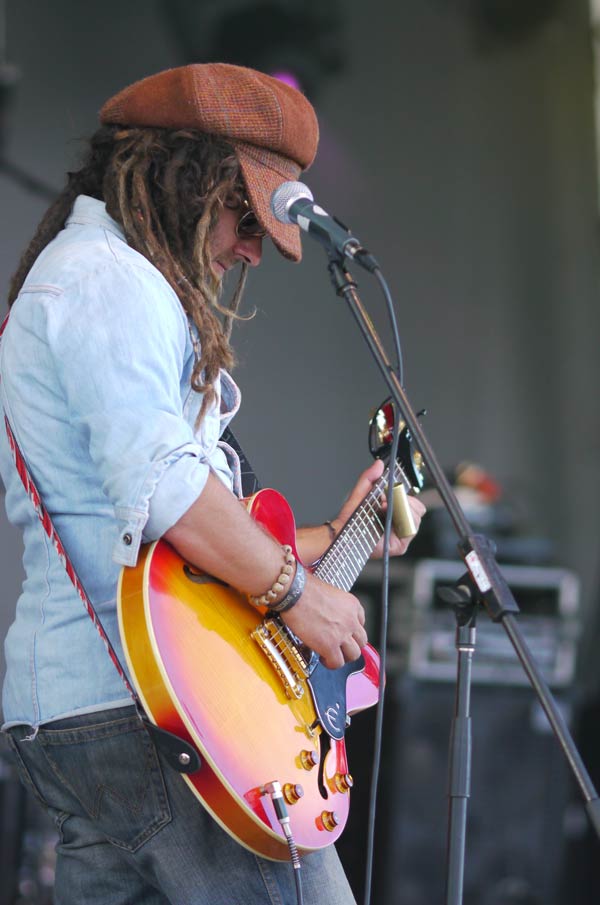
I thought I would push this lens even further, adding a the Canon EF 1.4x tele-extender which when combined with the Panasonic GH-1 gives a focal length field of view of a 378mm lens at light gathering of a f/2.8 lens but depth of field of f/5.6 just perfect – except, no image stabiliser on my Panasonic GH-1 either:

More from the Sunbury Festival here.
This lens is one of my favorite lenses along with the Olympus ZD 50-200mm f/2.8-3.5 SWD, the Panasonic Leica-D 25mm f/1.4 and the Olympus ZD 50mm f/2.0 macro lens, while for special purposes, I also love my Canon tilt shift lenses and my Olympus ZD 7-14mm super wide angle lens.
More examples of photos with the 135mm f/2.0L lens here, and taken with the GH-1 here.
Carl Zeiss announces new cine lens for videographers using cropped sensor cameras including Micro Four Thirds
Written by Gary on April 15th, 2010Carl Zeiss has just announced a new cine lens – the Lightweight Zoom LWZ.2 – which has an image circle of 24.9×18.7mm for ANSI 35mm cine which is just larger than APS-C Canon and DX Nikon sensors, and obviously large enough to cover Micro Four Thirds camera sensors as well.
Interestingly, Zeiss has decided on designing it with interchangeable mounts – in Nikon F, Canon EF and cine PL mounts so that videographers can change their cameras to give a different look or feature set without having to buy new lenses.
Of course, this need for interchangeable mounts did not apply to Micro Four Thirds camera users anyway as they can buy an adapter to use practically any mount lens, including cine PL mount.
Although they call it “Light Weight”, it is 2kg – much too heavy for hand held work with a small Micro Four Thirds camera, but it would be awesome on the recently announced Panasonic professional camcorder for Micro Four Thirds!
This lens has a focal length range of 15.5 to 45mm at T 2.6 aperture
Why spend all that money on one of these lenses when it will only be manual focus anyway?
There is a good reason for the discerning videographers out there who usually do not use auto focus anyway but need the following features which these lenses provide (assuming it has the same feature set of the Compact Prime CP.2 lenses):
- easy manual focus via longer focus rotation
- consistent manual focus distances unlike dSLR USM lenses which are unreliable in manually setting a focus to the distance scale – a critical exercise in professional videography
- ability to attach geared follow focus equipment to manually focus and adjust iris
- cine-style housing dimensions for compatibility with existing cine equipment
- iris diaphragm has an incredible 14 rounded blades (most current dSLR lenses use 8 or 9) to ensure it remains as circular as possible at all apertures to give circular out of focus images and thus contributes to more aesthetic and “natural” bokeh
- T style aperture which presumably is step-less to ensure changes in brightness are subtle
- superb image quality, free of distortions with T* XP multi-layer coatings to reduce flare
Carl Zeiss are also revising their Compact Prime CP.2 lenses which cover a 35mm full frame sensor without vignetting, and which have a common maximum aperture of T2.1 – more on these here. A set of 6 prime lenses will set you back $US20,000.
Photographic exhibition by Paul Marc Joffe opening in Melbourne this week
Written by Gary on April 13th, 2010Make sure you get out to see Melbourne photographer Paul Marc Joffe’s photographic exhibition displayed at Monash Medical Centre’s Art Space from Thursday April 15th 2010 with opening night starting at 6pm that evening.
The opening coincides with the release of the Photofile (89) essay by Kirsten Rann for the Australian Centre for Photography.
Joffe has a keen photographic eye which makes the most of compositional elements and the decisive moment in social documentary imagery.
See here for more information.
Images will also be exhibited at Art Melbourne from 22nd – 25th April for Lindberg Galleries.
Panasonic announce a pro camcorder for Micro Four Thirds which appears to bring all the features videographers need
Written by Gary on April 12th, 2010The Micro Four Thirds camera system has taken the still photography world by storm, and the Panasonic GH-1 HD video camera is the ONLY dSLR-like camera that can continuously autofocus during HD video, but as good as this camera is, it lacks a number of features which professional videographers really want.
Enter the newly announced Panasonic AG-AF100 AVCCAM HD professional camcorder which will shake up the whole video industry by introducing a professional level tool, with a Micro Four Thirds sensor size (4x larger than a RED Scarlet video camera and much larger than most HD video camcorders), and with the ability to use industry standard Micro Four Thirds lenses, and via adapters almost any lens ever made. They say it is scheduled to ship by end of 2010, no pricing yet although it is said to be ~$US6000, so you can bet it will be MUCH cheaper than a RED Scarlet.
No wonder Kodak, Fuji, Sanyo and Sigma have decided to join forces with Panasonic and Olympus in extending this incredible new photography system.
The features which are driving excitement amongst the videographers and which have been announced here include:
- Micro Four Thirds 16:9 MOS sensor for shallow depth of field and high image quality
- Micro Four Thirds lens mount
- uses advanced professional AVC/ H.264 Hi Profile AVCHD codec compatible with a wide range of editing tools and affordable players
- records 1080/60i, 50i, 30p, 25p and 24p (native) and 720/60p, 50p, 30p, 25p and 24p (native) in AVCHD’s highest-quality PH mode (maximum 24Mbps). Ready for global production standards, the camcorder is 60Hz and 50Hz switchable. (GH-1 AVCHD modes only records 1080/60i,50i, 720/60p,50p and at only 17mbps data).
- built-in ND filtering
- dramatically reduced video aliasing
- HD-SDI out and HDMI – now you will not be limited to AVCHD compression but can record uncompressed video via an external recording device – now that is awesome!
- time code recording
- built-in stereo microphone
- two XLR mic inputs with +48V Phantom power capability
- 48kHz / 16 bit two channel digital audio recording, support for LPCM/Dolby AC3
- dual SDXC memory card slots (can use SDHC cards as well) so that 2x 64Gb SDXC cards will allow 12 hours recording at maximum 24mbps video rate in PH mode
I presume it will not have a power zoom, but then I would imagine most professionals wouldn’t use that feature anyway.
Today, after 123 consecutive days, the temperature in Melbourne failed to reach 20deg C – a new record
Written by Gary on April 11th, 2010The previous longest running consecutive days of maximum temperatures above 20deg C in Melbourne was 78 days – easily beaten by this 123 day run of warm days!
Panasonic GH-1 with Leica-D 25mm f/1.4 on a quick forest walk
Written by Gary on April 7th, 2010On Easter Monday, I thought i would check out a local forest which was hand planted some 100 years ago in central Victorian highlands which makes it rather unique in Australia as it is mainly trees from northern hemisphere origin.
I had never been to this forest before and as it was a beautiful sunny early Autumn day, it would be great for a walk, but probably too sunny for great photographic forest landscape shots.
I only had an hour or so, so I took my beloved Panasonic GH-1 and Leica-D 25mm f/1.4 lens with the primary aim just to document ideas for shots in better lighting and when I had more time.
In stark contrast to native Australian Eucalypt forests, this man made forest of diversified trees including conifers, and oaks, had a very different ecology – most noticeable were the multitude of introduced mushroom species including the poisonous, hallucinogenic, Fly Agaric (Amanita muscaria) and the very weird absence of the usually omnipresent Australian native bull ant – which I must say made the walking a lot more relaxed, as no-one enjoys being stung by those ants!
Maybe the bull ants are killed by the Amanita, or they need Eucalypt habitat?
The flip out swivel LCD screen of the GH-1 was fantastic as usual for ground level work of hand held shots of mushrooms – the following two are at the closest focus of this lens and show the difference between f/1.4 (the first one) and f/2.8, – oh, and I do love native 16:9 image aspect ratio which is available on the GH-1!
at f/1.4:

and at f/2.8:

and here is a more mature Amanita muscara:

and of course, I better show a sample of this lovely forest:

more photos from the walk here