Reports that comet ISON C/2012 S1 has failed to survive its journey around the sun may be wrong

Written by Gary on November 29th, 2013

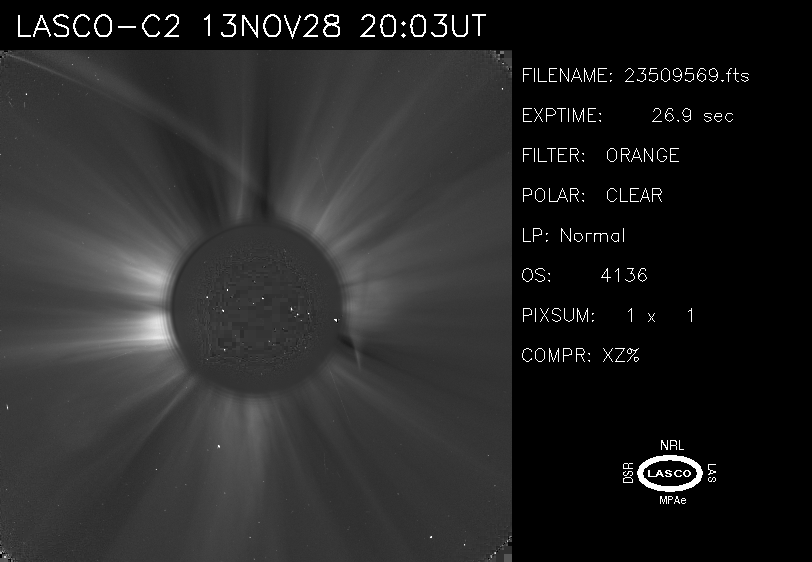
According to the latest reports based on images such as the following, it seems that comet ISON has failed to survive it’s close encounter with the sun which will be a big disappointment for those in the northern hemisphere hoping to see a bright comet next week.

Note that the brightest part of the comet is no longer the head:


comet ISON Nov 28th 2013

However, since this image, a later image shows it is still there:

comet survives

But as of 29th Nov, reports are that it has substantially faded to a magnitude of around +2.9 with suggestions that if the comet reappears it will probably be a large diffuse object without the usual dense comet head, and with a magnitude of +5 which will be a disappointment to those in the north hoping for a bright comet for Christmas.


At last! Comet ISON C/2012 S1 brightens after an outburst – should be an interesting couple of weeks

Written by Gary on November 16th, 2013

We all love comets, especially if they are bright, naked eye comets as these are quite uncommon.

For us in the southern hemisphere, comet ISON C/2012 S1 will only be visible BEFORE it passes around the sun on 28th Nov 2013,  and even then it will be difficult to see low on the east horizon just before sunrise.

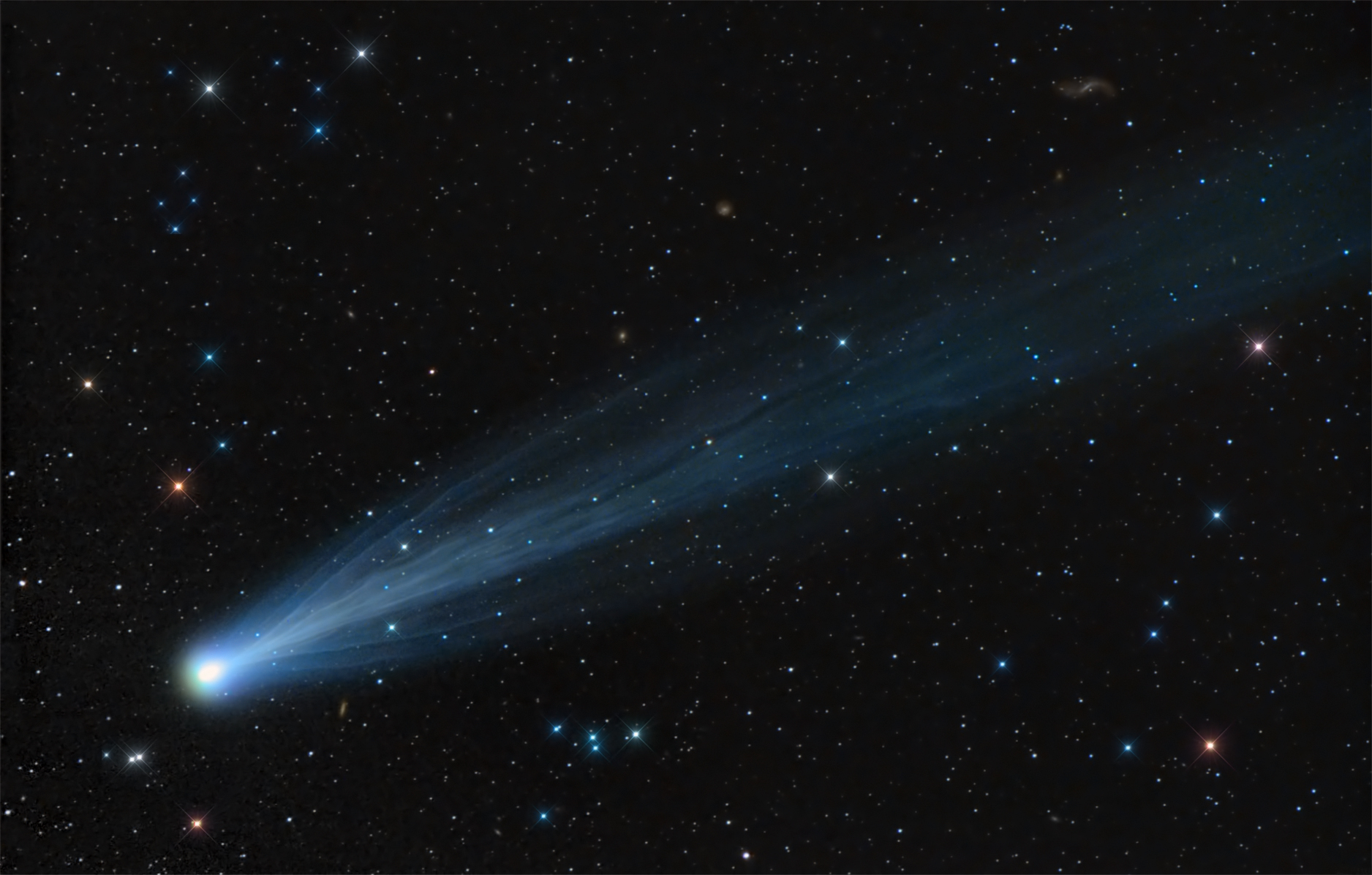
But, for those with motor driven telescope mounts and cameras with wide aperture telephoto lenses, it may be an opportunity to capture some lovely images such as this one by Damian Peach which was taken yesterday after the comet had suddenly brightened to magnitude 5.3 after an outburst:

comet

This 2.5 deg wide image was created by stacking 5 x 2 minute monochrome “L” images with a 2 min color “RGB” image using a SBIG STL-11k CCD astro camera mounted on a 105mm aperture f5.0 telescope (ie. focal length = 525mm).

A very cool animation posted on SolarSystemScope.com:

For those in northern hemisphere, especially at latitudes north of 30deg N, if this comet survives perihelion, it may become a lovely naked eye comet like the one I took of comet McNaught below – only time will tell.

comet McNaught

My photo of comet McNaught taken 23rd Jan 2007, Olympus E330 dSLR, 60sec, ISO400, Zuiko 50mm f/1.4 lens at F/2 in a rural region see HERE for more of my photos and info on comet McNaught P1

Hopefully the skies will clear next week so I can try some imaging myself with my Olympus OM-D E-M5 Micro Four Thirds camera with my Canon EF 135mm f/2.0 L lens.

 Unfortunately for us in the southern hemisphere, the comet has become very difficult to see in the morning twilight as it has not become bright enough to offset the atmospheric extinction of being close to the horizon, as well as being close to the sun and with moonlight increasingly becoming a compounding issue  – not to mention the low pressure trough bring clouds to much of Australia from 20th November onwards.

Update 26th Nov: reports that the comet may be disintegrating however, this is far from conclusive – see Ian Musgrave’s blog post


a Sunday afternoon with the Olympus 75mm f/1.8 lens

Written by Gary on November 11th, 2013

Readers of my blog will know how much I love the Olympus 75mm f/1.8 lens on my Olympus OM-D E-M5 Micro Four Thirds camera.

Yesterday was a rather chilly Spring day in Melbourne, Australia, and all the more so with my decision to head up to the nearby hills and explore some open private historic gardens at Mt Macedon which were created after the devastating bushfires of Ash Wednesday in 1983.

Here are a few to demonstrate the wonderful European influences from the 19th century:

At Forest Glade:

marble statue

child photographer

stork

child flautist

children reading

feeding the birds

dancers I

dancers II

At Tieve Tara:

girl

kissing

Wisteria

chair

At Duneira:

bluebells

bluebells II

And a trip to Mount Macedon should include:

an Australian rainforest bushwalk such as to the lovely stands of Eucalyptus viminalis at Sanatorium Lake, temperature had dropped to 6degC and it was getting quite dark:

E. viminalis

and check out this very loving tribute of this lady to her lover in the Macedon cemetery:

grave


New full frame cameras – mirrorless Sony and the retro Nikon Df

Written by Gary on November 6th, 2013

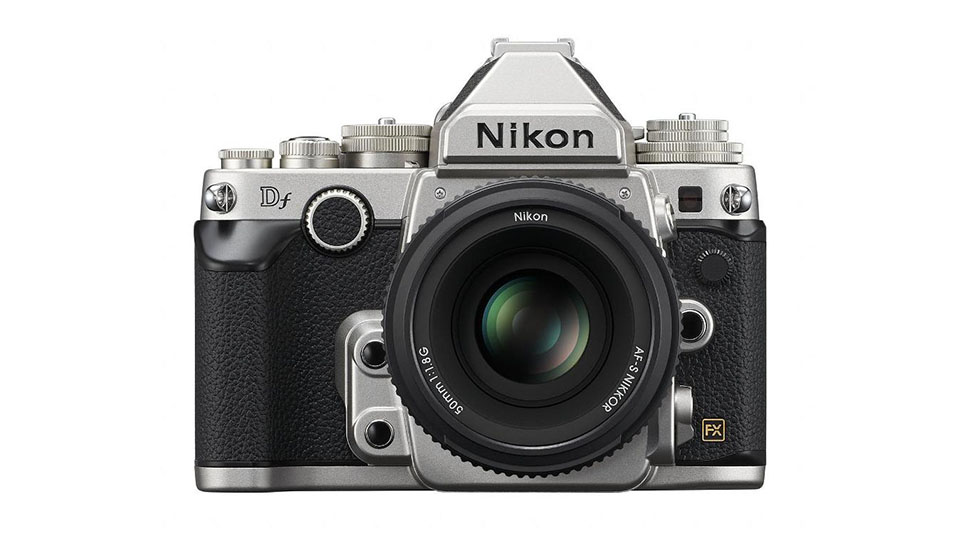
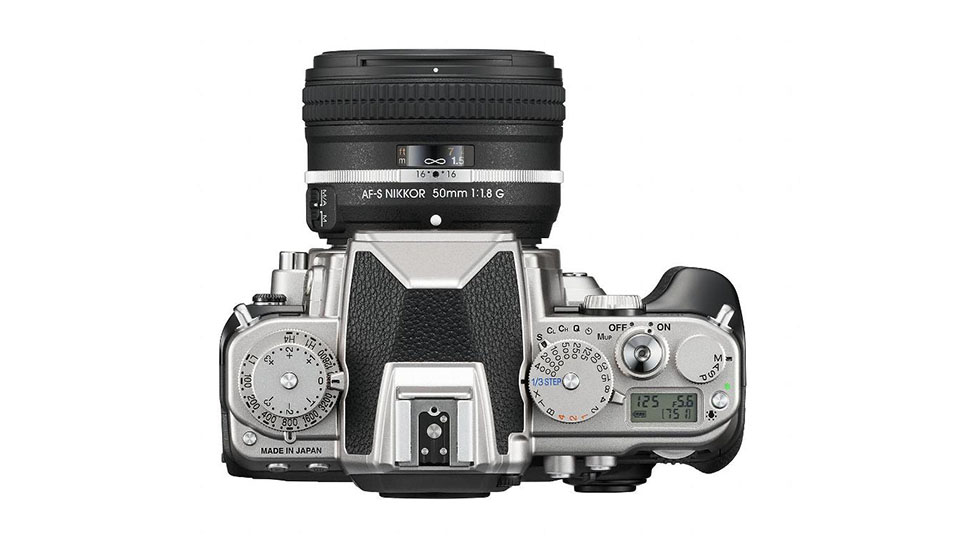
Nikon today formerly announced their new retro styled full frame dSLR – the Nikon Df.

The Nikon Df presumably is in response to the Olympus OM-D E-M5 and the Fuji mirrorless cameras which have enthused the enthusiast and pro photographer world with their great retro styling and classic ergonomics.


Nikon Df

Nikon Df

The Nikon Df is bound to be a hit with Nikon die hards who will fall in love with its nice styling but unlike the Olympus OM-D E-M5, instead of combining great retro looks and ergonomics with cutting edge technologies and awesome new versatility such as brilliant image stabilisation down to 2 secs hand held, almost waterproof features, WiFi control by smartphones, etc, etc, Nikon has produced a camera with no new technology but instead less technology and functionality  than is currently available in equivalent but less expensive cameras – such as their Nikon D800 dSLR.

It certainly has more aesthetics than Nikon’s other dSLRs, but at a cost of less customisation options – unlike the OM-D cameras, the top dials cannot be customised to other functions as needed and some dials such as the exposure compensation dial will be redundant in manual exposure mode.

The Nikon Df is a hybridization of:

  • Nikon F-series film camera:
    • body resembles that of Nikon’s F-series 35mm cameras, complete with dials for shutter speed, aperture, and exposure compensation.
    • unfortunately the utility and ergonomics of these dials is not great, especially if you have your eye to the viewfinder as these dials are difficult to unlock without viewing directly
    • furthermore, the argument the dials display all the data falls down as they don’t show aperture, and if you want more flexible shutter speeds, will not show that either as you use the front dial instead, plus you have the LCD screen to display all this anyway.
  • the Nikon D4 pro dSLR:
    • the 16mp full-frame CMOS sensor
    • EXPEED 3 image processing engine
    • 1/250th sec flash sync
  • the Nikon D600 mid-level dSLR:
    • the 39 point autofocus system from the Nikon D600
    • same boring fixed non-touch 3.2″ 921K dot LCD screen as the Nikon D600/D800/D4
    • same optical pentaprism viewfinder as the Nikon D600/D800/D4
    • same limited shutter range as the Nikon D600 (30sec-1/4000th sec)
    • same limited 5.5fps burst rate
    • “environmental sealed” as for the D800
  • minus a few features:
    • only +/- 3EV exposure compensation instead of +/- 5EV
    • only 1 SD card slot and no CF slot
    • lighter at 760g, it is lighter than the other Nikon full frame dSLRs (the D610 is 850g)
    • no movie mode
    • no scene modes
    • no timelapse recording
    • no built-in flash

In summary, lovely looking camera with great image quality with excellent high ISO capability designed for the still photographer only, but no built-in image stabilisation, and unlike the Sony option below only takes Nikon-mount lenses or larger format lenses.

Unfortunately the aesthetic design gets in the way of ergonomics and functionality instead of improving it as is the case with the Olympus E-M5 and E-M1.

and the hands on preview at dpreview concludes with “As such, although I hate to say it: from a cold, hard practical point of view, I can’t shake the feeling that the Df is a little bit… silly.”

Unless you really, really want the 16mp sensor, or you need to use very old Nikon lenses, you would be better off with a MUCH CHEAPER 24mp Nikon D610.

Now for the Sony mirrorless full frames – the a7 and a7R:

These two camera represent an the start of the future of full frame cameras – removing the old optical pentaprism and noisy, heavy mirror box and replacing it with modern high quality electronic viewfinders allows the cameras to be made much smaller, lighter, less expensive, and best of all, capable of using almost any 35mm full frame lens ever made, including Leica rangefinder lenses.

The Sony a7 camera is a 24MP camera with on-sensor phase detection sensors for faster continuous AF tracking and some AF capability with lenses not optimised for CDAF technologies.

The more expensive Sony a7R has a similar sensor to the Nikon D800 at 36mp with no anti-alias filter for highly detailed images but no phase detect sensors.

Time for Olympus to go full frame too?

Olympus and Sony are collaborating, and I only wish Olympus produce a full frame version of the their Olympus OM-D E-M1 with its wonderful features such as awesome image stabiliser down to 2 secs hand held which works on all lenses,  almost waterproof, cool Live BULB and timed BULB modes, WiFi control by smartphones, fast, accurate CD-AF, and a flash system compatible with Micro Four Thirds (although hopefully with new radio TTL flash system added).

Of course this would mean Olympus would need to develop a new range of CD-AF compatible full frame lenses but as there is really no-one else seriously doing this apart from Sony, this would be an awesome time to get in first and become a leader as they have done with Micro Four Thirds in the cropped sensor mirrorless genre.


The writing is on the wall – the end of the digital SLR is nigh – 1st 9 chapters of Khen Lim’s treatise now published

Written by Gary on November 3rd, 2013

Khen Lim continues his lessons of history with the 1st 9 chapters of his 20 chapter treatise on “The end of the dSLR” – see http://www.ayton.id.au/wiki/doku.php?id=photo:kl:dslr:dslr_end1.

While Khen is preparing the final 11 chapters, here are my thoughts on this issue.

1. cropped sensor dSLRs have little future other than sports

  • their lenses will always be bigger than Micro Four Thirds and the image quality of Micro Four Thirds is adequate for 90% of scenarios, so why carry bigger, heavier lenses?
  • Canon and Nikon really just viewed these as consumer and enthusiast level cameras with no real pro versions of either cameras nor lenses although the aging  Nikon D300S and the Canon 7D are at least semi-pro level cameras.
  • very few lenses are pro quality, so if you want pro quality you need to buy a full frame pro lens and if you are going to pay and carry these heavy, expensive toys then you may as well have a full frame camera to get the best use out of them
  • Micro Four Thirds cameras are less intrusive, more portable, quieter, and the electronic viewfinder adds far more functionality than is possible with an optical viewfinder
  • electronic viewfinder and electronic shutter technologies will advance far more rapidly than old optical technologies
  • they are still useful for sports as they give more telephoto reach than a full frame camera and the higher end cameras offer better C-AF tracking with less viewer blackout than current mirrorless cameras.

2. full frame dSLRs will increasingly be replaced by more versatile, smaller, lighter full frame mirrorless cameras

  • the shorter sensor to lens mount distance of mirrorless cameras means that almost any lens ever made can be fitted
  • the electronic viewfinder allows far more functions than optical viewfinders, including movie mode, face detection AF, live histograms, magnified view or focus peaking for more accurate manual focus
  • the cameras will be smaller, lighter and cheaper
  • now if only Olympus would make a full frame version of the OM-D E-M1 with weatherproofing and built-in image stabiliser, even better if they can add a global electronic shutter for full output flash at all speeds.
  • as more and more non-professionals enter the increasingly more affordable full frame market, professionals will move to the medium format dSLR market to distance themselves in the marketplace from what full frame  non-professionals can offer, this will further squeeze the full frame dSLR sales.

see also:

It’s now a new world with the latest Micro Four Thirds – why would anyone bother buying a cropped sensor dSLR anymore?

The 1st 3 chapters of Khen Lim’s 10 chapter treatise on the history of the Micro Four Thirds system – now online


Final 3 chapters of Khen Lim’s treatise on the history of the Micro FourThirds system now online

Written by Gary on October 15th, 2013

I have now uploaded a wiki version of the last 3 chapters of Khen’s very interesting treatise on the history of Micro FourThirds.

Chapter 7 – all the Olympus Micro Four Thirds lenses outlined

Chapter 8 – summary timeline of production of the Panasonic and Olympus cameras and lenses for Micro FourThirds.

Chapter 9 – detailed list and discussions on the other vendors joining the Micro Four Thirds system

enjoy!


Next 3 chapters of Khen Lim’s treatise on Micro Four Thirds now online

Written by Gary on October 8th, 2013

see the 4th chapter here – the Olympus Micro Four Thirds cameras in detail.

and 5th chapter – the Olympus E7 dSLR and the potential end of further development of the Four Thirds dSLR system.

and the 6th chapter – predicting future Micro Four Thirds cameras from Olympus.


The 1st 3 chapters of Khen Lim’s 10 chapter treatise on the history of the Micro Four Thirds system – now online

Written by Gary on October 4th, 2013

As promised, Khen Lim will be contributing to my photography wikipedia.

Here are the first 3 chapters of his incredibly detailed and insightful treatise on the history of mirrorless cameras and, in particular, the Micro Four Thirds system.

Click HERE to take you directly to the 1st chapter in which he describes the advent of mirrorless interchangeable lens cameras and how this will be a disruptive technology to the photographic industry as a whole.

My view of his line of thinking are as follows:

In 1990, no one would have believed that in a mere 10-15 years, film cameras would be almost totally replaced by digital cameras.

Digital photography was extremely disruptive and forced the closure of many well established companies, even taking down Kodak.

In the beginning of dSLRs, it made sense to create cropped sensor dSLRs ONLY because it was too expensive to create full frame dSLRs.

Cropped sensor dSLRs were clearly seen by both Canon and Nikon as a stop gap measure until the price of full frame sensors came down.

Canon and Nikon clearly demonstrated this by refusing to make high quality pro lenses designed for these cropped sensor dSLRs – only a few of the lenses were of high optical and build quality.

In 2000, few saw that smartphones would consume the low end point and shoot digital camera market – but this is exactly what is happening and many manufacturers are now substantially reducing their exposure to this market.

In 2008, few saw that the advent of mirrorless interchangeable lenses would again change the face of the photographic world, and led by Micro Four Thirds, they are certainly making their mark and over the next decade should consume the cropped sensor dSLR market.

The advances in EVF technology far outpace the advances being made in optical viewfinders, and have now reached a point where they are much more useful than optical for most situations.

These mirrorless cameras offer similar image quality and much more functionality in a smaller, lighter kit than a cropped sensor dSLR kit, and even areas led by dSLRs such as C-AF tracking will soon be completely overtaken by new technologies of dual AF sensor designs coupled with face recognition, etc.

Even now, Sony and Olympus appear to be teaming up to create a new mirrorless full frame system which will need a range of new lenses optimised for CDAF – this indeed will be interesting and very challenging for Canon and Nikon who have an extensive range of lenses but few if any will be optimised for the new technology of mirrorless full frame cameras.

I can’t wait to have bird facial recognition AF with electronic shutters at 40fps for truly awesome birding in 10 years time – this just won’t be possible on optical dSLR systems without resorting to clunky mirror lockup modes and the rear LCD screen. The global electronic shutter mode would not only be fully silent for wedding receptions, etc but potentially allow full output flash at all shutter speeds making over-powering the sun with flash units easy without having to resort to very powerful studio strobes with battery packs. A wedding photographer’s dream indeed!

I suspect also, that having mirrorless full frame system will not only be smaller and much, much quieter, but that they would design the lens flange distance so that many different types of lenses could be fitted, and just as with the E-M1, all would be image stabilised.  Affordable, through the lens live view Leica full frame with image stabilisation, focus peaking and live magnification .. hmmm… delicious indeed.

With mirrorless full frames eventually being more useful than full frame optical dSLRs for travel, fashion, weddings, sports, photojournalism and sheer fun of photography … where will optical dSLRs be … in cupboards like our film SLRs?

I wonder if the future in 15 years will be reduced to 3 main camera types:

  • waterproof, drop-proof smartphones
  • a middle of the road compact – and the best candidate for this is Micro Four Thirds as its lenses will always be smaller than APS-C sized mirrorless
  • full frame mirrorless cameras

Very interesting times indeed and there will be much gnashing of teeth by the losers and the winners will be grinners.
EM-5 compared to dSLRs

Olympus E-M5 size compared to the APS-C based Nikon D3100 with equivalent standard zoom lens fitted Image courtesy of www.camerasize.com


Chicken mounted stabilised video camera or the run and gun Olympus E-M1?

Written by Gary on October 4th, 2013

If you haven’t seen this amazing and quite funny adventurous chook with a video camera mounted to it’s head to ensure an image stabilised video even parachuting or going down a waterfall thanks to the chicken’s wonderful oculo-vestibular reflex which keeps its head still, then you need to do yourself a favour and check this Youtube video out:


Fortunately, for Micro Four Thirds users, the new Olympus OM-D E-M1 has the best non-chook image stabiliser built in – the sensor-based enhanced 5-axis IS system which works with ANY lens, and is so effective, it allows hand held shots longer than 1 sec with wide angle lenses to give those lovely flowing water waterfall/creek shots or blurred crowds, but not only that, it allows you to do away with looking after chooks or holding heavy, expensive stabiliser rigs, and allows you to have a very portable, fun to use, run and gun video kit:

One of the great reasons to buy the Olympus E-P5, E-M5 or E-M1 cameras.

Oh, and dpreview.com has just posted a full review of the E-P5 – see here.

“for the first time really, the E-P5 is a PEN model that offers a competatively complete camera – with the image quality, focus speed and user interface all coming together to offer a strong package. Of course its rather high pricing means it has to stand up to the E-M5 – one of our favorite mirrorless cameras so far – but if you want something a little smaller, the P5 does a good job of standing its ground.”

“the ability to easily transfer images to a smartphone (yours or someone else’s) proved to be rather liberating …… the Olympus system isn’t quite ‘click to send’ but it’s one of the easier to configure and initiate systems we’ve so far encountered”

BUT – seems to have a bug in the firmware or “shutter shock” as “Unusually prone to blurred/shaken images at certain shutter speeds (around 1/160sec)” … hmmm 1st time I have heard of this issue, and I haven’t noticed this on my E-M5.


It’s now a new world with the latest Micro Four Thirds – why would anyone bother buying a cropped sensor dSLR anymore?

Written by Gary on October 3rd, 2013

There maybe some good reasons to buy a Canon or Nikon cropped sensor dSLR including:

  • they are cheap and still take great photos
  • you have lots of Canon or Nikon lenses and want a 2nd camera body as backup or for telephoto reach, or plan to compliment it with a full frame dSLR
  • you desperately need radio TTL remote flash capability using Pocket Wizard modules

Hate to disappoint you but they are really the ONLY reasons now, and for the rest of us who can afford a Panasonic GX7, Olympus E-M5 or the new Olympus E-M1, you will find they offer far more versatility with much less weight, size, the same or better image quality and they are much more fun to use as they don’t have the archaic noisy, annoying mirror.

Top of the range cameras from each camp:

The Olympus E-M1 vs Nikon D7100 vs Canon 7D (although this is well overdue for a replacement being 2009 technology).

The advantages of the E-M1:

  • the best sensor dust cleaner – I have never had to clean my Olympus cameras yet my Canon 1D Mark III plagues me continuously
  • in-camera 5 axis image-stabiliser which is the most effective of ANY camera AND works on ANY LENS even old legacy manual focus ones AND is very effective in movie mode negating the need for heavy, expensive stabilising rigs
  • much reduced need to carry a tripod – the image stabiliser even allows hand held shots as slow as 1 second with wide angle lenses for those flowing water or moving crowd shots – awesome indeed!
  • the highest level of weather protection – it is almost waterproof as long as it is not subject to underwater pressures – just check out the videos online of using it under a shower and in a puddle of water! Makes it easy to clean, and you will feel much more comfortable in dusty places or in the rain!
  • an awesome electronic viewfinder which offers some great advantages over optical dSLR viewfinders including:
    • live histogram so you can keep an eye on blowing out highlights
    • image stabilised live magnification to make manual focus far more accurate and easier
    • focus peaking for an alternative mode of accurate manual focus
    • the EVF is far better than optical for accurate manual focus of tilt lenses
    • can set most settings without your reading glasses or taking your eye away from the viewfinder
    • ability to still visualise the scene and focus when using a dense filter such as a Hoya R72 infrared filter or a ND400 filter.
    • ability to pre-visualise effects such as Art Filtered or monochromatic images with filters applied and various levels of contrast and desaturation
    • ability to see panoramic stitching guides
    • ability to pre-visualise different aspect ratios
    • you can hold the camera to your eye for better stability in movie mode
    • NB. other EVF functions in other Micro Four Thirds cameras:
      • the GX-7 and some forthcoming cameras can use truly silent electronic shutter mode with potentially even faster burst rates with camera held to viewfinder
      • the GH-1 and presumably other GHx cameras also allowed pre-visualisation of shutter speed effect, displaying the extent of flowing water effects, etc
  • far more autofocus points when using the viewfinder – 800 CDAF + 37 phase detect easily beats 51 phase detect for the Nikon and 19 phase detect for the Canon – this means you can AF on ANYWHERE in the frame
  • faster, more accurate AF for slow moving subjects – on sensor AF sensors means that AF does not need microcalibration as with dSLRs and the AF is incredibly fast
  • ability to accurately and quickly AF on the closest eye of your subject anywhere in the frame – this is awesome and one of my favorite functions!
  • quiet shutter – much, much, better for shooting in quiet events such as wedding ceremonies, classical music concerts
  • no mirror-induced camera shake at high magnification – no need to go into clunky mirror lockup modes
  • extended shutter speed range to 60sec – great for astrophotography
  • unique Timed BULB and Live View BULB modes – long exposures are now much easier – just watch the image “develop” on the screen and terminate the exposure when you are happy with it
  • 10fps burst rate (w/o AF or IS) with up to 50 RAW shots (the 7D will only do 15 RAW in a burst and limited to 8fps)
  • automatic hand holdable HDR modes as well as traditional HDR bracketing modes
  • WiFi built in allowing almost full remote control and wireless tethering to smartphones or Apple iPads – you can see the LIVE image on your device, change settings and then even touch a subject and the camera will AF on that subject then take the shot – absolutely awesome capability which will allow new creative imagery to be achieved, placing the camera in dangerous situations or spots where a human cannot control it directly, yet still be fully controlled by WiFi.
  • tiltable touch screen – again, you can just touch the rear screen and it will AF and take the shot  – the screens on the Nikon 7100 and Canon 7D are fixed and do not have touch capability, and even if they did, AF is very slow in Live View mode
  • light – the E-M1 is only 497g, yet very nicely laid out for ergonomic use even with larger lenses. The dSLRs are around 800g.
  • smaller – 130.4 x 93.5 x 63.1mm
  • ability to convert almost any full frame legacy lens into an image stabilised tilt or shift lens
  • more telephoto reach for same size telephoto lens
  • ability to use a wider range of legacy lenses such as the superb Leica M rangefinder lenses, as well as a new range of f/0.95 manual focus lenses, and have them image stabilised.
  • ability to use the superb, cropped sensor optimised Olympus Four Thirds lenses with fast AF.

Advantages of the dSLRs:

  • don’t need to turn camera on to see through viewfinder
  • slightly better C-AF tracking but not in movie mode – however, C-AF will only get better as technology improves with mirrorless cameras
  • in addition to 30p movie mode, 24p movie mode plus 60p on the 7D – however, if you want the best video – look at the GX-7 or GH-3 Micro Four Thirds cameras
  • full compatibility with their respective full frame lenses albeit in cropped view – although the new Metabones Turbo EOS adapter may give this capability to Micro Four Thirds as well
  • radio TTL remote flash option not just light-based remote TTL flash – however, hopefully this will be addressed soon, although there is already a 3rd party option
  • a very cheap portrait lens option – the 50mm f/1.8 lens but no eye detection AF as with Olympus (~$199 vs $349 for the Olympus 45mm f/1.8)

The all important standard zoom lens:

Let’s compare the E-M1 with the 12-40mm f/2.8 lens with equivalents on the Nikon 7100 (Nikon DX Nikkor 17-55mm f/2.8G lens) or Canon 7D (Canon EF-S 17-55mm f/2.8 IS USM).

The additional advantages of the Olympus kit include:

  • 24mm wide angle of view in 35mm terms instead of only 26mm for the Nikon and 27mm for the Canon
  • 4 stops image stabilisation compared to 2-3 stops with the Canon and NONE with the Nikkor lens.
  • yes, that means you could hand hold this lens down to half a second, perhaps 1 second at the wide angle range, while you would be lucky to achieve similar results on the Nikon at 1/20th second.
  • almost waterproof
  • lens is almost half the weight at 382 g compared to 755g for the Nikkor and 645g for the Canon
  • lens is more compact being only 84mm long compared to 111mm and when mounted on the camera the differences are even greater as the E-M1 is not as thick
  • cheaper filters as you only need 62mm instead of 77mm for the Nikon and 72mm for the Canon
  • closer focus of only 0.2m giving 1:3 macro compared to 0.35/0.36m respectively for the Canon and Nikon
  • movie silent fast CDAF autofocus as well as phase detect AF capability – the Canon and Nikon lenses are not optimised for CDAF and are quiet but not movie silent
  • customisable lens function button on the lens which can be assigned to a range of roles
  • superb image quality – it will be interesting to see how the Canon and Nikon compare, but given the reviews I think I know the answer!
  • despite all the benefits above it is a similar price to the Canon and significantly more affordable than the Nikon ($999 vs $1399 for the Nikon)

To be fair, there is ONE advantage of the Canon and Nikon zoom lenses – 1 stop more depth of field versatility, however, this is easily addressed by supplementing the Olympus with one or two very small, affordable prime lenses such as the Olympus mZD 17mm f/1.8, Panasonic 25mm f/1.4, Panasonic 42mm f/1.2 (coming soon), or Olympus 45mm f/1.8, or if you really want a different lens to compliment the zoom, add the awesome Olympus mZD 75mm f/1.8.

Autofocus macro lenses:

The main options designed for the cropped sensors are the Olympus mZD 60mm f/2.8, the Nikkor DX Nikkor 85mm f/3.5G and the Canon EF-S 60mm f/2.8.

The Olympus lens has it all over the competitors with advantages such as:

  • better image stabilisation (although IS is not as effective in the closest macro ranges but still can be handy)
  • almost waterproof (neither of its competitors have any weatherproofing)
  • almost half the weight at 185g vs 355/335g – this is really important for hand held macro work as tired hands waiting to time the shot start shaking!
  • movie silent fast CDAF autofocus as well as phase detect AF capability – the Canon and Nikon lenses are not optimised for CDAF and are quiet but not movie silent
  • optimised for live view mode, and when combined with the E-M1’s tiltable screen means getting down low or high for those macro shots are far easier and far more fun
  • focus limiter switch included which further speeds up AF and allows immediate access to 1:1 focus – neither of its competitors have this
  • more affordable than the Nikon ($449 vs $635) and higher quality than the similarly priced Canon

Low light urban street walking capabilities:

When travelling, one of the great experiences for photographers is to walk the streets at dusk and capture a very different view of the cities – without a tripod and with a small discrete kit.

The GX-7, E-P5, E-M5 and E-M1 cameras blow away the dSLR competition for this purpose as they are much smaller, even jacket pocketable, have similar high ISO image quality, have much better image stabilisation for longer hand held shots in the dark and, particularly, if combined with the 12mm f/2.0 lens or 17mm f/1.8 lens, make awesome night time hand holdable street cameras.

The E-M5 can hand hold a 12mm lens down to 0.3secs comfortably while the E-M1 can do 1sec or perhaps more.

What wide angle low light autofocus primes are available for the dSLRs?

Canon offer an EF 24mm f/2.8 IS or the much more expensive EF 24mm f/1.4L lens or the 14mm f/2.8L but neither of the latter have image stabilisation.

Nikon offer 20mm f/2.8, 24mm f/2.8 or the much more expensive 14mm f/2.8 or 24mm f/1.4 lenses but NONE have image stabilisation.

There are no cropped sensor optimised EF-S or DX wide angle prime lenses, let alone image stabilised versions of these!

Neither Canon nor Nikon offer affordable cropped sensor dSLR low light solutions with AF with effective focal length wider than 30mm even without image stabilisation!

The Micro Four Thirds absolutely eats the cropped sensor dSLRs for this very common need.

More details:

I have created a detailed comparison table of the above and more on my wikipedia – see here.

For those concerned about the marginally less shallow depth of field in certain circumstances, they can resort to f/0.95 lenses, or consider the future technology – already the E-M1 uses intelligent jpeg sharpening of only the in-focus areas so it would not take much imagination to assume it won;’t be long before the user can “dial-in” a degree of extra blurring of the out-of-focus regions.

The end of the cropped sensor dSLR is nigh – I would be surprised if they exist in another 10 years.

Furthermore, one has to wonder what Canon and Nikon will do with their lens range which is generally NOT compatible with CDAF when CDAF becomes increasingly important with the advent of full frame mirrorless cameras.

There is a limit to what can be achieved with on-sensor phase detect AF alone compared to what can be achieved with CDAF combined with phase detect AF.

If I was a betting man, the whole range of current Canon and Nikon lenses,  just like the Olympus Four Thirds lenses will lose substantial value in 10 years because they are not CDAF compatible and will be replaced with more versatile lenses.

 You have to ask yourself – why would I even think of buying a cropped sensor dSLR – get a full frame dSLR if you really need that extra shallow depth of field  or go Micro Four Thirds for much more fun and versatility.