Infrared filter modification for Micro Four Thirds cameras – Panasonic G1 and GH1

Written by Gary on January 23rd, 2010

You can now order a modified Panasonic G1 or GH1 so that the IR blocking filter has been replaced by a clear filter which will allow better hand held infrared photography and much better nebula astrophotography.

The momentum for Micro Four Thirds is escalating, although it would be nice if Panasonic or Olympus added live video output feed and improved remote camera control in future models to make them even more useful for astrophotography.

Hutech will modify your camera for $US500 or you can purchase a modified camera from them.

See here.

To shoot IR, you can just purchase an IR filter for the lens.

To shoot daylight, you will need the daylight filter and do a custom white balance.

If you do not want to use IR filters on the lens, and you wish to shoot IR, then replace the IR blocking filter with a 715nm filter – but you may also need to remove the dust-shaker glass (thus disabling dust protection) as it seems this also blocks IR, at least on the Panasonic cameras.

ps.. another conversion service in the USA (Precision) is discussed here

Here is an example of a hand held photo by Carl Schofield from a Precision IR-converted G1 using a 715nm conversion filter with 14-45mm kit lens at f/8, 1/320th sec (click for larger size):

IR G1


Shift adapters for Micro Four Thirds – convert Canon FD, Minolta MD and Contarex lenses into shift lenses!

Written by Gary on January 19th, 2010

I recently posted my excitement of having discovered that you can now order lens tilt adapters for your Micro Four Thirds cameras which effectively can convert most legacy 35mm lenses into tilt lenses – but not shift lenses.

Now, one of my readers has informed me that you can also get shift adapters from Fotodiox for your M43 cameras but at this stage it seems there are only adapters for Canon FD, Minolta MD and Contarex lenses, and are selling for $US149.95.

It seems they offer 10mm shift in either direction and can be rotated a full 360deg.

In addition, the Contarex version comes with a tripod mount socket for seemless panoramic stitching.

Unfortunately they do not have a tilt function, however, according to the manufacturer, tilt and shift adapters should be avalable mid-2010..

The Contarex adapter also has an aperture control ring:

Contarex adapter

Nevertheless, this is a great development and will add to the momentum of the Micro Four Thirds system as it proves it is the most versatile of all camera systems in terms of lenses it can use and how they can be used.

With their longer lens flange to sensor distance, I do not think such adapters will be available for APS-C size EVIL cameras such as the new Samsung NX-10, and even if they could create such an adapter you would be much more limited in the amount of tilt or shift given the larger sensor size.


At long last, I have picked up a Mamiya 55mm lens for my C330 medium format film camera

Written by Gary on January 17th, 2010

I have been watching Ebay for a couple of years for a good quality 55mm lens for my Mamiya C330 6×6 medium format TLR film camera, and at last I have bought one.

Why buy one of these??

One of my loves is film infrared photography.

Unfortunately Kodak stopped making their HIE 35mm film which is really the only film that gives good IR results with a see through red filter.

So now I am forced to use an opaque Hoya R72 infrared filter which on a SLR such as my Olympus OM or my Bronica SQAi 6×6 camera, I have to continuously remove the filter so I can compose and focus.

The Mamiya C330 is different as it has a separate viewing lens, thus you can leave the IR filter on the taking lens all the time and the only issue then is to guess how much to adjust the focus for IR, and guess the exposure.

The 55mm lens at last gives me a wide angle lens – approximately the view of a 35mm lens on a 35mm full frame camera.

Not only that, but I might also use it for street photography as a curiosity!

Can’t wait to get it and try it out šŸ™‚

Some of my film infrared photos can be seen here, such as this HIE one taken with an Olympus OM2n and OM 21mm f/3.5 lens:

ir


Which digital SLR is best to compliment the almost mandatory Micro Four Thirds kit?

Written by Gary on January 17th, 2010

My previous post lists the pros and cons of Micro Four Thirds camera system.

Perhaps the next question is – which dSLR is best to compliment the almost mandatory M43 kit?

Every photographer will have their own special needs which will sway their final choice, but reasons to add a complimentary dSLR include:

  • substantially better image quality at high ISO or really shallow depth of field – if this is your main aim, it doesn’t make much sense to go for a cropped sensor camera as the gain is quite marginal – better to go for a full frame or Canon 1D.
  • substantially better sports AF and burst rate performance – a Canon 1D, Olympus E3/E5 or Nikon pro dSLR, Canon 7D or Nikon D300s
  • a particular lens-camera combination such as Nikon 85mm f/1.4, Canon 135mm f/2.0L, Canon 24mm f/1.4L II
  • 20+ megapixel full frame – are you sure you want 20+mp? – oh well – try Canon 5DMII or very expensive Nikon or cheaper Sony
  • weather-proofing – most recent pro dSLRs are weatherproofed
  • better remote TTL flash system – perhaps over-rated as manual flash is more reliable in complex scenarios, but most dSLR systems have good remote TTL flash options although Nikon is arguably the best, while wireless remote TTL with PocketWizards gets more support for Canon, and none for Olympus at present.
  • compatibility – obviously, Olympus Four Thirds dSLRs offer the maximum compatibility, then Canon as their flash system can be used in manual mode.
  • tilt-shift lenses at wide angle – full frame Canon or Nikon dSLR (you can use tilt shift on cropped sensors including M43 but you don’t get the wide angle that you can on full frame)

Some suggestions of dSLRs:

  • Olympus E5 when it comes out his year:
    • will provide TTL flash and Four Thirds lens compatibility
    • adds at least 5fps burst rate, weather-proofing, and beautiful Four Thirds lenses such as 150mm f/2.0 (ie. 300mm f/2.0), 35-100mm f/2.0 (ie. 70-200mm f/2.0) or 14-35mm f/2.0 (28-70mm f/2.0), allow remote TTL flash
    • the ZD 50mm f/2.0 macro lens is a superb lens optically and makes a fantastic manual focus macro lens on the M43 cameras with superbly fast manual focus on the Panasonic cameras.
    • Olympus menu structures and buttons should be more similar as on Olympus M43 cameras which makes for ease of use.
    • Olympus will be bring out more contrast detect AF compatible Four Thirds lenses which allow faster AF on M43 cameras.
    • Thus, rather than replace Olympus Four Thirds dSLRs, M43 may actually make having this system even more sensible for when you want to use lenses that are just too big for M43, or you want to shoot birds in flight, etc.
    • in the interim, the Olympus E30 may make the most value for money sense although its not weatherproof.
  • Canon 1D Mark IV:
    • 1.3x crop weatherproofed pro sports camera with 10fps and HD video – hard to fault except its big, heavy and expensive
    • can use Canon flash units and cables on the M43 cameras butĀ  TTL capability is not available
    • can use Canon EF lenses on M43 via cheap adapter but must set aperture while on the Canon camera
    • new EF 70-200mm f/2.8L IS II lens or the much smaller, lighter EF 135mm f/2.0L
    • perhaps a 24mm f/1.4L II lens
    • if you can’t afford this or you need more telephoto reach in a Canon, then a Canon 7D may be an option.
  • Canon 5D Mark II:
    • comments as for 1D Mark IV but 21mp full frame, not weatherproofed and AF is not optimised, but a cost effective full frame option to get full wide angles and nice with a 24mm f/1.4L II lens or 17mm tilt shift lens.
    • if you need weatherproofing, then a very expensiveĀ  Canon 1Ds Mark III
  • Nikon pro dSLR:
    • not a great match as nothing much is compatible, and currently the full frame dSLRs are very expensive while HD video is not as good, but they do have some nice new lenses and the flash system is probably the best around.
    • can use Nikon lenses on M43 but the new G ones do not have aperture rings and thus aperture will need to be set on a Nikon camera first – I presume this will work as it does with Canon lenses.
    • eg. Nikon D700 or D3 with 85mm f/1.4 lens, 14-24mm f/2.8, etc.
 

Micro Four Thirds cameras – pros and cons – you can’t really ditch your dSLR – yet

Written by Gary on January 17th, 2010

The Micro Four Thirds camera system has taken the photographic world by storm becoming 3rd in sales of dSLR-like cameras in Japan behind Canon and Nikon dSLRs.

There are a number of reasons for their popularity which essentially results from a culmination of various technologies coming together to make such a system possible in a functional manner for the first time.

Point and shoot users who are tired of the poor image quality, lack of versatility and limited ability to progress with learning photography have discovered that Micro Four Thirds can address all these issues and still be relatively compact and light, although still not cheap.

DSLR users have adopted Micro Four Thirds in their droves because it offers a much smaller and lighter, less intimidating camera kit to take almost anywhere and which compliments their dSLR kits beautifully, while only giving up marginal image quality.

Leica M rangefinder wannabe’s have also flocked to Micro Four Thirds, because for the first time they can get relatively affordable access to a Leica-like system with the ability to use almost any 35mm rangefinder lens, and unlike the far more expensive Leica M9, you get fast live preview manual focus and video as well as an option for autofocus lenses.

Creative photographers will also enjoy the fact that almost any 35mm lens ever made can be used and in addition, now be converted into a tilt lens via the new tilt adapter mentioned in a previous post.

Street photographers and candid portrait photographers just love the Panasonic 20mm f/1.7 M43 lens.

Whilst a Micro Four Thirds camera and lenses may solve 90% of photographic needs, the system is still immature and is not able to and may not ever be able to solve all photographic needs.

Let’s look at the many pros of the Micro Four Thirds system:

Large sensor in comparison to point and shoot cameras:

  • much better image quality, especially at higher ISO – very usable at ISO 800-1600, although marginally not as good as cropped sensor dSLRs or full frame dSLRs, but these mandate much larger lenses.
  • much shallower depth of field and thus ability to make your subject pop if using a wide aperture lens such as the 20mm f/1.7 pancake lens or a 50mm f/2.0 lens (M43 version coming next year), or the many legacy 35mm lenses – you can even use a Canon EF 135mm f/2.0L lens wide open with fantastic results, or a Voigtlander 50mm f/1.1 Leica M rangefinder lens.
  • much better low light performance – higher ISO perfromance, image stabilisation, large aperture lenses.

2x crop factor sensor:

  • generally allows better edge-to-edge image quality, particularly when used with telecentric Four Thirds and Micro Four Thirds lenses
  • fantastic super telephoto reach in a compact hand holdable package (although Olympus dSLRs would be even better for this)
  • many sports events wont allow more than 200mm focal length lenses, a 2x crop camera will give you much more telephoto reach.
  • increased depth of field in comparison to full frame cameras may be valuable for macro work as well as landscape work, while for low light portraiture, it means you could use a 50mm f/1.4 lens at lower ISO, but still have sufficient DOF to capture your subject – sometimes very shallow DOF of full frame dSLRs is NOT in your favour.
  • smaller image circle means smaller lenses needed.

Short lens flange to sensor distance:

  • allows almost any legacy lens to be adapted including rangefinder lenses, and allows tilt adapter to be used on 35mm SLR lenses.
  • allows far more compact super wide angle lenses – compare the Micro Four Thirds 7-14mm zoom with the Four Thirds 7-14mm zoom
  • allows more compact camera/pancake lens kits

No mirror and no prism:

  • allows the most efficient and accurate manual focus system available, and brilliant for MF of tilt-shift lenses which require magnified live view for accurate focus.
  • quieter shutter – hopefully in the near future, fully silent mode will be possible with electronic shutter for still images
  • no mirror vibrations to blur the photos, and thus no need to set a mirror lockup for super telephotos or macro work
  • means less moving parts to go wrong, and importantly, as the system matures, it should become much cheaper to roll out new bodies with upgraded sensors and features as there is no phase detect AF system, no mirror, and no prism to pay for, or to constrain the design of the body. This will become very important, we all hate having cameras that become technologically obsolete within 3-5 years, now there is an opportunity for bodies to be replaced quite cheaply so you are more able to stay with the advances. Furthermore, the cost will be able to be reduced due to the economies of scale that such a popular system will provide. A win-win situation.

Electronic viewfinder:

  • the new EVFs are so good that the view is better than in some entry level dSLR optical viewfinders and this will only get better as technology improves
  • allows real time display of digital filter effects, shutter speed effect, exposure effect, live histogram, camera level indicators (on Olympus), image aspect ratio, grid lines, etc.
  • allows option of tiltable or potentially in the future, removable EVF
  • much better view in low light or with stopped down legacy lenses than on optical dSLRs

Fast contrast detect autofocus:

  • no back focus AF calibration errors that need to be corrected as with dSLRs
  • fast enough to maintain AF on a subject as you walk towards it taking 3.5fps shots (using GH-1 with 14-140mm lens in AFC mode)
  • fast face recognition comes in handy
  • ability to track a selected object which is actually very handy – just choose your subject in tracking mode, and even if you zoom in or out, or get closer to subject, it will regain focus although this mode gives you blurry shots every alternate shot in 3.5fps burst mode as you walk towards a subject, as it takes a touch longer to recognise the subject that just AF on a given point. This is fast enough to track walking people, moving cars (using GH-1 with 14-140mm lens in AFC mode)
  • the best AF system for macrophotography currently availableĀ  (with Pan. 45mm f/2.8 macro lens)

Optimised for HD video:

  • extra lens contacts means faster contrast detect AF which is essential for HD video AF
  • 14-140mm HD lens is the only dSLR-like lens optimised for HD video
  • the only dSLR-like camera that will allow continuous AF in HD videos (Pan. GH-1 with 14-140mm HD lens)

Now, let’s look at some of the cons:

Too small:

  • some people with big hands will find such cameras too small to handle well
  • large, heavy lenses become unweildy – if you want to use a Olympus ZD 50-200mm f/2.8-3.5 lens, then an Olympus dSLR may be a better option on handling alone let alone this lens will not AF on a Micro Four Thirds yet.
  • sometimes a large camera is needed to give you credibility

Autofocus not fast enough yet:

  • as fast as the AF is, especially on the Panasonic models, it is only as fast as entry level dSLRs and will not yet match pro dSLRs, and thus shooting sports and action may not be as easy using AF.
  • having said that GH-1 +14-140mm lens at 90mm gives more in-focus images walking towards a subject and shooting at 3.5fps than does my Canon 1D mark III with 135mm f/2.0L lens at 3fps but then AF on that model has been buggy from the start šŸ™
  • at the current rate of technology change, I would think it would not be long before contrast detect AF becomes faster than dSLR phase detect technology which struggles with different temperatures, etc as it is not actually using the final image to judge focus accuracy. Olympus was right not to pursue their revolutionary E330 dSLR’s dual AF system – I think contrast detect AF will win in the end.

Still noisy at higher ISO:

  • if you really need to use ISO > 1600, then you need to look at a full frame dSLR, but remember, you can usually get more telephoto reach at faster aperture on this system than on a full frame dSLR which may allow you to use a lower ISO than on a dSLR.
  • dynamic range will always be marginally less than on full frame dSLRs of similar technology.

Limited flash systems:

  • no remote TTL flash capability as yet let alone radio wireless TTL flash
  • no inbuilt flash on some models
  • needs a compact macrophotography flash system although can use Olympus SR-11 Ring flash, etc as well as Canon Ring Flash (in manual mode)
  • flash sync 1/160th or 1/180th sec although high sync flash is available (FP flash) if use a FP-capable flash such as Olympus FL-50R

Limited range of AF lenses:

  • only one lens will do continuous AF in HD video – but then no other dSLR can do this
  • limited wide aperture prime lenses – need 12mm f/2.0, 40mm f/1.4, 50mm f/2.0 macro, 100mm f/2.0 macro, 200mm f/2.8, 250mm f/4 – at present we have 17mm f/2.8, 20mm f/1.7, 25mm f/1.4 Leica-D Four Thirds, 50mm f/2.0 macro Four Thirds (but slow if any AF on M43).

No shift lenses:

  • you can get a tilt adapter to convert almost any 35mm legacy lens into a tilt lens but no shift capability
  • can use legacy or even Canon EF shift lenses, but no dedicated M43 shift lenses

No through-the-lens optical viewfinder:

  • you can’t have your cake and eat it – no mirror, no through-the-lens optical view
  • a good dSLR will have minimal blackout of your view during burst shooting, even at 10fps – the GH-1 even at 3.5fps has some very noticeable blackout between frames – but technology should improve this for future cameras, and you could opt for a hot-shoe mounted optical viewfinder instead.
  • the view through a high quality full frame optical viewfinder can in itself be inspiring and nurture your creativity – something that is not easy to replicate with an EVF – yet, but it will happen

Most Micro Four Thirds lenses need digital correction of aberrations:

  • with the ready availability of post-processing or even in-camera aberration correction, the M43 lenses generally are designed to allow more aberrations so they can be designed more compact – a reasonable compromise but it may mean some loss of edge sharpness.

Video mode limitations:

  • 17mbps compression rate a touch too aggressive – 25mbps would be better
  • no B-frames in AVCHD compression means motion is not recorded as well as it could be
  • needs more frame rate options for the video enthusiasts
  • no power zoom – but then no dSLR is likely to get this either
  • no control over audio level

Special functions not yet available:

  • no intervalometer
  • no wireless remote camera control
  • no live view output to external devices
  • burst rate is only 3.5fps – similar to most entry level dSLRs but not up there with 5-10fps of the pro dSLRs
  • no GPS tagging – but this will come when the new GPS chips which do not use up as much battery life get to market
  • limited third party software control – an issue for astrophotographers
  • 20+ megapixels is not going to happen in the near future and if you really need this resolution and image stitching is not suitable, consider a medium format digital or film camera.

Personally, the Micro Four Thirds will replace my Canon EF 24-105mm f/4L IS lens for most of my photography, but I will still use my Olympus dSLR with ZD 50-200mm f/2.8-3.5 SWD lens (just love this combination, while others will also love the ZD 35-100mm f/2.0 lens), and my Canon 1D Mark III with tilt-shift lenses and the 135mm f/2.0L lens.

The Micro Four Thirds kit will do almost everything else well enough to produce good 20″x30″ prints and I don’t need any bigger.

Which would you rather take to the zoo with you:


Canon5D 100-400mm vs 45-200mm

This photo was posted on dpreview.com forum today by Robert Deutsch and compares Canon 5D full frame with Canon 100-400mm IS L lens and a Panasonic GF-1 M43 camera with Panasonic 45-200mm lens.

He also posts comparison images hand held with each at 400mm effective focal length, ISO 200 and there is little difference in image quality – so which would you take?

Personally, I would take my Olympus E510 + ZD 50-200mm lens to the zoo – the 400mm f/3.5 with IS gives a nice compromise with better background blurring for portraits such as when used at 100mm f/2.8, while allowing close focus to 1.2m, as well as my GH-1 with 14-140mm for video and snapshots.


Macrophotography with the Micro Four Thirds – what options do we have?

Written by Gary on January 11th, 2010

This post is an attempt to answer one of my reader’s questions on whether to buy a GH-1 for dental macrophotography.

As popular as the Micro Four Thirds cameras have been in 2009, the system is still very young, and one area that is yet to be developed adequately is macrophotography.

Micro Four Thirds allows you to embark on either an expensive auto-focus route with the Leica-D 45mm f/2.8 macro lens, or an extremely large range of very cheap but high quality, legacy manual focus macro options.

First, the bad news:

There is only one dedicated AF macro lens available for the M43 system at present – the expensive Panasonic Leica-D 45mm f/2.8 OIS MFT lens which is a very nice lens with focus range limiter and allows one to image a subject size 1/4 that of a full frame film, but its lack of focus scale makes manual focus more difficult than with other macro lenses.

The Olympus Four Thirds ZD 50mm f/2.0 macro lens, although one of the sharpest lenses ever made, it will not AF on a Panasonic M43 camera, and will AF slowly on an Olympus M43 camera. This AF issue also applies to the cheaper Olympus ZD 35mm macro lens for Four Thirds.

The Olympus SRF-11 Ring Flash for Four Thirds has a FR-1 adapter for the Olympus Four Thirds ZD 50mm f/2.0 macro lens but it is 1mm too wide to attach to the Panasonic Leica-D 45mm macro lens, and is quite a large flash to use on the small M43 bodies – but you do get TTL exposure and it is a lovely ring flash with full circumferential flash unlike the Canon ring flash.

The 14-140mm lens will have difficulty with AF inside the mouth given its f/5.6 aperture (I have tried that!)

The built-in popup flash of the GH-1 is not high enough to prevent lens shadowing when the 14-140mm lens is used at focal lengths 14-20mm, or when the ZD 50mm f/2.0 macro lens is used at closer than 0.26m focal setting.

The GH-1 will not allow TTL flash with legacy lenses – seems it needs to know what the aperture is and works on the assumption aperture is ~f/2.8, furthermore flash exposure compensation with legacy lenses gives strange results – please Panasonic fix this up with a firmware update! Fortunately, you can easily set the Ring Flash to a manual output setting (you can’t do this with the built-in flash though!).

Now the good news:

1:1 macro on these cameras is HIGHER magnification than 1:1 on 35mm cameras as it gives subject size of 23mmx17mm not 36mm x 24mm.

From dpreview.com’s review of the Panasonic 45mm f/2.8 macro lens:

“On Panasonic G-series models, the 45mm becomes capable of something that’s simply not possible with any DSLR system – genuinely usable autofocus when shooting macros. These cameras allow you to choose an extremely small AF point and place it wherever you like within a large area of the frame (although not at the extreme borders). This means you can tell the camera to focus precisely where you want within your composition, and it will just do it without any fuss – it’s a very useful tool indeed.”

Most photographers who are serious about macro work do not use autofocus but use manual focus – often setting the lens to a given magnification setting (ie. a focus point), and then move the camera in or out from the subject until focus is achieved.

Autofocus is generally a challenge in macro work, particularly when the subject is not in a plane parallel to the camera, and in the low light levels inside someone’s mouth, and where there is low contrast such as on mucosa or teeth, combined with specular reflections of the light source.

Thus, the lack of AF macro lenses is not a big deal.

The absence of a mirror means you have much more efficient access to accurate manual focus and you can choose any area of the screen to magnify, plus you don’t have to worry about vibrations of the mirror and having to use mirror lock up for each shot at high magnification.

For instance, to see how easy and accurate it is to manually focus with the Olympus ZD 50mm f/2.0 macro lens on a Panasonic GH-1:

  • turn GH-1 on and set it to Manual Focus, set desired aperture/exposure mode as usual.
  • turn focus ring of the lens to closest focus
  • half-press shutter to return view to full view and then move camera in to get approximate focus
  • either press the AF button on the rear of the GH-1 and press OK button, or better still, rotate the lens focus towards more macro (and thus it won’t change the focus point as it is already at closest focus, but this will activate the magnified view function of the GH-1)
  • now magnified view is activated, move camera in or out to achieve perfect focus
  • take the shot even while in magnifiedĀ  view mode if you wish – there is no mirror to drop down as with dSLRs
  • manual focus with this lens on a M43 camera is super easy and accurate, much better than on ANY dSLR I have seen.

The M43 cameras allow you to use a wider 16:9 aspect ratio which may be more applicable to cosmetic dental photography.

The EVF or LCD means that even if you stop down a lens, your viewfinder does not become dark as it would in optical dSLR viewfinders.

If you use the GH-1 on a tripod, you also have the wonderful advantage of the flip out swiveling LCD to make your life that much easier.

This means you have access to using almost every macro lens ever made with or without extension tubes or bellows or teleconverters.

For example, you can pick up an excellent Olympus OM 50mm f/3.5 macro lens on Ebay quite cheaply, and as this is a legacy lens, it has magnification markings (although you will need to double these for the 2x crop factor).

If you are going to routinely use the same magnification, then manual macro flash photography becomes a LOT easier and you could even use a Canon Ring Flash on your M43 camera in manual mode, and attach it to whichever lens you wish to use via the appropriate filter adapter – see using Canon flash on M43 cameras here.

If you have the Olympus Ring Flash, it can be used without an adapter for a lens by holding it as the lens sits inside the ring, and of course you will have TTL auto exposure, even if using legacy macro lenses (as long as you use an Olympus M43 camera as TTL on Panny’s seems to assume lens is set to f/2.8!)

The hopefully near future:

I posted a blog in August 2009 suggesting that it was time for Olympus to revamp their macro system, in particular, a faster focusing 50mm f/2.0 macro lens for Four Thirds – in fact, Olympus has announced a M43 50mm macro lens will be available in 2011 – hopefully a f/2.0 so it can be used as a portrait lens as well, and a more compact macro ring flash kit with ability to adapt onto M43 lenses.

Although neither Olympus nor Panasonic have announced a new Ring Flash for M43, I am sure it can’t be too far away, presumably it is more likely to be 2011 than 2010.

In the meantime, there are many options to consider, and the many Canon dSLR users who have adopted M43 as their 2nd camera system will be thankful that their Canon flashes can be used without modification on a M43 camera – albeit only in manual mode.

What options now for dental work using a Panasonic GH-1?

Option 1 for AFĀ  andĀ  TTL flash but need to hand hold the ring flash:

  • Panasonic Leica-D 45mm f/2.8 OIS ($US899 or $A1549 RRP) + Olympus Ring Flash ($A1299)
  • manual focus more difficult as no focus distance scale thus hard to preset a focus distance
  • perhaps the best macro AF system available with any camera system
  • softer corners on imaging flat surfaces as not a true flat field lens

Option 2 for MF only and TTL but no need to hand hold the ring flash:

  • Olympus ZD 50mm f/2.0 macro ($A769) + Four Thirds adapter ($A345) + FR-1 Ring Flash adapter ($A100?) + Olympus Ring flash ($A1299) +/- EC-20 2x teleconverter for 23mmx17mm subject size ($A675)
  • focus distance scale makes presetting manual focus distance easier
  • f/2.0 allows better use as a portrait lens for blurring the background
  • very sharp edge to edge image quality
  • can add the EC-20 teleconverter to give a 35mm equivalent 200mm focal length reach at f/4 light levels, and subject size 23x17mm
  • FR-1 ring flash adapter makes a very handy and effective lens hood as well as helps to protect the lens – I leave mine on!
  • can be used with full AF on Four Thirds cameras, and with slow AF on Olympus M43 cameras
  • only marginally larger than the 45mm f/2.8
  • this would probably be the best option for those who also have Four Thirds dSLRs.

Option 3 for good quality on the cheap, manual flash and hand hold the ring flash:

  • Olympus OM 50mm f/3.5 macro ($A150 Ebay) + OM-M43 adapter + Olympus ring flash ($A1299)

Option 4 for good quality on the cheap, manual flash but no need to hand hold the ring flash:

  • Olympus OM 50mm f/3.5 macro + OM-M43 adapter + Canon ring flash + 49mm ring flash adapter (or 49mm step up ring)
  • Olympus OM bellows or OM 65-116 auto tube with OM macro lenses + OM-M43 adapter
  • Nikon micro lens + Nikon F-M43 adapter ($A40)
  • Canon FD macro lens + Canon FD-M43 adapter ($A40)

NB. of course, you may find the cheaper Olympus E-P1 is adequate for your needs instead of a GH-1, in which case you will get some slow AF with the ZD 50mm macro and you will also get image stabilisation for non-flash uses, and presumably you will get TTL external flash even with legacy lenses (unlike the GH-1 but I have not tested this on the E-P1).

See also my links to macrophotography information although this article was written before Micro Four Thirds system was developed and some of my macrophotography photos (mainly taken with an Olympus E510 before I bought my GH-1)

Ring flash
Panasonic GH-1 with Olympus ZD 50mm f/2.0 macro, flash adapter and Olympus Ring Flash. The hand grip on the GH-1 is very handy here.

Finally, Metz offer a Mecablitz 15 MS-1 Slave Ring Flash which is compatible with Olympus and Panasonic Four Thirds wireless TTL, however, as no M43 camera yet has remote TTL capability you may need to resort to also using its 6 level manual output control and either an in-built or external flash to trigger it optically (I presume that is what is meant by Slave Flash with pre-flash suppression). It has adapter rings for 52, 55, 58, 62, 67, and 72mm filter threads.


Extreme weather – big freeze in Europe while tomorrow it will be 44degC here (111degF)

Written by Gary on January 10th, 2010

The climate sure is going crazy, after our devastating bushfires last summer with the record breaking temperatures and finishing the hottest decade on record for Melbourne, I had hoped this summer would not be as bad.

But as Europe is stuck in its worse freeze in 30 years, the areas near Melbourne are due to reach 44deg C again tomorrow.

ps. fortunately apart from a fire near Cann River, no major incidents of bush fires occurred this time but Melbourne equaled its record highest overnight minimum temperature set in 1902 of ~30.6deg C and its highest midnight temperature of 37degC.


Optical viewfinders for your Micro Four Thirds cameras

Written by Gary on January 10th, 2010

Some people like optical viewfinders, and even the excellent electronic viewfinder (EVF) available for the Olympus E-P2 may not suit their needs.

Olympus have an optical viewfinder that fits in a hot shoe and was designed for the Olympus E-P1 with 17mm f/2.8 pancake lens, but it only has a fixed view – to match the 17mm lens.

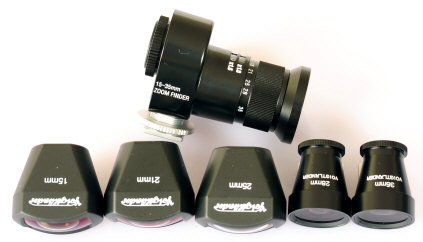
An alternative is the type B Voigtlander 15-35 Multi Format Zoomfinder which allows setting for either the 2x crop of MFT cameras or the 1.3x crop of Leica M8 cameras and apparently costs $US529.

The zoom adjustment changes the field of view to match focal lengths from 15mm to 35mm – almost the coverage of the 3x zoom kit lens, and thus could come in handy particularly for those with an E-P1 which does not take an EVF.

It has a diopter adjustment to correct for your eyesight, and has a generous 15mm eye relief and a locking ring to ensure it doesn’t fall off your hotshoe.

It is approximately half the size of the Leica 16-28 Universal Wide Angle Finder, and perhaps further adds to the retro look of the E-P1.

It has a 3:2 field of view so it does not exactly match the 4:3 field of view, but at least it is very versatile otherwise and may save you batteries in not having to always power on the camera to compose scenes.

It can be used on any camera with a hotshoe and replaces the need for individual optical viewfinders as shown below:

viewfinders

Other alternatives include the Helios Multifinder Mk2 which is a fixed focal length optical viewfinder but with frame lines for 35mm, 85mm and 135mm – nice for the panasonic 20mm f/1.7 lens on an Olympus E-P1 but no diopter adjustment. These are cheap (Ā£30.00 from here) and may come in handy used as a walk around tool for composing scenes.


Camera lens mount flange distance and implications for compact digital cameras with intercheangable lenses – Micro Four Thirds or Samsung NX?

Written by Gary on January 10th, 2010

The Micro Four Thirds camera system has surged to 3rd in popularity of “dSLR” sales in 2009 partly because of the versatility its short sensor to lens mount flange distance offers allowing almost any lens ever made to be used.

The recently announced competing system from Samsung which is a welcome competition for us all, may have a larger sensor and marginally less noise at high ISO, and less crop factor for 35mm lenses, but it has a number of disadvantages when compared to the Micro Four Thirds format.

To understand some of these issues, let’s first look at the implications of the sensor to lens flange distance – on the Micro Four Thirds cameras, this distance is 20mm, while on the Samsung NX system, it is 25.5mm.

One of the implications is the range of legacy lenses that can be mounted.

In theory, both systems should be able to have adapters made which allow infinity focus for most legacy lenses, HOWEVER, unlike the MFT cameras, it is uncertain if a Leica M bayonet lens would achieve infinity focus on a Samsung mount as Leica M flange distance is 27.8mm, only 2.3mm more than the Samsung and maybe too thin for an adapter.Other rangefinder lens mounts such as Leica M screw mount,Ā  and Canon rangefinder, and the half-frame Olympus Pen should be possibleĀ  to make for the Samsung given they would require only 3.3mm thin adapters.

An important factor may be the difference in throat diameter – for example, the Canon EF is 8mm wider than the OM which may make a 2mm thin adapter design easier by allowing enough metal to give it strength, but more importantly, allows the narrower OM mount to fit inside the EF mount given there is no latitude to create a conical shaped adapter.

The Leica M throat is 44mm at the small end for SLRs and if the Samsung throat is 38mm, they will not be able to fit a Leica M mount inside it and thus it would appear one would not be able to fit rangefinder lenses such as a Leica M on a Samsung and still get infinity focus.

Without this capability, Samsung will struggle to gain support of photo enthusiasts who would be the early adopters, and without these early adopters and their ongoing support combined with the lack of goodwill in the SLR community, I would be surprised if Samsung make big inroads into this sector, however optimistic they may be.

A list of flange distances can be found on wikipedia and from this list you can see why you cannot use non-Nikon F mount lenses on Nikon dSLR as Nikon has one of the widest flange distance of 46.5mm, but you can mount Nikon F, Leica R, Yashica/Contax, and Olympus OM lenses on most other dSLR systems including Canon EF (44mm), Olympus Four Thirds (38.67mm).

You can also see that Sony/Minolta/Pentax lenses could also be used on Four Thirds but not on Canon EF cameras, but you need the mirror-less systems such as MFT and Samsung NX to use Canon FD/FL/R/EF lenses.

Optimal focal length for a compact pancake lens:

In order to make a pancake lens as thin as possible, the optimal focal length is close to the sensor-flange distance – this is why Olympus made its 17mm f/2.8 (34mm in 35mm camera terms) and Panasonic made its superb 20mm f/1.7 lens which is 40mm in 35mm camera terms, and presumably the reason Samsung chose 30mm f/2 pancake (48mm in 35mm terms).

For street photographers wanting a compact camera kit, a focal length of 30-40mm in 35mm terms is often the most desired focal length – obviously the 2 MFT lenses mentioned above fill this niche nicely, but the Samsung 30mm is too long – if they made a 25mm pancake which would equate with its flange distance, you could get a 40mm focal length reach in 35mm terms and still be a compact pancake lens.

They could make thin pancake lenses at focal lengths less than these, but I suspect the rear element may need to protrude into the camera or they would need to resort to a more complex lens design.

Short lens flange distances and sensor size:

As Leica have discovered, in order to make digital cameras using their 27.8mm flange distance for their Leica M lenses, increasing sensor size requires expensive specialised sensor design to ensure the light rays hitting the outer parts of the sensor are more consistent with the image characteristics of those hitting the central parts.

They appear to have finally achieved this in their Leica M9 full frame digital, but it is very expensive and does not offer live view for manual focus, nor movie capabilities.

Samsung with their NX-10 appear to have ignored this issue so it will be interesting to see how much vignetting, CA and poor image sharpness they will get in the outer areas of their images – there is always a compromise in photography – you can’t have your cake and eat it too!

Optical aberrations increase exponentially with distance from centre of the image, thus it will always be easier to make lenses with better edge-to-edge image quality on a 2x crop sensor compared to the NX 1.6x crop sensor.

Of course they could use in-camera digital corrections instead of expensive sensors but this would increase noise, and reduce image detail in the periphery.

Conclusion:

The Samsung NX is a welcome addition to the competition in the mirror-less interchangeable lens digital camera market as it will spur on further development and we should all benefit from that.

However, its design, whilst allowing similar size camera bodies to MFT, inevitably means potentially less versatility in what lenses could be adapted – in particular, they may not have access to Leica MĀ  lens users, and their AF lenses will necessarily be larger than MFT lenses and with potential for less image quality in the periphery.

The 2x crop of the MFT sensor also means that focal length reach can be achieved in a much more compact lens than with Samsung’s APS-C size 1.6x crop sensor – you could easily design a compact 200mm f/2.8 lens for MFT or Four Thirds which would give high quality 400mm f/2.8 focal length reach in a very compact, hand holdable kit (please Olympus, bring one of these out soon), but to do so on a NX camera would require a massive 250mm f/2.8 lens with its much larger image circle.

Furthermore, Samsung does not have access to a range of AF lenses as does MFT with their MFT and Four Thirds lenses, and this as well as their lack of following, will limit their success.

It may though stimulate Nikon or Canon to enter this market, although I suspect Canon has the high end in its sights with some of its new lenses offering a 40mm image circle which allow for a larger than full frame sensor.

In comparison to the Samsung NX, the Micro Four Thirds format offers a better compromise on lens size, edge-to-edge image quality, greater hand holdable telephoto reach and compatibility with legacy lenses, and at present, a much greater range of dedicated AF lenses, much better video capability with only marginally less high ISO performance.

ps.. Novoflex has just announced its adapters for Samsung NX which include Nikon F, Canon FD, Minolta MD, Leica R, Pentax K, Olympus OM, M42 and T2, but as predicted, none for Leica M or Olympus Pen.


At last, a tilt adapter for Micro Four Thirds – make almost any legacy lens into a tilt lens!

Written by Gary on January 3rd, 2010

In June last year I wrote a blog post suggesting the Micro Four Thirds system could become the ultimate tilt-shift system as its lens to sensor distance is short enough that a tilt-shift lens adapter could theoretically be made which would convert any legacy 35mm lens into a tilt shift lens, and you would get the fastest manual focus capability thanks to the mirror less live view.

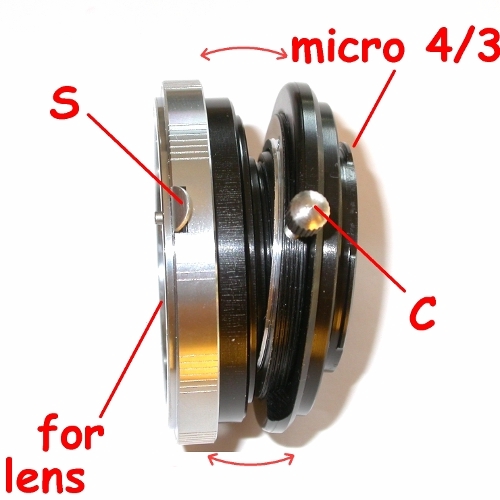
Now at last, a tilt adapter has been made available for MFT from Adriano Lolli – see here. The tilt can be rotated 360 degrees, and at zero tilt, focus at infinity is still possible.

adapter


Forget your expensive Lens Baby lenses, or the extremely expensive Canon or Nikon tilt-shift lenses, if all you need is tilt and not shift, then this relatively inexpensive adapter will convert your existing legacy lenses into tilt lenses for you, and of course, if you have Olympus MFT cameras, you also have image stabilisation to boot!

This adapter should be one very popular adapter for macrophotography and creative work – it seems at present he has versions for Nikon, Contax-Yashica, Leica R, Contarex, and Olympus OM.

It would seem the adapter is not yet available but presumably one could order one?

Perhaps he has a shift adapter on the way as well?

He has a full catalogue here (pdf) – look for item #3107 – current price in 2010 is 136Euro.

I was notified of this adapter by one of my readers who knew I was interested in such things – his source was actually the 43rumors.com website so I add this note to give credit and to remind Four Thirds users of this excellent resource.

Some rumours posted on this site suggest to me:

  • Panasonic may create a new Four Thirds dSLR with a hybrid optical/electronic viewfinder system – perhaps EVF when mirror is up, and using their fast contrast detect AF algorithms found in their MFT cameras?
  • Olympus may announce a E-P3 in 1st half of 2010 with an in-built EVF – now that would be a very nice evolution of the E-P2!
  • new Panasonic sensor coming early 2010 with better high ISO noise and dynamic range – well that’s pretty logical – they wouldn’t do a Canon with their G10 and make it worse now would they?