Time to get rid of those zoom lenses and return to fast primes

Written by Gary on January 3rd, 2010

With the surge in digital photography over the last decade, the general public have demanded zoom lenses and manufacturers like Olympus with their Four Thirds system have responded to this demand by manufacturing a range of beautiful zoom lenses as well as very good consumer zoom lenses.

Zoom lenses can be wonderful lenses to take with you when you don’t have much time to really think about your subject and move position to appropriately compose it. They make great lenses for travel and general purpose as well as for many commercial photography genres.

Despite this, zoom lenses have many problems:

  • they often have a relatively small aperture such as f/3.5-5.6 which means you will have much difficulty controlling depth of field, ability to blur the background, and force a high ISO to manage low light
  • large aperture zooms (eg. f/2.0 Olympus or f/2.8 Canon or Nikon) are large, heavy and very expensive
  • they are much bigger and heavier than for a prime of the same aperture
  • they make you lazy and in the process stop you thinking about the subject but instead distract you by making you decide which focal length you want to use instead concentrating on the subject, or moving around and actually seeing changing perspectives that can be achieved
  • if you are photographing a commonly photographed subject, using a 28-100mm zoom range tends to result in similar photos to what everyone else produces while prime lenses with large apertures allow you to create something that is more likely uniquely yours.

When I go walking, whether in the forests or in the streets, I usually only take 2 cameras and 2 lenses with me – depending on how I feel, it may be different ones each time, but nevertheless I restrict myself to 1 to 3 actual focal lengths and then look for subjects that suit these.

My favorite focal lengths in 35mm terms are:

  • 21-24mm – please Panasonic or Olympus, make a 10-12mm f/2.8 (or even better, an f/2.0) Micro Four Thirds lens – not a 14mm – we don’t need more lenses at 28mm!
  • 35-50mm f/1.4-1.8 – hence the popularity of the superb Panasonic 20mm f/1.7 MFT lens (and I do love the Leica-D 25mm f/1.4 Four Thirds lens)
  • 85-100mm f/2.0 – the Olympus 50mm f/2.0 macro is very nice but needs revamp for MFT, Canon 85mm f/1.2 is too hard to use, I would prefer an 85mm f/1.4 on Canon but have to settle with the nice f/1.8 instead.
  • 180-200mm – the Canon 135mm f/2.0L lens on my Canon 1D MIII is just a great combination, I would love Olympus to bring out a 100mm f/2.0 MFT macro lens!
  • hand holdable 400mm – the Olympus 50-200mm ZD lens is great but I wish they would make a more compact 200mm f/2.8 or even a 250mm f/3.5 prime. I wouldn’t bother with 400mm lens on a full frame Canon or Nikon – it would be too big for my liking.

Having only 2 focal lengths with you creates a beautiful simplicity which enables your brain to focus on other decisions, allow you to create more interesting photos by forcing you to see more creatively, and has the wonderful bonus that it will not cost you as much and thus the less money you spend, the less you have to work, and the more time you have to take photos!

The smaller the kit you have, the more you are likely to take it with you, and by using primes with larger apertures than zoom lenses, you get better quality images at lower ISO, shallower depth of field and more blurring of the background to make your subject pop out in your images.

In my mind, there is really only one zoom I would be bothered routinely taking with me if I had the above lenses available to me, and that is the Panasonic HD 14-140mm OIS zoom as this is optimised for HD video and will practically give as good, if not better results than any other kit lens or even my Canon 24-105mm f/4 L lens.

Obviously special niche photography will require other lenses such as:

  • tilt-shift for architecture
  • Canon 200mm f/2.8 for astrophotography
  • ultra wide angle lenses for special creative uses although these tend to be more difficult to use well
  • 24-70mm f/2.8 and 70-200mm f/2.8 for Canon/Nikon wedding/fashion photographers

This reversal in trends is partly the result of the surging popularity of Micro Four Thirds camera with their compact size and generally much simpler operation than pro dSLRs which allows one to revisit the days of the Leica where the focus was on the subject and not on the complexities of cameras.

Small, fast prime lenses really compliment Micro Four Thirds as it reduces the need to resort to high ISO and allows more shallow depth of field and ability to blur the background – all of these have been issues with smaller sensor cameras such as Four Thirds and Micro Four Thirds, but which large aperture lenses help to address.

Micro Four Thirds is bringing fun back into photography and allowing people to really see the world in a different light. It allows them to create high quality images without looking like a pro photographer with all the expectations or subject intimidation that creates.

For more thoughts on the future of photography- see Kirk Tuck’s New Year’s blog post.

Kirk also points out another great feature of the Olympus E-P2 in this post which further adds to the simplicity of portrait photography – it is the first digital camera with sufficient image quality that can shoot in square format AND display the image in real time efficiently AND allow you to shoot in B&W with a green filter for portraiture – now all he needs is a nice fast wide aperture portrait lens for MFT which has contrast detect AF.

ps. 3 days after writing this post, Andy Westlake at dpreview.com posted a blog in a similar vein – “On lenses for small cameras


Panasonic GF-1 + 20mm f/1.7 vs Canon 5D + 35mm f/1.4 lens

Written by Gary on January 3rd, 2010

Lorin Niculae has just posted some comparisons of these two kits on pbase which are worth a look and the conclusions are that the GF-1 does a very comparable image quality (at least at low ISO up to ISO 800), much better auto white balance, able to be hand held at slower shutter speeds, less optical distortion, but with a far smaller, lighter and less expensive kit.

There are some DOF, high contrast dynamic range, and high ISO image comparisons and of course the size difference which I have shown here linked from that pbase website:

GF-1 vs 5D

Suggested settings for the GF-1 were setting sharpening at -2 to reduce halos and digital look, and boosting saturation to +1.

There is a forum discussion thread regarding this comparison here from which I have taken the liberty of giving some quotes which some may find useful:

Lorin:

  • “the (Canon) 350d looks a toy compared with the gf1. The built quality of the pany is just amazing, except for the little left door which can be left open”

BruceK56:

  • “I am amazed how sharp this lens (Panasonic 14-140mm)  is even at 280mm. I know it is a relatively large lens for the GF1 but compare it to my 1D Mark lll with 24-105 and 70-200 f4 IS I would have to carry to cover the same focal lengths!”
  • “The GF1 is miles ahead of the (Panasonic) LX3 in quality from iso 200 up. Also the GF1’s iso 1600 is better than the LX3 at iso 400. As stated previously the GF1 will NEVER replace my big gear but it is a perfect compliment to it”

Neroangelo:

  • “I prefer the grain from the GF1 at 1600ISO more than the (Canon) 40d. So much so that I sold the 40d.”

Pixee:

  • “Jpeg from Pan is very good, but I have found that best results can be obtained with Raw using the new Phase One 5.1 or Bibble pro 5 . Noise Ninja included in Bibble pro 5 is very usable with GF1 raw-files. Also Lightroom 2.6 supports GF1 -raw.”
  • “border sharpness is not especially good because of automatic distortion correction of the camera”

Just another of the many comparisons coming in on the net confirming how good the Micro Four Thirds cameras are for cameras of their size.


New Year’s Day 2010 – a very overcast morning in Melbourne

Written by Gary on January 2nd, 2010

Despite having a sleep in New Year’s Day morning, it will still heavy overcast in Melbourne but ideal for a walk to stretch the legs.

I was hoping to get some shots of celebration remnants in the city streets but alas, the Melbourne street cleaners had beaten me and it was as if it was just another day albeit with rather empty streets.

As I strolled down Flinders Lane, I took the opportunity to get a couple of quick shots of Melbourne’s ever changing graffiti art in the alley ways using the Panasonic GH-1 with 14-140mm lens:

AC DC Lane
AC/DC Lane – yes the rock band AC/DC were from Melbourne.

Graffiti


Happy New Year’s Eve – some photos from Melbourne, Australia

Written by Gary on January 1st, 2010

I had arranged to take my wife to a city hotel for New Year’s Eve this year just to be different, and I chose the Sofitel Hotel on the south eastern aspect of the CBD.

I was initially given the 50th floor (top floor) but my room looked out to very nice views of the north-eastern aspect of Melbourne, but no view of the fireworks, so I had it changed for the 44th floor, looking south-west over Federation Square, the Art Centre, Southbank and to Port Phillip Bay, as well as views to the north.

Unfortunately, as I discovered, the view to the main fireworks at Docklands to the west of the CBD is obscured totally by the adjacent ANZ building.

I decided to only use my Micro Four Thirds Panasonic GH-1 camera with 14-140mm kit lens and a very small, compact tripod, leaving my heavy Canon 1D Mark III behind. The photos are essentially untouched jpegs straight from the camera and resized for the web – click on them for larger views.

New Year’s Eve day in Melbourne was hot and windy with temperatures to 38 deg C before a Summer storm blew in from the west at dusk:

storm coming in 1
Hand held. ISO 400, 1/40th sec, f/5, 32mm (64mm in 35mm terms). ND grad filter; Looking north with Mt Macedon in the distance.

and the view overlooking the Bay was even more ominous:

storm 2
Hand held. ISO 800, 1/20th sec, f/4.5, 19mm (38mm in 35mm terms). ND grad filter.

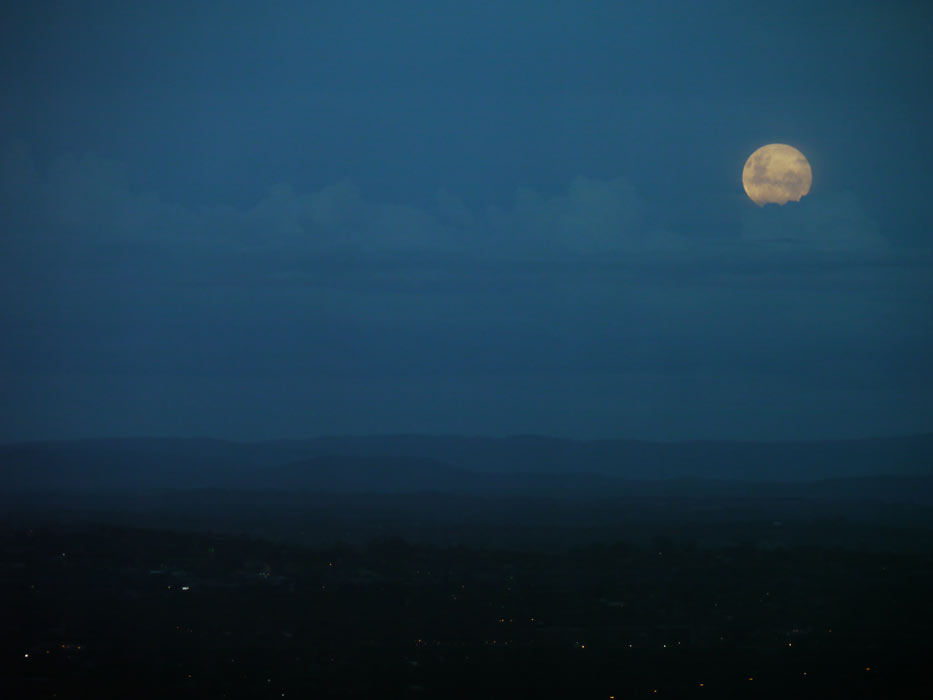
It was time to go down to the east facing Club lounge on the 35th floor for some desserts, and we were pleasantly surprised by the full moon rising before it soon disappeared behind the approaching storm clouds: This is the first Blue Moon on a New Year’s Eve since 1990.

moon rise
Hand held. ISO 800, 1/160th sec, f/5.8, 140mm (280mm in 35mm terms).

It was obvious that this storm was here to stay and the rain and wind made outdoor fireworks photography not that exciting, so we retreated to the comfort of our 44th floor apartment where the raindrops on the window were to also impact on any photographic efforts.

Nevertheless, I set up my small tripod, and set the camera to the settings as I advised in my previous post on fireworks photography – daylight white balance, manual focus, manual exposure, ISO 100, 4 secs at f/8, and managed to grab a couple of shots in between rain drops on the window:

fireworks 1

fireworks 1

Yes, that was the strong wind blowing the fireworks to the right – not great conditions for aesthetic firework photography, but at least in blew the smoke and most of the rain away from my window!

I also managed to get some nice HD video of the fireworks using the GH-1 in manual movie mode, and it seems that f/5.6, ISO 800 and 1/10th-1/40th sec, daylight white balance, manual focus was the most reasonable settings to use.

Here is a quick unedited sample of what the GH-1 will do at ISO 1600, f/5.6, 1/15th sec, 720p motion jpeg uploaded as is to YouTube:

Click here to see it as HD video on YouTube.

I would have liked to get more, and also shots of the lightning strikes (as with this one I took in Nice, France at 2am from a balcony with my Olympus C8080 during a storm), but this was New Year’s Eve and to be enjoyed.

After the midnight fireworks, the rain subsided and we went for a walk for an hour or so mingling amongst the very noisy, happy, variably wet and drunk but well behaved New Year’s Eve crowds in the city streets – but I decided rain and intoxicated people were not a great mix for the camera and thus it was left in the safety of the hotel. If only I had an Olympus E-P2 with Panasonic 20mm f/1.7 lens to take amongst the crowds at night – would have been perfect!

For those interested in staying at the Sofitel Hotel
, it was built in 1980, has 50 floors of which hotel rooms occupy the 36th to 50th floors. Luxury and Prestige rooms are corner ones which give 180 deg views.

The 35th floor has a restaurant (“No 35”), bar (“The Atrium”), the famous male urinals with a widescreen window view across to the MCG and for those whose room includes “Club Lounge” access, the Club Lounge. Car parking will cost you an extra $38/day but at least it is a no fuss friendly valet service for that price.

The Sofitel Club Lounge faces east and in addition to providing free business facilities including WiFi internet access, it is where you get your buffet breakfast (6.30am-10.30am), midday tea (noon-2pm), afternoon tea and cakes (2pm-5pm), evening drinks (wine, spirits) and very nice canapes (5.30-7.30pm) and evening sweets (chocolates, nougat, etc 8pm-10pm), all inclusive with your Club Lounge room rate – not a bad offer at all!

Check the Sofitel out on wotif.com. If you want the 50th floor though, you will need to call them directly and see what deal they can do for you as it is normally a $50-120 upgrade over the usual Prestige Suite price.

Oh, and if you are thinking of booking into a hotel for next New Year’s Eve, be aware that they may double their usual hotel room rate – I could have bought an Olympus E-P2 for the amount I paid for this room for the night – but I did have to show my wife that I loved her more than cameras – so now it will be back to work to pay the credit card off 🙁

Hope you all had a happy and safe New Year’s Eve and may 2010 be kind to you.


Photographing fireworks New Year’s Eve – Micro Four Thirds cameras are ideal choices

Written by Gary on December 31st, 2009

It’s New Year’s Eve, and in many cities that means fireworks at midnight, so here are a few tips:

Your best shots are likely to be in the first few minutes of the fireworks display BEFORE smoke ruins your photos – YOU NEED TO BE PREPARED BEFORE THEY START – or wait until next year!

Camera settings:

  • set white balance – many choose Daylight – if you shoot RAW then it does not matter so much as you can change it later.
  • manual exposure
  • ISO 100 – yep, you do not need to worry about noise at high ISO and thus a big camera is not necessarily going to help you!
  • shutter speed 2-8 secs depending on how much trailing you want – try 4 secs – if you have a dSLR and not a MFT camera, you should set it for mirror lock up to reduce blurring from the dSLR mirror.
  • aperture – try f/8 – your kit lens should do fine – the 10x zoom of the GH-1 with 14-140 lens will be perfect
  • consider using self timer 2secs to reduce camera movement from pressing the shutter
  • to take multiple exposures to image multiple bursts, set camera to BULB or 30secs, and use a black cardboard in front of lens to open it for 4secs for each fireworks burst – if you have an Olympus E-P1 or E-P2, you may wish to experiment with its multiple exposure feature instead.
  • focal length depends on your position, etc but usually 28-100mm range will be adequate – ie. most kit lenses
  • use a lens hood to minimise flare from nearby street lights hitting the front of your lens
  • consider turning off image stabiliser, it is unlikely to be helpful at 4 secs and will just eat batteries, and in some cases reduce image quality if you are using a tripod.
  • set manual focus and use live view to accurately focus on a distant building and leave it there – consider using a legacy manual focus lens so the lens focus position does not change if you turn it off.
  • turn flash off
  • remove lens filters to reduce flare

Tripod:

  • using a shutter speed of 4secs, you will need some sort of camera support
  • the larger the camera, the larger the tripod you need to keep it steady
  • thus MFT cameras can get away with a smaller tripod – less to carry
  • be aware that the sonic vibrations of fireworks may shake your tripod – some prefer a bean bag type support

Location, Location, Location!

  • you need to find a good position so that your composition will be nice, with hopefully some foreground interest such as water to reflect the fireworks, and no heads bobbing up at the bottom of your image.
  • make sure the wind is NOT blowing towards you otherwise smoke will ruin your images
  • if you are unfortunate enough to live in the Northern Hemisphere and midnight New Year’s Eve won’t be a balmy 30deg C like in Melbourne, you may need to avoid high locations if there is low level mist or cloud.

Micro Four Thirds are perfect because:

  • you only need ISO 100 – noise at high ISO is irrelevant – sensor image quality will not be an issue
  • there is no mirror so you don’t have to fuss with mirror lock up and black out for every shot
  • even a 3x zoom kit lens will be fine as you only need f/8 anyway
  • manual focus is fast because you don’t have to move a mirror out of the way
  • you can use any legacy lens on it – and your focus won’t then change when you turn the camera off and on.
  • timed shutter exposures up to 60 secs means you don’t have to resort to BULB for multiple exposures
  • Olympus E-P1/E-P2 offers a multiple exposure mode
  • nice and small – great for crowded situations, and you don’t need as big a tripod as with a heavy dSLR
  • EVF or LCD live view is much easier to focus at night than an optical viewfinder.
  • HD video if you want to use it – and on the GH-1 you can use full manual exposure with long shutter speeds of up to 0.5 sec – although 1/10th-1/40th sec at f/5.6 at ISO 800-1600 should be perfect for fireworks

The big question – will my Canon 1D Mark III stay at home??

See my wiki page for a continuously updated page on shooting fireworks with the latest technologies.


Sales of Micro Four Thirds cameras surge to 3rd place – where to now for Four Thirds?

Written by Gary on December 30th, 2009

Anyone who reads my blog will know that I am a convert to the Micro Four Thirds camera format.

The ranking of the Japanese dSLRs sales (including MFT in this category) shows that I am not the only convert, with MFT cameras surging into 3rd place, well ahead of Pentax, Sony, and Four Thirds dSLR sales.

If you sum the percentages of those in the top 20 you get (approximately):

  • Canon dSLRs 40%
  • Nikon dSLRs 24%
  • Micro Four Thirds cameras 11.5%
  • Pentax 4.3%
  • Sony 4%
  • Olympus E520 1.3%
  • not in ranking 15%

Given how hard it has been to actually buy Panasonic MFT cameras and lenses due to stock issues, and the fact that the surge really only started with the availability of the Olympus E-P1 and Panasonic GH-1 in July 2009 giving only 6 months of sales, the results really surprised me, and would suggest that this popularity of Micro Four Thirds is just the beginning and I would not be surprised to find in 2 years that MFT sales surpass Nikon dSLR sales.

Furthermore the Olympus E-P1 was voted the most popular camera of 2009 in a Japanese survey.

Olympus will need to come up with something special in their Four Thirds line early in 2010 to ensure the future of Four Thirds now that Micro Four Thirds has become so popular.

Why bother buying a cropped sensor dSLR at all when it is going to be bigger than a MFT kit of similar capability and image quality for 90% of non-professional shots such as travel, social, documentary or just sheer fun photography?

A full frame dSLR may offer pro build quality, higher resolution, higher image quality, with significantly better high ISO performance and dynamic range while allowing faster burst rates, better AF for sports, shallower DOF and the availability of tilt-shift lenses.

But the advantages of most entry level cropped sensor dSLRs over a MFT are considerably less as image quality is only marginally better if at all, while the MFT system offers many advantages over dSLRs not just size and weight but are much quieter, much faster at accurate MF,   accurate, relatively fast live view AF (within the limits of the AF system as there is no back focusing errors as with dSLRs), able to use almost any lens ever made, much more discrete which adds up to much more fun to use.

You should be aware that Micro Four Thirds does have some disadvantages though:

  • too small to allow large external flashes (eg. Olympus FL-50R) to be used comfortably
  • no remote TTL flash capability as yet
  • no radio wireless remote TTL capability as yet (you need a Canon or Nikon for this and 3rd party vendors such as PocketWizard)
  • MFT lenses cannot be used on any other camera type such as Four Thirds
  • the compact size of MFT cameras makes use of large telephoto lenses or f/2 zoom lenses more cumbersome, although they can be used
  • burst rate currently limited to 3fps while AF tracking of fast moving subjects not yet up with pro dSLRs
  • MFT lenses tend to need some optical aberration correction in post processing as the priority for compact size means optical performance is often compromised – at least Panasonic MFT cameras have this correction done in camera for you.
  • limited dedicated AF lenses available as yet – but this will change rapidly over the next 2 years.
  • movie mode like all dSLRs does not have a power zoom as do camcorders.
  • not yet fully silent – but hopefully a silent mode will come soon.
  • no real time live view output as yet.
  • dynamic range marginally less than larger sensor dSLRs
  • image noise at high ISO greater than larger sensor dSLRs
  • depth of field shallower than larger sensor dSLRs but if you use a large aperture lens (eg. f/1.4-f/2.0) then DOF is generally shallow enough for most purposes.
  • cannot adjust aperture on lenses without mechanical aperture control until someone comes up with an adapter to do that (eg. for Canon EOS or Nikon G lenses although there are hacks to change aperture).
  • thus there are compromises you must make when choosing a compact, versatile camera kit with high image quality such as MFT, but these are easily offset by having a second dSLR kit such as Olympus Four Thirds, or a full frame dSLR.

The main niche advantage for Four Thirds is in hand holdable weather-proofed telephoto reach which, due to the 2x crop factor, it can do much better than Canon, Nikon, Sony, Pentax, or Micro Four Thirds, but Olympus is yet to fully realise the potential here.

I have mentioned it time and again here, the Olympus ZD 50-200mm f/2.8-3.5 Four Thirds lens is rather unique:

  • allows hand holdable image stabilised weather-proofed 100-400mm telephoto reach at f/2.8-3.5 aperture
  • close focus to 1.2m
  • gives high quality images and autofocus capability even when combined with either a 1.4x or 2x teleconverter – the latter giving an incredible 800mm f/7 hand holdable reach.
  • beautiful bokeh for portraiture
  • in short, one of my favorite lenses to carry with me, and much lighter and cheaper than a Canon 70-200mm f/2.8 IS, and better than a Canon 100-400mm f/4L
  • compare this with capabilities of Canon/Nikon here.

Olympus does have some beautiful Four Thirds telephoto lenses such as ZD 150mm f/2.0 (= 300mm f/2.0), ZD 300mm f/2.8 (=600mm f/2.8), and the awesome 90-250mm f/2.8 (= 180-500mm f/2.8). Unfortunately, these are generally large, very expensive, although lighter and less expensive than equivalents in the Canon or Nikon world if they exist.

Olympus needs something to compliment the Micro Four Thirds system but which will also make the most of the weatherproofing and sports AF capabilities of their forth-coming Olympus E-5, but will be affordable to make it worth while for MFT users to give up their heavy, expensive Canon/Nikon dSLRs.

This means the lenses would need to be relatively compact, light, high image quality, weather-proofed and compatible with contrast-detect AF (to enable AF on all MFT cameras) as well as having fast USM AF for the Four Thirds cameras as well as AF range limiters to improve AF performance.

I for one would love to see the following prime lenses added to the Four Thirds arsenal:

  • revamped 50mm f/2.0 macro
  • 100mm f/2.8 macro
  • 200mm f/2.8  but more compact and lighter than the ZD 50-200mm
  • 250mm f/3.5
  • 300mm f/4
  • 400mm f/4 or f/4.5 (yes, a hand holdable lens with 800mm telephoto reach at f/4)

The wide aperture and lighter lenses would easily negate the 1-2 stop high ISO noise disadvantage with full frame dSLRs, and if the E-5 had a nice fast burst rate and great AF for capturing birds in flight, etc, I know which system I would prefer to go walking with and it wouldn’t be a Canon or Nikon!

Who really enjoys carrying around a 7kg+ kit of Canon dSLR + 600mm f/4 IS L lens when they could achieve the same thing in less than 3kg with an Olympus Four Thirds kit at a much more affordable kit and a have lighter, more compact tripod to carry as well?

Not to mention that you are going to get to more photo opportunities with a hand holdable 3kg kit than a big tripod-requiring 7kg kit!

One more thought for Mr Olympus though – perhaps its time to make all new Four Thirds lenses and cameras with the extra lens mount pin couplings so that they will allow faster contrast detect AF and improved compatibility with MFT, but still be backwardly compatible with older cameras and lenses.


Micro Four Thirds and ability to blur the background

Written by Gary on December 28th, 2009

One of the common misconceptions is that you need a large sensor to blur the background, and the 2x crop factor of the Four Thirds and Micro Four Thirds cameras makes it harder to blur the background.

It is true that the 2x crop sensor means depth of field for the same subject magnification will be deeper for the same aperture, thus the depth of field at the same subject magnification using a 25mm f/1.4 lens will be similar to using a 50mm f/2.8 lens on a 35mm full frame camera.

HOWEVER, the mathematics of background blurring is DIFFERENT to the mathematics of depth of field.

Let’s have a look at this visually.

I have set up a little Christmas themed scene and aimed to keep the subject the same size in each image (the large one is ~8″ tall, while the middle one on which focus is set is ~5″ tall) and see what happens to the blurring of the background Christmas tree ornaments.

The Panasonic GH-1 makes this a little easier as you can use a native 3:2 image aspect ratio, the same as on my Canon 1D Mark III which has a larger sensor (1.3x crop factor compared with 2x for the GH-1).

Let’s have a look at what the Canon 1D Mark III can do with an Olympus OM 35mm f/2.8 lens at f/2.8 giving an effective focal length of 46mm and similar DOF to 46mm f/3.6 on a 35mm camera:

1DMIII 35mm f/2.8

Now for the same effective focal length on a Panasonic GH-1, firstly, an Olympus OM 24mm f/2.8 lens at f/2.8:

GH1 24mm f/2.8

Not bad, the background blurring is almost as good as in the Canon image (note also the different colour rendering even though using AWB and default picture modes).

But let’s see what we can achieve on the GH-1 with a Leica-D 25mm f/1.4 lens which in DOF terms should be similar to a 50mm f/2.8 lens on a 35mm full frame camera:

GH1 leicaD 25mm f/1.4

Wow, beautifully smooth bokeh, and much smoother than one would expect from the DOF equivalences alone.

And for comparison, the GH-1 with OM 35mm lens at f/2.8 (equiv. to 70mm focal length in 35mm film terms), with camera moved further away to maintain same subject magnification:

GH1 OM 35mm f/2.8

Other than the change in perspective (ie. less background visible) compared with the Canon image at the top of this post, the background blurring is very similar.

This is why so many people are loving the Panasonic 20mm f/1.7 lens – it is sharp, very compact, much cheaper than the Leica 25mm, perfect for social events and candid photography, gives a fast aperture for low light work and to top it off, allows nice background blurring at f/1.7 – better than a Canon 24-105mm f/4L lens and similar to, if not better than the Canon 24-70mm f/2.8L lens and the f/1.7 aperture nullifies any high ISO advantage of the larger format cameras when they are using f/2.8 or f/4 lenses.

Of course, Canon 1D users can resort to 35mm f/1.4 lenses, and Canon / Nikon full frame users can resort to a 50mm f/1.2 or f/1.4 lens to give even more background blurring at this effective focal length, but the result is a much bigger, heavier, more intimidating, less discrete and more expensive system.


Micro Four Thirds 6 months on – which camera – Panasonic GH-1 or GF-1, or Olympus E-P1 or E-P2?

Written by Gary on December 27th, 2009

I have previously compared the Canon G11 with Olympus E-P1 here.

In June 2009, I decided to buy the Panasonic GH-1 to compliment my Olympus E510+ZD50-200mm lens, and my Canon 1D Mark III system. I chose the GH-1 because it added high quality HD video with full autofocus (the only dSLR-like camera that will do this) and it had a great electronic viewfinder (better than the optical viewfinder of the Olympus E510), the unique 10x high quality kit lens optimised for HD video, and the flip out LCD screen.

The Micro Four Thirds Panasonic GH-1 is a brilliant camera, and the ONLY digital camera with interchangeable lenses that does full AF during HD video. My GH-1 was one of the first available in Australia, and despite firmware updates it does have a few issues – see here (I would recommend extending Panasonic’s 1 year warranty to 3 years because it gives the feeling that one will need it – unlike my Olympus gear so far).

Having said that, the GH-1 has become my main carry around camera kit for taking into the city, to conferences, to social events, on travel, and to work, but one does need an extra lens or two to compliment its 10x kit lens – I would recommend the Panasonic 20mm f/1.7 lens (although I use the much bigger, more expensive Panasonic Leica-D 25mm f/1.4 Four Thirds lens as that was the only one available when I needed it), and perhaps a manual focus 100mm or 135mm f/2.8 prime lens (I use Olympus OM as they are beautifully compact and you can change the aperture). Some may add a 50mm f/1.8 lens as well for portraits, or if they have the money, the MFT Panasonic Leica 45mm f/2.8 macro lens. The forth-coming Olympus MFT 9-18mm lens is likely to be another nice lens to add to your collection.

BUT, many do not wish to go for the SLR-like styling, cost, and marginally larger size of the GH-1, and HD video is not so important to them, so I thought it is time to offer a comparison of features between the models.

Firstly, a few things they have in common:

  • no mirror thus smaller and quieter than dSLRs and able to take almost any lens ever made, and no image blurring from mirror vibrations while accurate manual focus anywhere in the frame is much faster.
  • 12 megapixel Four Thirds sensor
  • 3fps burst rate
  • accurate contrast detect autofocus – no need to worry about back focus errors as with dSLRs
  • full time live preview with easy manual focus magnification (no need to drop mirror down, etc)
  • able to change aperture of Four Thirds lenses, and in some cases also autofocus Four Thirds lenses
  • use SD/SDHC memory cards
  • hot shoe for external flash and TTL compatible with Four Thirds flashes (and can even use Canon off-camera TTL cord)
  • no remote TTL available?
  • +/- 3EV exposure compensation
  • HDMI out for playback on TVs but not live output
  • in general, easier to use than dSLRs
Olympus E-P2 Panasonic GF-1
Panasonic GH-1
dimensions 121mm (W) x 70mm (H) x 36mm (D) (excluding lens) 119 x 71 x 36.3 mm
124 x 90 x 45 mm
weight with battery 355g 315g 385g
sensor size 18.00 x 13.50 mm, 2.43 cm² same as E-P2 over-sized to allow for uncropped 16:9 and 3:2 image aspect ratios
in-built flash No Yes 6.5m range Yes 10m range but shadow with kit lens at 14mm
flash sync 1/180th ? can manually force increase for non-TTL external flashes

FP TTL with FL50R and FL36R

No built-in flash.

Manual flash output settings.

TTL flash even with legacy lenses.

sync 1/160th – no ability to force higher sync

no manual flash output setting

built in small flash

no TTL flash with legacy lenses

other flash issues see here

sync 1/160th – no ability to force higher sync

no manual flash output setting

built-in flash

no TTL flash with legacy lenses

ISO 100-6400 100-3200 100-3200
image stabilisation in-camera – works on ALL lenses but not during video optical in some lenses works during video optical in some lenses works during video
movie video modes 1280 x 720 (30 fps), 640 x 480 (30 fps)

EVF port functions as external mic port as well

Must place mode dial in movie mode then start/stop movie using shutter button. No dedicated movie start/stop button.

Image stabiliser does not work other than by changing ISO.

Can use ART filters.

1280 x 720 x 30fps (AVCHD, Motion JPEG)

848 x 480, 640 x 480, 320 x 240 (Motion JPEG)

Optical image stabiliser in lens works.

Can use film modes.

Dedicated movie start/stop button.

1920×1080 AHCHD

1280×720 at 50/60fps AVCHD or motion jpeg

smaller sizes motion jpeg

stereo mic + ext. mic port

Dedicated movie start/stop button – works in any camera mode, but must set mode dial to Custom Movie for manual movie mode.

Optical image stabiliser in lens works.

Can use film modes.

LCD 230,000 dots fixed; Better in sunlight than GF-1; 460,000 dots fixed; Better low light performance than E-P2; 460,000 dots swivel
viewfinder very high quality clip-on tiltable EVF included

optional optical fixed focal length for 17mm lens

optional lower quality EVF which attaches to the hotshoe integrated very high quality EVF
lens kit lenses – 14-42mm f/3.5-5.6 and 17mm f/2.8 pancake 20mm f/1.7 – THE MFT lens to get! the unique HD video optimised 14-140mm lens – heavy and expensive but the only lens with continuous AF in HD video
AF issues slower AF but works with nearly all Four Thirds lenses and AF speed with 20mm f/1.7 is similar to that on GF-1.

select AF mode via rear button

Can use MF to fine tune AF – just set AF mode to S-AF+MF and after setting AF via half-press shutter (keep it half-pressed though), use other hand to turn lens MF ring.

Can use AFL in one touch to set AF in MF mode (use MF mode 3) – a favourite setting of mine!

faster AF but no AF on most Four Thirds lenses unless they are contrast-detect AF capable

Moving magnified MF area around on the screen is more cumbersome than on the E-P2, but you do get smaller AF area rather than just the 11 larger AF frames as on the E-P2.

AF assist lamp (not on E-P2 and must use flash on GH-1).

faster AF but no AF on most Four Thirds lenses unless they are contrast-detect AF capable

select AF-C, AF-S or MF via lever on top left. Cannot use MF to easily fine tune AF, must move lever to MF to use MF.

select AF mode via button on rear.

Must move lever to AF then half-press shutter or use AFL button to set AF.

Auto modes iAuto – camera automatically selects either Portrait, Landscape, Night Scene, Sport or Macro mode.

Art – use digital art filters such as soft, pinhole, grainy film, pop art, diorama, cross-processing, etc

SCN – you select a Scene mode

Movie – you can use P, A, M +/- art

P, A, S, M exposure modes

iAuto – camera automatically detects scene mode to use.

Scene modes – night, macro, sports, scenery, portrait, color.

SCN – other Scene modes – sunset, party, baby1/2, pet.

Custom Movie – allows manual exposure, even shutter speeds as slow as 0.5 sec!

CUST – option of 3 custom settings

P, A, S, M exposure modes

Sequential shooting/self timer Select option via button on rear

In addition, you can set an Anti-shock setting from 1/8th to 30sec to delay shutter release from shutter press in any mode not just self-timer shooting – useful for micro and astro work.

Select option via lever at top right
Fn button can be set to either: Toggle Face Detection;

Preview;

Custom WB One Touch;

AF Home position;

MF <=> AF

JPEG <=> JPEG+RAW

Test photo

My Mode

Backlit LCD

Aspect ratio;

Jpeg quality;

Metering mode;

i.Exposure on/off;

Guideline grid;

Rec Area;

Remaining time/shots display;

Exposure compensation via rear control wheel while the upper sub-wheel controls either Program shift, aperture or shutter speed depending on auto mode.

LCD shows exposure selected without having to press a Preview button as on the GF-1.

A multiview display can compare visual effect of 4 different  exposure compensation settings by pressing INFO button repeatedly.

Flash exp. compensation +/- 3EV.

AE or flash bracketing 3 frames up to +/- 1EV

via front control wheel (press in to toggle in and out of exposure compensation mode)

Flash exp. compensation +/- 2EV.

AE bracketing 3,5 or 7 steps by either 1/3rd or 2/3rd EV.

Picture modes i-Enhance, vivid, natural, muted, portrait, monotone (can select neutral, sepia, blue, purple, or green toning), custom.

Can select B&W filter from neutral, Y,O,R, or G.

Film modes – as for GH-1? Film modes – Standard, Dynamic, Nature, Smooth, Nostalgic, Vibrant, Standard B&W, Dynamic B&W, Smooth B&W, 2 My Film settings, MultiFilm.

Unfortunately, cannot select a filter for B&W modes, and cannot apply a monotone toning.

Other features may need post-processing to correct optical distortions (eg. some purple fringing, etc when using the 20mm f/1.7 lens)cropped 16:9, and 3:2 image aspect ratios

MF magnification automatically appears on moving MF ring on MFT and FT lenses.

One button press to enter MF magnified view mode. Press OK to return. If you are in another liveview mode than the magnifying mode, then you have to press the info button in order to circle between the different liveview screens, untill you get the magnifying green rectangle.

Highlight based spot, Shadow based spot metering

Camera leveling indicator

Multiple exposure capability

Arguably, nicer jpeg colours out of the camera. Better blue skies  and green foliage than the GF-1 but need to reduce default NR to get similar details.

Twin dials with less stiffness offer better ergonomics than GF-1.

in-camera optical aberration correction

cropped 16:9, and 3:2 image aspect ratios

MF magnification automatically appears on moving MF ring on MFT and FT lenses.

One button press to enter MF magnified view mode. Half-press shutter button to return.

ISO value is ~1/3rd less than actual (ie. at ISO 100 it should be ISO 125)

in-camera optical aberration correction for Panasonic lenses.

uncropped 16:9, and 3:2 image aspect ratios

MF magnification automatically appears on moving MF ring on MFT and FT lenses.

One button press to enter MF magnified view mode. Half-press shutter button to return.

Automatic switching between LCD and EVF when place eye on EVF.

Shutter speed and aperture live preview simulation.

Better images at high ISO (see dpreview here) than GF1, EP1, E620 but more banding although Nik Dfine does a great job fixing this banding.

ISO value is ~1/3rd less than actual (ie. at ISO 100 it should be ISO 125)

Some models have problems with loose strap lugs which then may fall out unexpectedly – if you have loose lugs – perhaps send it back for repair under warranty.

None of these are perfect cameras, and they each have their pros and cons, but best of all, each of them are great fun cameras you can take almost anywhere, and use almost any lens ever made on them via adapters.

The general consensus seems to be that the Olympus E-P2 is the better camera when compared to the Panasonic GF-1 as you can manage the slower AF, while the better out of camera jpegs, the in-body IS, the art filters, the much better optional EVF, better LCD in sunlight, much, much better control of external flashes and the ability to AF on nearly any Four Thirds lens (albeit slowly) generally outweigh any advantages of the GF-1 – unfortunately you can’t buy the E-P2 with the Panasonic 20mm f/1.7 lens as a kit – you have to get that lens separately or as a kit with a GF-1. However, with the price reduction, if you don’t need an EVF, then the Olympus E-P1 is much better value for money than the E-P2.

If you primarily want a camera to use legacy manual focus lenses or Art filters, then the Olympus E-P2 or E-P1 would be the ones to go for as they have the in-built image stabiliser and TTL flash will work even for the legacy lenses.

If you want the highest resolution HD video and full autofocus in movie mode, then the GH-1 is the way to go.

If you really want fast AF and don’t need AF on non-contrast-detect-AF Four Thirds lenses, nor built-in IS, and not the video or EVF or flipout screen of the GH-1, nor TTL flash for legacy lenses, then the GF-1 with 20mm f/1.7 may be the way to go.

Which ever MFT camera you get, I would highly recommend you also getting the Panasonic 20mm f/1.7 lens.


I’m in love with my car, and my Panasonic GH-1

Written by Gary on December 12th, 2009

I decided to go for a drive on my own today… at my own pace this time.

I drove through the back roads of Victoria’s ruggedly beautiful volcanic plains which were once host to the 1850’s gold rush in Australia.

There are few things more peaceful than listening to classical music as one leisurely drives through isolated rural pastures with rolling hills and barely a sole to be seen.

I can drive for hours and I could not feel more relaxed even lying on a beach on the French Riviera.

But perhaps best of all is having my Panasonic GH-1 with 14-140mm lens and my Olympus E-510 with ZD 50-200mm lens sitting on the seat next to me, just begging me to stop the car and stretch my legs a bit to try to capture those wonderful feelings where one is alone, yet does not feel lonely – sheer bliss of getting away from the stresses of the world – and the madness of Christmas shopping!

The day was far from a perfect day for a photographer, but I have learnt to try to make the most of whatever nature throws me.

It is early Summer and the hay fields have been cut. This depression was once a thermal lake created by the surrounding volcanoes and was once home to palm trees, crocodiles and gold-bearing rivers. The gold has since been mined in deep leads, and the climate has changed, while the volcanic activity has ceased some 10-30,000 years ago.

hay field

And I keep driving never knowing what will be around the next bend as the sunlight plays across the fields:

the long and winding road

Perhaps there will be an old gold mining relic such as this one:

gold mine

Or just another nice vista:

vista

Whatever, it is, photography has taught me to search for the beauty in all things and to see the world in a different light. Does it really matter if others like my work or not? Of course not, but what matters is that I lived for that moment in time.

The Olympus E510 with ZD 50-200mm lens comes in handy for when I need a bit more zoom (400mm in 35mm terms) as I avoid trespassing on private property, yet many subjects of interest are some distance from the road. It also comes in handy when I need more shallow depth of field.

I would like Olympus to make a more compact Four Thirds ZD 200mm f/2.8 or 250mm f/4 lens with contrast detect AF compatibility with Micro Four Thirds but much cheaper than their 150mm f/2.0 lens.

Here’s another photographer’s blog (Craig Mod) on how much he loved the Panasonic GF-1 and 20mm f/1.7 lens for hiking the Himalayas, leaving his Nikon gear at home.


3500km Oz road trip in 5 days – a day of rest at Robe’s Annual Fair then the trip home

Written by Gary on November 30th, 2009

Someone had forgotten to tell us it was Friday night and this was Robe’s Annual Village Fair weekend with live bands outdoors Friday night and all Saturday, and hosted by a number of local wineries.

Not surprising then that accommodation at short notice was hard to find, here are the main motels worth trying:

  • Robetown Motor Inn – a modern looking motel on the main road as you enter the town
  • Robe Harbour View Motel – boasts views of both harbour and the bay while being close to shops
  • Robe Haven Motel – older motel in quiet area but close to shops and has quite large rooms – this is where we ended up and it served our needs very well so we stayed the second night

The weather was still very bleak on Saturday with storms, wind and torrential rains still persisting:

Robe surf

We decided that we would stay an extra night in Robe and take it easy, that way we were guaranteed on a Saturday night bed, we were able to have a break from driving as well as sample some of the local wines, and we were able to wait for the storms to pass, and get to catch up on some local culture and some rock bands – any more excuses why we should stay? 🙂

After a nice brunch at the Wild Mulberry Cafe, we took a short drive to Beachport then Canunda National Park where I hoped to see the massive shifting sand dunes but it seems one needed to get down and dirty and do some real 4WD work over sand dunes to get to see these, so instead we opted for a short walk to the beach between showers – big mistake – I have never had such a swarm of bush flies around me as on that little walk (we don’t usually have a problem with bush flies in Victoria until mid-November when the first hot winds drive them down from the NSW cattle farms):

bush flies Canunda

We decided that was enough driving so headed back to the motel in Robe and walked down to the Fair to watch the bands from the safety of the marquee:

Robe Fair rain

Did I mention it was raining??

Luckily we were able watch the band from a vantage point within the marquee which just so happened to be close to the stand for Cape Jaffa Wines – I thought I had better sample a few glasses of their Sav Blanc on our “day of rest”.

Low Rider rock band:


Low Rider rock band

And, we stayed for the night to watch Sth Australian band, The Screaming Jets, belt out their high energy rock, and they played a bit of AC DC and Steppenwolf:

Screaming Jets

The Panasonic GH-1 Micro Four Thirds camera was fantastic at the Fair (if you kept it dry!) – the HD videos were great – the only problem – the very loud bass from the band was too much for the camera’s sound recording algorithms and unfortunately, I didn’t bring my Zoom H4N digital sound recorder to allow dubbing onto the videos.

Sunday was time to head home to Melbourne another 700km or so trip – but an easy one.

A word of warning – very few shops or petrol stations are open Sunday morning in rural areas so you better be prepared – we had to wait until Hamilton in Victoria to find a decent petrol station and cafe for brunch.

But they were not all like this:

petrol station

More photos and maps of trip can be found here.