Perhaps Nikon is worried that Micro Four Thirds is becoming the iPOD of the photography world

Written by Gary on October 29th, 2009

If rumors of new patents by Nikon are true, it would seem that Nikon is rushing to get a competitor system out to try and be even smaller than the Micro Four Thirds camera system which has been taking the photographic world by storm.

The rumours suggest that Nikon may be working on Micro Four Thirds like camera system but with an even smaller sensor – 17mm diameter compared with MFT’s 21mm diameter, which would give it an effective 2.5x crop factor compared to a full frame 35mm sensor (MFT is 2x crop factor).

It would also seem that they are aiming this at the camcorder marketplace by apparently incorporating a lens zoom rocker on the camera just like on point and shoots and camcorders but which is not yet available on MFT or larger dSLR cameras.

The rumours suggest Nikon is initially looking at the following lenses in 35mm terms:

  • 35mm f/2.8
  • 45mm f/1.4
  • 22-105mm f/2.8-5.6
  • 26-270mm f/2.8-5.9
  • 75-270mm f/4.0-5.6

Such a camera could theoretically use almost any lenses ever made in manual focus, including Micro Four Thirds and Four Thirds, and presumably, Nikon would make a fully compatible adapter for their F mount full frame and DX lenses – although these would almost certainly not AF during video nor would they be able to zoom using the camera rocker switch. Furthermore, the 2.5x crop factor makes them much less usable unless you are shooting super telephoto.

These rumours are only for patents, and thus Nikon would still have a long way to go in actually producing a marketable product (perhaps late 2010 or 2011), and given their lack lustre and rather under-whelming performance in producing point and shoot cameras to date, and their very average movie mode functionality in their new dSLRs, they have much to do to make a competitive product, and even then, the smaller sensor will mean more noise at high ISO, less dynamic range and more DOF than even that of the MFT cameras.

Personally, I think they have left their run a bit too late, and the smaller sensor will give lower quality, still not be truly pocketable and perhaps too small for larger hands, so the system would mainly be of interest to those with Nikon gear wanting a smaller 2nd camera which is compatible with their lenses and flashes, and to those point and shoot photographers wanting something a bit better than what they have but smaller than MFT.

The 2x crop factor of FT and MFT seems to me to be a perfect compromise on image quality and size. I think anything bigger or smaller adversely impacts either factor.

The 2x crop sensor of the Four Thirds and Micro Four Thirds sensor makes it tough getting your portraits to pop out from the background, and you must resort to using the 50mm f/2 macro or 50-200mm f/2.8-3.5 lens to achieve this. A 2.5x crop sensor camera will have an even harder time creating nice portraits, and none of the lenses listed above would be adequate as it would require a native focal length of 40-50mm f/1.4 (note the 40mm f/1.4 listed above is in 35mm terms, it’s actual focal length is 18.4mm, and in 35mm DOF terms these would equate to a 40mm f/3.5 lens – great for street photography but not for portraits).

Interesting times indeed, and competition is nearly always good for the consumer.
 

3 new Panasonic Micro Four Thirds lenses coming

Written by Gary on October 25th, 2009

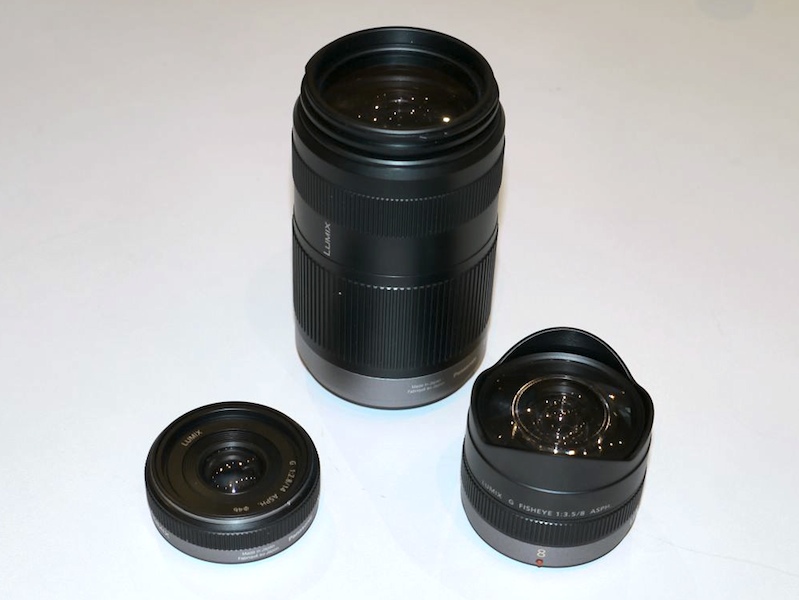
From a Japanese website, we have photos of the 3 announced Panasonic Micro Four Thirds lenses on their way for 2010:

Panasonic Lumix 8mm f/3.5 fisheye

Panasonic Lumix 14mm f/2.8 – I would have preferred an 11 or 12mm instead.

Panasonic Lumix 100-300mm f/4-5.6 OIS (that’s a very compact 200-600mm telephoto reach in 35mm terms!)

see the website here.

lenses


Micro Four Thirds does infrared photography and video hand held – what a wonderful surprise!

Written by Gary on October 25th, 2009

I love infrared photography. In the middle of the day when the light is not conducive to good landscape shots, you can always resort to infrared photography.

The problem with modern digital cameras is that with each new generation, the infrared blocking filter has been becoming stronger making IR exposures with an infrared filter such as a Hoya R72, longer and longer such that exposures of 10-25 secs in bright sunlight are not uncommon.

Up until now, I tend to use my Canon 1D Mark III with Olympus OM wide angle lenses on a tripod. You have to take the filter off, compose, manually focus the lens, then adjust the focus to the red marker on the lens to account for infrared wavelengths, reapply the IR filter (now you can’t see anything in the viewfinder or in live view), then guess the exposure manually.

OK, so that was not so much fun, especially carrying around your tripod, setting it up then deciding you didn’t like it anyway.

BUT, now there is Micro Four Thirds to the rescue, the EVF on the Panasonic GH-1 displays the IR image beautifully so, not only can you compose with the Hoya R72 filter on a Leica-D 25mm f/1.4 lens, but it will accurately autofocus it quickly (except in darker shadow areas), and in bright sunlight, you can do a carefully hand held shot at ISO 800, f/1.4, 1/15sec, and, not only this but you can bump up the ISO to 1600 and use 1/30th sec for HD video hand held – now that is cool!!

Of course, if you have your tripod, or you use an Olympus Micro Four Thirds with in-built image stabiliser, you can get away with lower ISO for still shots.

Here are a few quick ones I shot today with the GH-1 with Leica-D 25mm f/1.4 (with a 58mm Hoya R72 filter via a 62-58mm step down) – not the most exciting, but shows what is possible even on cloudy days (it was cold, windy and very cloudy today, so sorry I don’t have much full sunlight shots to show):

First, an optimistic hand held shot in cloudy lighting at ISO 800, 1/10th sec – a bit of camera blur, but you get the idea, and it shows a nice Wood’s effect (B&W film mode jpeg):

cloudy hand held 1/10th sec

Next, another cloudy day shot, this time the camera was partly supported on a wire fence at ISO 1600, f/1.4, 1/10th sec (Custom WB jpeg converted to monochrome in PS):

cloudy on a wire fence

Lastly, the sun came out briefly for a part sun shot, camera rested on a fence post, ISO 100, f/1.4, 1sec exposure (Custom WB jpeg converted to monochrome in PS):


ISO 100, sun

More information on infrared photography here.

More of my digital infrared photos here.

Now, if Olympus can bring out an image stabilised MFT camera with a nice EVF, then hand held infrared photography will be even easier.

I have just checked and the exposure for IR is practically the same on the Olympus E510 as on the Panasonic GH-1, so what I am really seeing is the benefit of the superb f/1.4 aperture of the Leica-D 25mm lens. The advantage of the E510 is that it is image stabilised but the advantage of the GH-1 is not only its video capability but the EVF allows full time composition and ability to quickly AF rather than rely on the cumbersome MF assist live view of the E510.


What a great macro shot – the Olympus E-P1 with kit lens!!

Written by Gary on October 24th, 2009

I found this great macrophotography shot on the dpreview.com Micro Four Thirds forums and just had to show it here to show how good the Micro Four Thirds cameras are – and this was with a kit lens, not the superb panasonic 20mm f/1.7 or the 45mm f/2.8 macro lens.

Enjoy.

Echodyne's pic

See his flickr photostream here.

Oh, and while I am at it, here is another E-P1 with kit lens shot from another photographer – Walter A23:

Walters


The medium format dSLR arena gets new entry level cameras which may persuade many to use them instead of 35mm full frame dSLRs

Written by Gary on October 22nd, 2009

From my previous posts, I have suggested that one needs several types of cameras (see here and here ):

  • a point and shoot ultra compact for social events
  • a compact, high image quality digital for to take with you almost everywhere – such as the Micro Four Thirds or perhaps Canon G11
  • a relatively small wide aperture super telephoto zoom kit such as Four Thirds dSLR with Olympus ZD 50-200mm f/2.8-3.5
  • a large sensor, big camera for use on a tripod for when you want the highest quality images

In the last category, we have an increasing number of 35mm dSLR options such as Canon 5DMII, Canon 1D Mark III/IV, Canon 1Ds Mark III, Nikon D700, Nikon D3, Nikon D3x, Nikon D3s, and Sony a700.

BUT, now that medium format dSLR prices are coming down, perhaps a medium format dSLR may start playing a much bigger role with its double size sensor, even shallower depth of field options, 16 bit files instead of 14 bit, 12 stop dynamic range and lower spatial resolution on the sensor allowing use of legacy lenses.

Let’s face it, if you are going to carry a big camera, big lens and big tripod for your best image quality, and you don’t need 5fps burst rate, then you may as well be carrying a marginally bigger camera with even more potential for improved image quality.

Leica has earlier announced its S3 system but like Hasselblad and Phase One, and the like, these will be expensive and out of reach for most photographers.

However, Mamiya has just announced their DM22 dSLR, a 22 megapixel camera with 16 bit double size sensor (from 35mm – 48mmx36mm) with an 80mm lens that has ISO 25-400 at a RRP of $US9995 – sure it is just under double the price of the new Canon 1D Mark IV or Nikon D3s, but then it will allow you to use legacy Mamiya 645 MF and Hasselblad V series lenses via an adapter, and it should offer better image quality at low ISO.

Mamiya DM22

This is potentially a great alternative for those who have these legacy medium format lenses, and don’t have expensive pro 35mm lenses, don’t need sports/action or low light capability but want high image quality at a reasonable price.

Another new alternative which is perhaps more modular and thus more upgradable, is the new Leaf Aptus II 5 digital back at €5,995, which can be combined with a Phase One 645AF camera body and 80mm lens for a total RRP of €7,995. This back is also 22mp, 16bit, ISO 25-400 but with a touch screen LCDand option to upgrade to other Leaf Aptus II backs such as the 56mp 56x36mm Aptus II 10 back.

These Leaf Aptus II digital backs can be used on many medium format cameras including Mamiya 645AFD, Mamiya RZ67/RB67, most Hasselblad H and V series, Contax 645, Fuji GX680 II/III, Bronica SQA/Ai/ETRS as well as many view cameras such as Alpa, Arca, Cambo, Horseman, Linhof, Sinar, Toyo, Rollei X-Act2 and others via Leaf Graflok or third-party adapters.


Panasonic Leica-D Micro Four Thirds 45mm f/2.8 OIS macro lens

Written by Gary on October 22nd, 2009

Dpreview.com has posted a review of this superb and compact 1:1 macro lens for Micro Four Thirds cameras – see here for the details.

The review confirms that this expensive lens has superb optics and currently provides the only autofocus option for macro on MFT cameras, as well as being a reasonable portrait lens.

Despite it being a superb lens, its price and f/2.8 instead of f/2.0 aperture means it will not be as well accepted other than by those who can easily afford it.

It is great that it is compact, has superb optics, has an optical image stabiliser (but does not give any benefit in macro work), has focal distance range limiter for improved AF performance, 1:1 macro (that is it can shoot a subject the same size as the sensor which is 1/4 the area of a subject that a 35mm camera with 1:1 macro can shoot).

BUT, where it is NOT going to meet the demands of many photographers, is as a portrait lens.

MFT desperately needs a high quality but reasonably affordable and compact portrait lens such as a lens in the focal range of 45-60mm with an aperture of at least f/2.0 but preferably even wider – not f/2.8 as with this lens.

Thus if this lens is not going to fulfill the needs of a portrait lens, its price may make it not justifiable just for macro work.

Macrophotography is usually best achieved with manual focus – just set the focus distance for the desired magnification you need then move the camera to the subject until it is in sharp focus – best done on a tripod with a macro focusing rail for high magnifications. In this scenario, the MFT photographer has the luxury of using almost any macro lens ever made, and for many, these can be purchased at a very reasonable price on Ebay – just add some extension tubes or bellows and away you go.

Thus, although Panasonic are to be congratulated for offering high quality optics for MFT cameras such as the 20mm f/1.7 and now this 45mm macro, I must agree with dpreview.com that the 45mm macro may not sell as well as they hoped because of its f/2.8 aperture.

Will Olympus jump in and upgrade their Four Thirds 50mm f/2.0 macro and allow it to AF on MFT, or will they design perhaps a new MFT lens which will meet the needs of both macro and portrait work specifically for MFT?

And, while they are at it, please revamp the macro flash system to make the controller more compact and the ring flash fit the new lenses as well as Four Thirds lenses.


Canon announces its answer to the Nikon D3S – the Canon 1D Mark IV pro dSLR

Written by Gary on October 21st, 2009

Nikon recently announced a 12mp 9fps full frame pro expensive dSLR with ISO to 102,400 and a movie mode – the Nikon D3S.

Not to be outdone, Canon has just announced its upgrade to the 10mp 10fps 1.3x crop Canon 1D Mark III – the new 16mp 10fps 1.3x crop Canon 1D Mark IV with ISO to 102,400 and movie modes and a revamped AF system.

On paper, it would seem the Canon 1D MIV is much better suited to sports photography than the Nikon D3S and has a much more versatile movie mode. The Nikon D3S being full frame will not have the same telephoto reach but will be able to use the 35mm lenses at there native focal length without cropping and thus will provide better ultra wide angle possibilities. Presumably the larger photosites in the Nikon D3S should give lower image noise at higher ISO but we will have to wait and see if this is indeed the case.

Canon 1D Mark IV specifications:

  • 16 megapixel, 1.3x crop (APS-H size) sensor
  • 10 fps burst rate with a continuous burst of up to 121 large JPEGS, or 28 RAW images using a UDMA 6 card
  • ISO 100-12,800 with boost from 50 to 102,400
  • new 45-point Auto Focus (AF) system with 39 f/2.8 sensitive cross-type points and newly-evolved AI Servo II AF offers more precision when tracking moving objects. The user can select which AF points to use for each camera orientation.
  • the first ever integration of ALO (Auto Lighting Optimizer) in a professional EOS body, automatically correcting the contrast and brightness of images as they are recorded
  • Canon 7D movie modes including 1080p at 24,25, 30fps and 720p at 50 and 60fps with manual exposure control but no AF, recorded in H.264 MOV files BUT maximum recording is 30min and 4Gb file size
  • flash x-sync 1/300th sec with EX speedlights – unchanged from Mark III
  • 1180g – only marginally lighter than the Nikon D3S which is 1240g w/o battery
  • RRP $US4999 – $US200 cheaper than the Nikon D3S

Will I take better photos with the Mark IV instead of my 1D Mark III?

  • if I was a dedicated sports photographer, the hopefully fixed AF bugs along with higher ISO would potentially give more in-focus images and ability to stop action in low light
  • if I regularly took indoor available light action shots then the above would help get images previously not possible
  • it would be great for those pre-dawn, super telephoto shots of wild cats on African safari – but I don’t do that either
  • if I didn’t have the Panasonic GH-1, the movie modes would have been very handy
  • thus, for me, there is not much to be gained by upgrading, but for many this does represent a very handy upgrade, and looks like it will be a great camera albeit heavy, bulky and expensive
 

My Olympus Four Thirds lens wish list – what’s yours?

Written by Gary on October 17th, 2009

The main strengths of Olympus Four Thirds system are:

  • great colours in jpegs straight from the camera no need for post-processing – arguably the best out there
  • great edge-to-edge image sharpness and contrast even at f/2.0
  • superb lenses designed especially for the sensor – my favorites include the unique ZD 50-200mm f/2.8-3.5 SWD which I would never part with and which has features that are just not available on any other camera system – see my earlier blogs
  • the best telephoto reach courtesy of the 2x crop factor – who else can give you a hand holdable 100-400mm f/2.8-3.5 (the ZD 50-200mm), a 180-500mm f/2.8 lens (the 90-250mm f.2.8), or a 300mm f/2.0 (the ZD 150mm f/2.0) or a 600mm f/2.8 (the ZD 300mm f/2.8)?
  • in-built image stabiliser makes all of your lenses including legacy lenses image stabilised
  • the ability to use almost any legacy lens ever made (except Leica M or Canon – but these work on Micro Four Thirds cameras)

So here is my wish list:

  • 100mm f/2.0 macro (ie. 200mm focal length – great for nature work as well as portraits and the EC-20 will give you a compact 200mm f/4 lens with telephoto reach of 400mm – very nice indeed) – I believe this is coming very soon!
  • upgrade of the superb 50mm f/2.0 macro – needs a focus range limiter and addition of CDAF for live view and on MFT’s.
  • firmware upgrades as promised to add CDAF to the 12-60mm and 50-200mm lenses
  • compact pro fast telephoto
    • 200 mm f/2.5 (that is a compact hand holdable 400mm f/2.5 IS) for those times when the 50-200mm is just too big to carry around or is too intimidating at 200mm with the lens extended.
    • 250mm f/3.5 (that is a compact hand holdable 500mm f/3.5 IS) or a 300mm f/4 (that is a compact hand holdable 600mm f/4 IS) for when you need more reach than the 50-200mm.
      • in the 1970’s and 1980’s, wildlife photographers and even some fashion photographers bought 500mm or 600mm f/8 mirror lenses to get good telephoto reach in a compact size. NOW, with Four Thirds, a 300mm f/4 lens would give the same telephoto reach with better contrast (as there is no mirror obstruction), in much the same size and weight, with fast AF, better bokeh, ability to use filters on the end rather than drop in, and ability to stop down the aperture if needed. Please Mr Olympus, I would love one of these as the 300mm f/2.8 is just too big and expensive for me.
  • compact high quality 10mm f/2.0 or f/2.8 wide angle prime with minimal distortion for landscapes and architecture
  • an affordable, entry level 40mm f/1.4 for portraits (OK, it could be f/1.8 or f/2, but just make it at least comparable in quality and price as a Canon or Nikon 50mm f/1.8 or 1.4 lens)
  • if we didn’t have MFT, a 20mm f/1.7 for FT, but the superb Panasonic 20mm f/1.7 MFT lens mated to an Olympus E-P1 will cover that very nicely indeed.

What else would you really like and why?

Footnote:

Now, before anyone criticises my 35mm equivalences and say that a 200mm f/2.5 lens does not give the same depth of field as a 400mm f/2.5 35mm lens, of course it doesn’t but you get the same telephoto reach (ie. angle of view) at the same aperture and thus ability to use the same shutter speed and ISO, and the wider DOF is actually an advantage at super telephoto focal lengths.

So please don’t bother raising any of those silly arguments – sure they apply to a 50mm f/2 FT lens which gives similar portraiture DOF as a 100mm f/4 35mm lens but at f/2 aperture, but for super telephoto that argument is not important – what is more important is telephoto reach, hand holdability or at least portability whilst hiking, and wide aperture to allow fast shutter speeds and the in-built IS.

It is much easier to wield a 1.8-2.0kg lens chasing a bird than a 6kg lens – and much easier on your hands and back, not to mention your pocket!


Epson announces new EVF almost as good as optical viewfinders – another boost for Micro Four Thirds?

Written by Gary on October 15th, 2009

43rumors.com has posted the news of Epson’s breakthrough new EVF technology which may provide almost as good as optical viewfinder experience.

This is great news potentially for users wanting a nice EVF on their Olympus Micro Four Thirds cameras assuming Panasonic is not likely to share its class leading EVF technology as found on their GH-1 with Olympus.

Perhaps we will see this on the Olympus E-P2 when it is released – probably March 2010.

I still can’t see dSLR’s doing away with their reflex mirrors any time soon as contrast detect AF has not quite reached the speed of high end dSLR AF for sports, although this new technology may be the impetus for the creation of some interesting cameras.

For instance , perhaps Olympus may make a mirror-less thinner Four Thirds camera which will allow an adapter for use of MFT lenses, and an adapter for Four Thirds lenses. The main reason would be a more stable and ergonomic camera (than MFT bodies) without mirror vibrations and noise for longer telephoto Four Thirds lenses, but one which could use more compact MFT lenses.

I am not sure of the market demand for such a hybrid camera, but perhaps when the promised firmware upgrades to the Four Thirds ZD 12-60mm and 50-200mm SWD lenses which provide fast contrast detect AF eventuate then such a camera may have its place.

You would then have a EVF as good as if not better than the Panasonic GH-1, a thinner, shorter, lighter body than current Four Thirds bodies, and with full in-body image stabilisation and movie mode capability of the E-P1, and a stronger, bigger lens mount of the Four Thirds which will give you more confidence in mounting a giant 90-250mm f/2.8 lens.

Such an EVF may find its way into dSLRs optimised for video as using video on current dSLRs via the fixed LCD screen is not ergonomic, and can be very difficult, particular as one usually needs to manually focus them.


A photographic exhibition for those in Melbourne Nov 2009

Written by Gary on October 15th, 2009

I have posted a previous blog highlighting the creative eye of Melbourne social documentary photographer Paul Marc Joffe.

Finally we get to see his images in the big print at an exhibition in Melbourne starting on 31st October 2009 and lasts for 3 weeks – don’t miss it.

As an aside, following from my last post on the Nikon D3S, Paul is one of the many waiting for an affordable 20+mp Nikon full frame dSLR and a nice 20mm wide angle with minimal distortion – I believe most of his images were shot with a Nikon 35mm film camera and 20mm wide angle.

The following is from the flyer sent from ImageScience Gallery:

The latest featured artist on the walls of Image Science is Paul Marc Joffe. We’ve selected 5 of our favourite images from his vast body of excellent work, so check them out when you next visit our office!

Paul is a rapidly emerging talent in the documentary/art photography field here in Melbourne. He has a major exhibition opening soon at Lindberg Contemporary Art, and it’s a testament to his formidable skills that he already has full gallery representation before he’s even had his first exhibition!

Paul is one of those photographers that just ‘gets it’ and has a superb natural eye and a real photographic way of seeing things. We helped with scanning, retouching, shot selection and of course printing, and it has been a real pleasure to be involved in what seems to me to be one of the most interesting photographic exhibitions in recent years.

His pictures really need to be seen big – itty bitty web jpgs really don’t do them justice – his pictures are rich with meaning and emotion, full of details that can challenge the viewer and change your first impressions. Clever and visually arresting, you are strongly encouraged to visit the exhibition!

The massive prints on the walls will look fantastic, and he’s got some fascinating work. 5 years from now everyone will want to own a Joffe so beat the rush and get in early!

Paul Marc Joffe – Inferior Oblique

Lindberg Contemporary Art
Opening Night: Sat 31st of October, 5 to 8pm
48 Cambridge St. Collingwood

Exhibition runs 31st Oct to 21st Nov 2009
Paul’s Page on the Lindberg site
Paul’s Homepage