The new Nikon D3s dSLR

Written by Gary on October 14th, 2009

Nikon today announced their new high end dSLR, the Nikon D3S, presumably to try to compete with the new Canon 7D as a sports camera.

It is a bit of a strange beast really – it is obviously targeting the pro sports photographers with its pro build and price tag (~$US5200 body only) and 9fps burst rate (11fps in 5mp DX crop mode), double size buffer over the D3 to allow 48 RAW in burst (instead of 18 in the D3) and its ultra high ISO capability (up to ISO 12,800 in regular mode and up to an incredible ISO 102,400 in boost mode).

BUT, being a full frame, it lacks the telephoto reach of the Canon 7D, Canon 1DMIII or Nikon D300s, and no where matches the hand holdable telephoto reach of Olympus E3 (or its successor).

AND, it doesn’t compete with the Canon 5DMII in resolution terms being 12mp compared to the Canon’s 21mp or even the 17mp on the Canon 7D.

It strangely adds a movie mode with some AF capability (I wouldn’t be holding my breathe on how well this is going to work but it will be interesting to see how it pans out in tests) but in a rather crippled 720 24fps motion jpeg only capability with mono mic and external stereo mic input. Sure movie shooters will be able to shoot at much higher ISO than before and with nice shallow DOF, but I would have thought if they are into action, they would be wanting at least 720p 60fps (50fps in PAL).

A potential advantage over Canon dSLRs is that you can shoot using cropped sensor lenses (DX) but why bother when you only get 5mp other than you get 11fps burst rate??

It does finally get a sensor cleaning system at long last, and the very slow Nikon contrast detect AF has been apparently made a touch faster – not sure why a sports photographer would really care for a still slow live view AF though.

So, as we have come to expect from Nikon and Canon, another evolutionary camera which further pushes the boundaries – in this case high ISO – great for low light sports pros who don’t need telephoto reach or high resolution but nothing really revolutionary, and way too expensive for most of us who are not professional sports photographers.

I suspect pro sports photographers will find this complements their Nikon D300s nicely as the D300S will provide the added telephoto reach that the D3S misses out on, while the D3S maximises the ultra wide angle potential of the amazing Nikon 14-24mm f/2.8G lens when used for creative action photography and they can go for the D3X for resolution needs (at a price).

So I am sure it will be much loved by the pros, but the keen amateur Nikon shooters wanting an affordable 20+mp full frame are still missing out – maybe that is coming very soon as Nikon really needs to compete against the Canon 5DMII but would seem to be no where near the competition in video capability.

Feature Canon 1D Mark III Canon 7D Nikon D300S Nikon D3S
price body only $US3700 $US1700 $US1800 $US5200
sensor 10mp 1.3x crop 18mp 1.6x crop 12.3mp 1.5x crop 12.1mp full frame
burst rate 10fps 8fps 7fps 9fps (11fps in 5mp DX)
max burst RAW 30 48
pixel density 1.9 MP/cm² 5.4 MP/cm² 3.3 MP/cm² 1.4 MP/cm²
ISO normal modes 100-3200 100-6400 200-3200 200-12800
ISO boost modes 50, 6400 12800 100, 6400 100, -104200
Built-in flash No GN 12m ISO 100 GN 12m ISO 100 No
X-sync 1/250th 1/250th
contrast detect AF no and low res LCD slow slow faster than slow?
movie modes none 1080i, 720p, 24/25/30/50/60fps H.264 720p 24fps mjpeg 720p 24fps mjpeg
AF points 19 cross type 19 cross-type 15 cross-type (51 total) 15 cross-type (51 total)
Max telephoto reach hand holdable lens < 2.5kg f/4 or faster AF IS lens 400mm f/4 IS DO = 520mm reach

300mm f/4 IS = 390mm reach

400mm f/4 IS DO = 560mm reach

300mm f/4 IS = 480mm reach

300mm f/4 IS = 450mm reach 300mm f/4 IS = 300mm reach
weight w batt 1335g 860g 938g 1240g + batt

Nikon has posted image samples here – there is substantial noise at ISO 12800, much nicer at ISO 6400 but presumably this is a market-leading performance.

Finally, there is a price to pay for the ever increasing sensor sensitivity and high ISO capability – lower quality images at ISO 100 and ISO 50 not possible, making wide aperture fill flash in sunlight that much more difficult – see previous two posts.

Personally I don’t really need ISO 104,200 but I do like hand holdable compact, light 600mm telephoto reach at f/4 and the D3S will not be able to deliver this.

For hand holdable telephoto reach, you really can’t go past Olympus Four Thirds – the brilliant ZD 150mm f’2.0 mated with a EC-20 2x teleconverter gives telephoto reach of 600mm at f/4 and well under 2kg for that combo. Now we just have to wait and see what Olympus delivers in terms of a replacement for the E3. It won’t be high ISO (max. probably ISO 6400), it won’t be lots of megapixels (probably 12mp), but hopefully it will be 7-8fps at least instead of 5fps, and then throw in a new lens such as a 200mm f/2.5 or 250mm f/3.5 which would give a beautiful hand holdable 500mm f/3.5 which could be pushed further to 1000mm f/7 while retaining AF.

See dpreview.com for specs of the D3S.


Get shallower depth of field in flash-filled sunlit portraits II – high sync flash

Written by Gary on October 13th, 2009

Following on from my previous post on getting shallower depth of field for flash filled sunlit portraits by using a trick to use a higher shutter speed with a normal flash, this post is about doing the same but using a high shutter speed sync flash (HSS or Super FP as it is termed).

In the 1970’s, Olympus invented off-the-film TTL flash for their OM2, and in the 1980’s went a big step forward again when Olympus invented Super FP flash for their OM3 and OM4 film cameras that would allow the flash to operate at all shutter speeds not just up to the x-sync speed of 1/60th sec (as it was in those days and 1/160th-1/250th sec in most digital cameras now).

Since then, the other manufacturers have adopted this technology and while Olympus calls it Super FP mode, Canon calls it High Speed Sync (HSS), and for brevity I will just call it HSS here.

The main purpose of HSS is to allow outdoors flash at high shutter speeds so that you can balance with sunlit ambient light and still have a relatively wide aperture for shallow depth of field portraiture.

The good news is that it is quite simple to use and allows shutter speeds up to 1/8000th sec usually, and thus apertures of even f/1.2 depending on the strength of your ND filter.

The bad news is that you need a camera and flash that will allow this, and the maximum output of your flash in this mode decreases very rapidly as your shutter speed becomes faster – typically, the flash output halves for every 2 stops shutter speed up from the x-sync speed.

Unfortunately, Canon do not publish the maximum GN available for each shutter speed for their main flash – the 580EXII – I can’t find it anywhere in their user manual, but the following is from the Olympus FL-50 user manual:

Note that instead of using a ND8 filter for the below calculations, if your camera is capable, you can use ISO 50 and ND4 filter instead. If your camera’s ISO starts at ISO 200 then life is that much more difficult as you are not going to want to use a 4 stop ND 12 filter as you will have trouble focusing, so you will have to settle with a 1 stop higher aperture and more depth of field – sorry Nikon users.

In HSS/Super FP, maximum flash distance remains unchanged (~3.5m when using the FL50 at full zoom and using -1EV fill), and the figures below assume you want to fill flash at 1 stop under the ambient sunlight exposure as an example.

Using x-sync instead of HSS allows you to effectively gain more flash output and thus maximum distance or in reality, ability to use soft boxes with your flash, as you shorten shutter speed BUT at  a cost of an increasingly large unlit band at the bottom of the image which limits this to 1/400th sec.

Olympus FL50 at ISO100 and zoom at 85mm focal length in 35mm terms Normal X-sync
Super FP mode
GN in m at maximum output at 1/180th sec 50 30 – yep we already have taken a hit!
aperture bright sunlight at 1/180th sec f/12 (f/4.2 with ND8) f/12 (f/4.2 with ND8)
maximum flash distance in meters 5.6m 3.4m
GN in m at maximum output at 1/250th sec 50 25
aperture bright sunlight at 1/250th sec f/9.8 (f/3.5 with ND8) f/9.8 (f/3.5 with ND8)
maximum flash distance in meters 7m 3.5m
GN in m at maximum output at 1/320th sec 50 but some banding at base of frame 22
aperture bright sunlight at 1/320th sec f/8.9+ (f/3.1 with ND8) f/8.9 (f/3.1 with ND8)
maximum flash distance in meters 7.9m 3.5m
GN in m at maximum output at 1/400th sec 50 but banding at base of frame 20-30% of image 20
aperture bright sunlight at 1/400th sec f/8 (f/2.8 with ND8) f/8 (f/2.8 with ND8)
maximum flash distance in meters 8.9m 3.6m
GN in m at maximum output at 1/500th sec 50 but banding covers at least 50% of frame 18
aperture bright sunlight at 1/500th sec f/7 (f/2.5 with ND8) f/7 (f/2.5 with ND8)
maximum flash distance in meters 10m 3.7m
GN in m at maximum output at 1/1000th sec not possible 13
aperture bright sunlight at 1/1000th sec not possible f/4.9 (f/1.7 with ND8)
maximum flash distance in meters n/a 3.7m
GN in m at maximum output at 1/2000th sec not possible 8.9
aperture bright sunlight at 1/2000th sec not possible f/3.5 (f/1.2 with ND8)
maximum flash distance in meters n/a 3.6m
GN in m at maximum output at 1/4000th sec not possible 6.3
aperture bright sunlight at 1/4000th sec not possible f/2.5 (f/1.2 with ND4)
maximum flash distance in meters n/a 3.7m
GN in m at maximum output at 1/8000th sec not possible 4.4
aperture bright sunlight at 1/8000th sec not possible f/1.7 (f/1.2 with ND2)
maximum flash distance in meters n/a 3.7m

Thus, HSS or Super FP mode is great for direct flash fill of sunlit portraits, but if you are doing a wedding group in the sun, your flash GN will be much less for wider focal lengths and you generally will be more than 3.7m away, so you would be better off with using 1 or 2 Metz 45CT, 45CL or 60CT flashes (these have much higher GN at wide angles than a FL50 or 580EXii and you have to use manual mode anyway for this trick) at a slightly higher shutter speed such as 1/250th or 1/320th sec given the unlit portion at the bottom may not come into play anyway.

Likewise, if you are wanting to use your flash in a soft box or bounced, then even at maximum zoom, you may find you don’t have enough flash output in HSS / Super FP mode unless you get in close with the flash, and you may be better off using x-sync.

Lastly, the above figures are just one example. You may wish to slightly over-expose for the sun so that it becomes a kick light such as a hair light which would allow wider apertures and more flash distance, and you may want to change the amount of flash fill – less flash fill needed means more flash distance that can be possible.

Try out your camera and flash combination, and let me know how it fairs by writing a short note in the comments.

Have fun!


Get shallower depth of field for flash-filled sunlit portraits

Written by Gary on October 12th, 2009

Portraits in the harsh sun can be very trying ordeal for the photographer with a lot of issues to overcome.

One of the main issues is getting shallow depth of field so your subject will be the focus while the background is blurred.

Let’s assume we will be using an Olympus E510 with Olympus ZD 50mm f/2.0 macro lens (but almost any camera with wide open lens will do).

The main problem is the flash x-sync shutter speed.

Using the Sunny 16 rule, in bright sunlight at ISO 100 and 1/180th sec shutter, your aperture will be about f/11 – not great for portraits – we want somewhere near f/2.0-3.5 to make the subject stand out, so let’s see what we can do.

If you have a camera and flash that will do Super FP flash (Olympus FL-50 for instance) or High Speed Sync (HSS) on Canon or Nikon then you can bump up your shutter speed until the exposure for sunlit ambient light gives a nice wide open aperture, then you just have to hope your flash output will be sufficient for the subject distance and the loss of output due to the special focal plane flash mode (typically, the flash output halves for every 2 stops shutter speed up from the x-sync speed).

See here for my post on using Super FP or HSS flash for this purpose.

But what if you can’t afford a Super FP or HSS flash, or you wish to use your flash off camera and these modes won’t be possible?

Most Olympus dSLRs have a flash sync of 1/180th sec, and even at ISO 100, you will need a ND8 filter to get to a reasonably wide aperture of about f/4.5 – not really enough for our shallow depth of field.

But there is a little trick to get around this problem although you still need your ND8 filter.

If you use a non-dedicated flash, or use non-TTL hotshoe adapter, you can use manual exposure mode on most cameras to go to faster shutter speeds than the default x-sync speed (BUT not with the Panasonic GH-1 unfortunately – you are stuck at 1/160th sec!).

Depending on your camera and whether or not you use radio wireless triggers, you can use faster shutter speeds and only get a small band at the bottom of your frame which does not get light from the flash. This is not a problem if that part of the image is distant background.

Using this trick, you can use flash fill-in very easily at more than 2m from your subject at ISO 100, f/2.2, 1/400th sec even with a low powered flash such as the Olympus Ring Flash (just remember to alter its manual output to desired fill effect).

Let’s see what effect different shutter speeds has when using the Olympus E510 and a wired flash (ie. mechanical PC sync via cable or non-TTL hotshoe adapter or non-dedicated flash such as Canon 580EX II in an E510 hotshoe):

Please ignore differences in exposures and just look at the extent of the black band at the bottom of the image.

First, at 1/250th second – practically perfect!

1/250th sec

At 1/320th sec, the band becomes obvious but very manageable for nearly all shots:

1/320th sec

At 1/400th sec, the band is now very prominent, but should still allow many shots to be composed without this affecting the subject:

1/400th sec

At 1/500th sec, essentially unusable apart from special circumstances where subject is less than half of the frame:

1/500th sec

Although this works on most cameras, it is especially useful for Four Thirds cameras as the 4:3 image aspect ratio allows more width for portraits and thus you can more afford to not have part of your image lit by the flash.

With Canon, Nikon, Sony, or Pentax cameras with their 3:2 image aspect ratio, not only do you have the problem that in portrait orientation there is wasted pixels at the top or bottom or your image, but with this trick, you are even more limited in composing your subject as you also lose ability to use all of your already narrow width.

4:3 aspect ratio is to me, the best ratio for portaits in portrait orientation, and this little trick can further improve your portraits – have fun!

Unfortunately, using cheap radio trigger devices generally gives more of a band at the same shutter speed, so depending on your composition, you may need to reduce the shutter speed by a half to a third of a stop when compared with direct PC sync – see here.

If you have a pro Canon dSLR such as the 1D MarkIII, the flash sync is 1/300th second (with EX speedlights only) and you can purchase the very expensive new Pocket Wizard FlexTT5 radio triggers which have a hypersync function allowing full flash output at 1/500th sec without banding – see Rob Galbraith’s tests using a Canon 1DMIII. The 1DMIII also allows ISO 50 (albeit at reduced image quality) and thus even wider apertures or less of a ND filter – perhaps a polariser instead.

Please Panasonic, in your next firmware update, allow a switch which will allow users to use faster shutter speeds than 1/160th on the GH-1 for the above purpose at least!

More information and tips on outdoor portraiture here.


Could a mirrorless APS-C/DX or 35mm Full Frame system compete with Micro Four Thirds?

Written by Gary on October 11th, 2009

The introduction of a mirror-less, almost silent and compact but high image quality, interchangeable lens system that is the Micro Four Thirds has inspired much of the photography world.

It not only has the above features, but its short lens mount to sensor distance means almost any lens ever made can be mounted on it (albeit with 2x crop factor and in manual focus), and the absence of the mirror means manual focus, image aspect ratio selection and very low light AF is now much easier and faster. Not only that but if you use Olympus MFT cameras, you automatically convert all these lenses into image stabilised ones – even tilt-shift or ultra wide angle!

But could a larger sensor system be built that could compete with it?

Now, imagine a 48 megapixel full frame sensor camera that could also do 12mp Micro Four Thirds or Four Thirds with 2x crop factor and use almost any lens ever made – sorry but this is extremely unlikely to ever happen in cross-system AF-capability, but I can dream can’t I?

Let’s have a look at a few issues manufacturers would face:

  • edge-to-edge image quality
    • the larger the sensor, the more aberrations in the periphery, this is even greater when using short lens mount to sensor distances as with the new Leica M9
    • to solve this, the Leica M9 uses a very expensive Kodak sensor with offset microlenses to optimise the peripheral light rays hitting the sensor, at present, this would mean expensive camera, no live view and thus no AF, and the potential for aberration problems with other lens types
    • the easiest alternative is to keep the usual 35mm dSLR lens mount to sensor distance, but then you would never be able to use Leica M or Canon FD lenses, nor MFT or Four Thirds lenses, and the camera would be MUCH thicker than a Micro Four Thirds camera
  • fast contrast detect AF lenses
    • MFT has shown that to achieve fast contrast detect AF, you need a great computer algorithm (such as Panasonic’s), live preview sensor with fast readout rates, extra lens mount communication pins for finer AF control (such as Micro Four Thirds), lens motors and algorithms optimised for contrast detect AF, relatively small lenses that the AF mechanism can rapidly adjust in this iterative manner
    • the above pose many hurdles for larger sensor manufacturers, most they can jump if they wish to, but the lens size issue may be the main limiting factor in allowing fast AF
  • in body sensor stabilisation
    • the bigger the sensor, the bigger the mechanism needed to control sensor image stabilisation and thus potentially a bigger more expensive and noisy camera
  • short lens mount to sensor lenses
    • no manufacturer other than Leica, Panasonic or Olympus currently makes interchangeable lenses with short lens mount to sensor distances, thus Canon, Nikon, Sony or whoever else would have to embark on a new lens system in addition to their APS-C/DX lens system and the full frame lens system – not something they would look forward to doing, particularly in a global recession
    • to not have a short lens mount to sensor distance defeats the prime advantage of a mirror-less system – smaller size cameras
  • electronic viewfinder technology
    • Panasonic appear to be the leader in EVF technology and the size of their company will tend to keep them as leaders
  • video capability
    • one of the main advantages of a mirror-less system optimised for contrast-detect AF is that AF-capable video potentially becomes functional
    • as even HD video is only about 2mp, there is little more to be gained in jumping to a larger sensor than MFT for video apart from ability to use 35mm lenses at their native focal length, higher ISO capability and even shallower DOF

Thus, such a camera could technically be built, but at substantial cost, R&D, and in the end, it would be necessarily bigger, heavier and more expensive than Micro Four Thirds, and necessitate a new range of dedicated AF lenses which are likely to AF slower than MFT given the size of the glass in them.

It is unlikely a full frame camera would be much smaller than the Leica M9 – much bigger than MFT.

Whilst such a camera may offer greater image quality (although likely to be worse in the periphery), especially at high ISO, and allow legacy 35mm lenses to be used at their native focal length, the whole point of a mirror-less system would seem to be lost when compared to the compact size of MFT.

Given that neither Canon nor Nikon have created great pro quality lenses dedicated for their extremely popular cropped sensor dSLR cameras, it would seem that they would be unlikely to create a dedicated superb lens system as Panasonic and Olympus have done for their MFT (still evolving) and FT cameras.

I have dreamed of having a 48mp 35mm full frame sensor system with short lens mount to sensor distance that could be used with any lens system – even MFT via an AF-capable adapter giving a 12mp 2x crop, but then could be also be used in full frame with full frame lenses via appropriate AF-capable adapters.

My dream of having in effect a universal 35mm full frame digital back that could be used for most lenses ever made including Leica M, Canon FD, Four Thirds and MFT in a cost-effective and functional system is likely to stay that way in the next 5-10 years at least (and unfortunately, I can’t see AF-capable adapters ever eventuating) – a dream.

I can imagine Canon and Nikon producing fixed lens mirror-less cameras with APS-C or full frame sensors in the near future but not an interchangeable lens system, but Sony may be a different story – Sony with their company size (albeit half that of Panasonic as I understand it), and substantial expertise in video systems, may create a full frame version of the Panasonic GH-1 by 2011, but it is unlikely to have a short lens mount to sensor distance and will probably only take Sony/Minolta 35mm lenses and it will likely be as big as their full frame dSLRs.


What I would like in a upgraded Olympus E-3 dSLR

Written by Gary on October 10th, 2009

After reading the previous 2 posts, you should be fairly well aware that it’s not really the camera features I place value upon but the lens.

And, for a cropped sensor Four Thirds dSLR from Olympus, my old E510 does a great job for 90% of the time with my favorite lens of all time – the Olympus ZD 50-200mm f/2.8-3.5 SWD – a lens which you just can’t get from Nikon or Canon or anyone else with similar features, size and cost.

But there are 3 main limitations of the E510 which frustrate me for the 10% of the shots I would like to take with this lens:

  • weather-sealing – unlike the lens, the E510 is not weather-sealed so I have to protect it in the rain
  • AF points – with only 3 AF points, continuous AF for a moving subject is not really possible unless the subject always occupies the centre AF (that’s the only one I use on the E510), – but unfortunately, I tend to compose images with the subject at intersections of thirds – not dead centre of the frame!
  • burst rate: with such a great potential for a sports lens, the E510 let’s it down by only having 3.5fps burst rate

There are a couple of other features I would of course like in my upgrade from an E510 – the latest sensor, a bigger viewfinder, and flip out LCD.

The Olympus E-3 of course satisfies nearly all of my requirements but at a cost of added weight and price, but what I am really looking forward to is how Olympus will compete with the new Canon 7D, Nikon 300S and Pentax K7 with its successor to the E3 (an E-5?) which should be due very soon.


Here is my wish list of features in addition to those of the E3 based on my needs plus perceived market competitiveness:

  • burst rate increased to 8fps to match the Canon 7D (up from 5fps on the E3 and K7)
  • HD video mode as for the Canon 7D – 720p/1080i with at least 25Mbps rate and selectable 24p, 25p, 30p, 50p, 60p frame rates and full manual exposure capability plus stereo mic input and preferably ability to adjust volume manually, and give us a 2x digital zoom option with selectable aspect ratios of 16:9, 3:2, 4:3 as with the Panasonic GH-1. Of course, I am not expecting continuous AF during movie mode as per the GH-1 as this requires extra lens mount pins and special lenses – but you are not going to get AF on other dSLRs either
  • over-sized sensor – similar to that used on the GH-1 so you can do uncropped 16:9 images
  • higher flash sync – if possible 1/250th sec would be nice
  • continue to improve image qualityI don’t really want more than 12mp, but please put the weaker AA filter of the GH-1 in so we can get even more image detail from the superb lenses, and further reduce image noise at high ISO
  • 920K LCD screen use a swivel LCD but, in a high end model, perhaps it’s time to give similar quality LCD screen, and stop using small jpegs in playback mode
  • SD card plus CF card – Olympus, it’s time to adopt the industry standard SD card in place of the xD card, and please can we have it so we can write a RAW to one and a jpeg to the other
  • keep the weight down – I would like it as close to 800g if possible
  • competitive pricing
  • DNG RAW files – consider giving the option of DNG RAW format if you still insist on keeping Olympus RAW format – I am getting tired of waiting for RAW converters to become compatible every time I buy a new camera
  • image level function – it would be nice to incorporate the K7’s automatic image level function option which physically changes the angle of the sensor to ensure your image is level with the ground
  • lens mount – maybe it’s time to start adding the extra communication pins of the Micro Four Thirds mount in anticipation that one day, the Four Thirds will adopt the same to allow fast contrast detect AF – of course, it will be backwardly compatible – and then one could potentially buy a future ZD 14-54mm f/2.8 mark III which would give fast contrast detect AF when used on Four Thirds or Micro Four Thirds – now wouldn’t that be logical?
  • same battery – if possible, keep the same battery that I use on my Olympus C8080, E330, and E510 and which is also in the E3 – great for minimising travel gear and switching batteries if needed
  • live view silent mode – PLEASE, I have been asking this for years – in live view when using manual focus, manual exposure and a manual WB setting, there is NO need to drop the mirror down to take the shot – please keep it silent!
  • auto-HDR – it would be nice for it to simultaneously take 3 images with different exposures and merge them in-camera for auto HDR, although not essential

If such a camera is produced, I would buy it in preference to a 7D, 300S or K7 because of the differentiating features:

  • the superb Olympus lenses, in particular, the ZD 50-200mm f/2.8-3.5 SWD which will not break your bank or back like a 70-200mm f/2.8 IS would on a Canon or Nikon, and gives you more telephoto reach (400mm in 35mm terms) to boot
  • the in-built image stabiliser which works on any lens you mount
  • flip out LCD – indispensible for movie mode, and great for tripod use and low or high angle shots – this is not available on the others
  • ability to use almost any lens ever made (except Canon EOS/FD/Leica M – although these can be used on MFT camera)
  • compatibility with Micro Four Thirds which is now becoming the de facto standard for a compact high image quality interchangeable lens camera system
  • arguably the best jpegs out of camera without RAW post-processing
  • fast AF – and potentially the fastest contrast detect AF if it adds the new pins and creates lenses to match
  • 4:3 aspect ratio and not 3:2 as with Canon and Nikon – 3:2 ratio whilst OK for landscapes, is no where near as nice as 4:3 for portraits – this means if I take a portrait with my Canon 1DMIII, I end up losing lots of pixels by cropping it. It will be even better if native 16:9 can be used as with the GH-1, because then you would have the best of both worlds: 4:3 for portraiture and 16:9 for landscapes and story telling, and 3:2 only if your subject suited it, or the output demanded it. If I am doing stitched panoramas, I prefer using 4:3 in portrait orientation rather than 3:2.

There are rumours that it may use a Fuji Super CCD sensor – I’m not sure if that’s the way I would like to go given that movie mode is on the table for marketing reasons – just give me a GH-1 sensor with its oversized sensor, fast video capability, and weak AA filter. However, a Fuji sensor may make good sense given that many people have been buying the Fuji cameras primarily for their sensor technology.


Which camera-lens combinations to take with you?

Written by Gary on October 5th, 2009

Before you read this, perhaps read the previous post on “which camera is best“.

There is no perfect camera, so I have found I need 3 separate camera types and usually choose 2 of these to take with me on any photo trip:

1. a relatively small, light, walkaround camera that is relatively discrete but takes great quality photos and is versatile that it can do almost any shot I need as well as HD video if needed.

2. a wide aperture telephoto zoom for when I want to isolate a subject and have beautiful smooth out of focus backgrounds.

3. a pro level camera that will excel at sports/action as well as be able to do super-narrow depth of field or tilt-shift work.

What I have chosen for each of these categories may differ from you:

1. Panasonic GH-1 with 14-140mm HD lens – extremely versatile and can use almost any lens ever made for added fun such as a Panasonic 20mm f/1.7 pancake for street photography or low light conditions or the many macro lens options for manual focus macrophotography. The 20mm f/1.7 lens is almost a must for a walkaround camera-lens combo, it is super sharp, and produces superb images – consider mating it with an Olympus E-P1 for even more compact kit if you don’t need the video or EVF of the GH-1.

2. Olympus ZD 50-200mm f/2.8-3.5 lens with Olympus Four Thirds image stabilised body (in my case an old E510). Many people opt for the smaller, cheaper ZD 70-300mm zoom which gives a unique 140-600mm telephoto reach at f/5.6, again, this is just not possible on Canon or Nikon for this size, price and quality. Others with more money may opt for the superb ZD 150mm f/2.0 which gives an unprecedented 300mm reach at f/2.0 and the option of 600mm reach at f/4.0 hand held – again, not available on Canon or Nikon.

3. Canon 1DMIII with tilt shift lenses, 85mm f/1.8, 135mm f/2.0 + 1.4xTC – and if I was really interested in sports, perhaps either a 300mm f/4IS or 400mm f/5.6

THUS, what I am saying is, you need at least two cameras – a small high image quality camera such as a Micro Four Thirds, and a larger sensor camera such as a Canon 1DMIII or a full frame dSLR so the two systems are complimentary.

You could of course use a 70-200mm f/2.8 IS lens on your Canon or Nikon dSLR to replace the Olympus 50-200mm in item 2, but the 70-200mm lens is twice the price, 50% heavier and too long to fit in most shoulder bags and forces you to buy those cumbersome backpacks which need to be placed on the ground to unzip.

I have left out an ultra-wide option, so if you are a keen user of ultra wide, you could have an option to add this to eany of the above items such as:

1. Panasonic 7-14mm MFT lens (expensive) or Olympus ZD 9-18mm lens (much better priced but still a great lens but bigger).

2. Olympus ZD 7-14mm FT lens or Olympus ZD 9-18mm lens or Olympus ZD 11-22mm lens.

3. Depends on whether you use Canon APS-C camera such as a Canon 7D or Nikon DX camera such as a Nikon D300s (perhaps a 3rd party 10-24mm lens), a Canon 1DMIII (1.3x crop which limits ultra-wide to full frame lenses this a 16-35mm lens becomes 21-46mm – not that wide!), of full frame such as a Canon 5DMII or Nikon D700 – the best ultra wide lens is clearly the new and expensive Nikon 14-24mm f/2.8 – absolutely superb and even worth getting for the full frame Canon cameras and using in MF mode only.

Finally the differences between a Olympus Four Thirds and a cropped sensor Canon or Nikon are not sufficiently large for me to consider having both (I consider the 1DMIII closer to full frame than cropped sensor as it is only 1.3x crop), although the Canon 7D does offer functionality such as 8fps not currently available in a Four Thirds system unless Olympus manages to produce a competitive upgrade with their successor to their E-3.


Which camera is best?

Written by Gary on October 2nd, 2009

Sorry, there is no answer to that – each camera has their strengths and weaknesses depending on what needs are required, and usually its not just the camera that one needs to consider but the lens for the job at hand and whether you can afford it and have it with you.

As you will hopefully see, it’s not the camera so much but the lenses you choose which tend to be more important, but of the most importance is your own skill and vision as a photographer – a $100,000 grand piano won’t enable you to play a Beethoven sonata if you can’t play the piano – although some shots can be great without much skill, in general, the camera and lenses are only enabling devices to allow you to maximise your creative potential.

But let’s first look at the needs of the pro photographer.

This is not advice for the pro – they know their own individual needs far better than I will – this is to give the non-pro’s out there an outline of why pros will choose particular systems or kits.

I am sure that being a pro could be fun and interesting, but like many things when they become your job, in the end, you often resent it because you are forced to do things what other people want and when they want it, and usually not on your own terms.

The pressures placed upon a pro are considerable, and their choice in equipment will usually give priority to the following factors while generally ignoring weight and size considerations:

  • reliability even in adverse weather conditions (hence the Canon 1D series or Nikon D3x)
  • highest image quality with low noise at high ISO, high resolution (good quality pixels), wide dynamic range to minimise blown highlights as well as allow for some exposure latitude (hence very expensive, large, slow medium format kits for studio work, or 35mm full frame for other work)
  • ready availability of rental or rapid repair service wherever one is in the world (hence the Canon/Nikon dominance)
  • for action work, fast AF with rapid burst rates of 8-10fps (hence Canon 1DMIII or Nikon D700/D3 and now perhaps Canon 7D)
  • availability of highest quality specialty lenses such as the superb Nikon 14-24mm, the Canon or Nikon tilt-shift, super telephoto, wide aperture portrait and wide angle lenses, and special macro lenses.

If you think sports pro work is always fun, check out this image posted on dpreview.com – if this poor lady doesn’t go home with neck and back strain, stress and migraines, she must have a very good physio, masseur and yoga master!

pro at work

NOW, for the rest of us who can actually do photography for fun!

There are some niche areas which require niche solutions:

  • astrophotography – although possible with most dSLRs, generally the serious guys will use a Canon for the availability of third party camera control systems, use of modified camera bodies with IR filter replaced, true RAW image files, and the nice Canon EF 200mm f/2.8L lens
  • infrared photography – this is best done with use of modified camera bodies with IR filter replaced – and usually this means a Canon or perhaps a Nikon mainly as a volume issue
  • action photography – requiring 5-10fps, preferably weather-proofed – maybe the Canon 7D or the successor to the Olympus E3 will be the way to go, although other options include Nikon D300s
  • radio wireless TTL flash photography – if you need radio instead of infrared for either distance, lack of line of sight or in bright sunlight, then you need either Pocket Wizard or RadioPopper units, and unfortunately, these are only made for Canon or Nikon systems at present
  • you regularly enlarge prints bigger than 20″x30″ – well either you get a 10-15mp camera and do panoramic stitches, or you go to a full frame 20+ megapixel camera with the best prime (non-zoom) lenses mounted on a tripod with self-timer and mirror lockup (ie. look at getting a Canon 5DMII or Sony a700 assuming you can’t afford a Nikon D3x or Canon 1DsMIII)

If you do not have a burning need for the above niche areas, then almost any dSLR or MFT camera may suit your needs, although each has their own strengths and weaknesses.

My personal philosophy (and I own Canon Pro gear, Four Thirds and Micro Four Thirds gear as well as film gear), is that you should consider the following:

  • only consider that which you are likely to be able to afford
  • do not spend too much on the camera as this will be almost worthless in 5 years, but look carefully at your lens choice as this is what generally will determine the images you create, and will depreciate much less rapidly
  • the best camera will be the one you are willing to bring with you – small size and weight does matter!!
  • there will be times you need full manual control including manual focus – make sure the camera does this well
  • if possible have a camera with built-in image stabiliser that works on every lens – you will be surprised how often you need it, it doesn’t impair optical quality, does not add weight and expense to every lens you buy, you can still use optical IS if you need it
  • while the viewfinder image quality helps to inspire you, other than that, it will not give you better image quality, but it does help if it displays the full frame and works well in low light (a good reason for the GH-1 even though it does not look as nice as an optical one)
  • if possible, get weather-proof lenses as this will help prevent dust getting inside them as well as moisture – both of which will adversely impact your investment
  • one camera is not enough, try to always take two with you – you don’t want to be continually changing lenses and it’s nice to have a back up system

So what would I buy???

Look at the lenses first:

  • standard zoom covering 28-70mm (or 120mm perhaps) in 35mm terms – most kit lenses will suit your needs here but you may want to pay a little more for a wider aperture lens but then it gets bigger, or a special lens like the Panasonic 14-140mm HD lens which gives 28-280mm coverage with full AF HD video capability
  • a portrait lens – focal length in the 35mm equiv. of between 85-135mm with a wide aperture (f/1.8-2.8)
  • telephoto zoom – I prefer a wide aperture one so it can double as portrait lens and allow use of lower ISO
  • low light street photography lens – wide aperture (eg. f/1.4-2.0) lens with focal length 35-40mm in 35mm terms (eg. the Panasonic 20mm f/1.7 pancake looks like it will be awesome for this
  • architecture/landscape wide angle lens which allows gradient filters and has minimal distortion (eg. Olympus ZD 9-18mm)
  • creative ultra wide lens (eg. Panasonic 7-14mm)
  • macro lens (all manufacturers have good ones such as Olympus ZD 50mm f/2.0)

For telephoto work, cropped sensors generally offer you the best telephoto reach for the size and expense.

This is why I love the Olympus ZD 50-200mm f/2.8-3.5 SWD lens:

  • it is the only lens that provides wide aperture, high quality, weather-proofed 100-400mm telephoto reach with beautiful bokeh in a relatively compact size with its weight is only about 1kg (the Canon 100-400mm IS is f/4.5-5.6 and 1.4kg, the Canon 70-200mm f/2.8 IS is 1.6kg and either are more than twice the price, the Nikkor 200-400mm f/4 VR is 3.3kg and much more expensive)
  • it provides reasonable macro performance for nature photography as its closest focus is 1.2m at equivalent focal reach of 400mm f/3.5 (closest focus comparisons: the Canon 100-400mm = 1.8m, Canon 70-200mm f/2.8 = 1.4m, Nikkor 200-400mm = 2m)
  • it has 9 circular diaphragm blades for nice bokeh (Canon 100-400mm and 70-200mm have 8 blades)
  • it’s short length allows it to be stored in a 24cm deep shoulder bag (the Canons above require at least a 28cm deep bag which means those backpacks you need to take off to get access to your gear – not my favorites!)
  • it’s wide aperture allows use of 1.4x or 2x tele-extender, the latter allows an incredible hand holdable 800mm reach at f/7 and at 1/200th sec, you don’t need high ISO for reasonable daylight conditions
  • it becomes image stabilised when used on most Olympus dSLRs and MFT cameras
  • see my photos for how versatile it is

Once you decide on the lens you need, you can then look at the camera, for instance, to match the ZD 50-200mm:

  • if you need full weather-proofing to match it, go for the 5fps Olympus E-3 or its successor which should be coming soon.
  • if you don’t want the weight of the E-3, then the cheaper E-30 offers the same 5fps and action photography AF needs as the E-3
  • if you can’t afford the E-30 or want something lighter still, go for the E-600 or E620 – both of which still have built-in image stabiliser and flip out LCD, but not as many AF points for continuous AF work
  • if you can’t afford the E600/E620, then the E520 or a second hand E510 (which I use), will suffice as long as you can get by with only 3 AF points (thus not great for moving subjects), and these still have an image stabiliser built-in

Now, the ZD 50-200mm will not be everyone’s cup of tea – it is still a big, heavy lens, and if you are happy to go for either less aperture (thus less suitable for portraits and needs higher ISO for low light or action work), less telephoto reach or less image quality (most are softer at wide open and at the long end of zoom), then you can choose from a multitude of other telephoto zoom lenses for either Olympus (eg. the ZD 70-300mm), Canon, Nikon, Sony, etc – see here for the telephoto options.

For almost everything else, the Micro Four Thirds system will eventually (if it doesn’t already) offer the best in image quality for size of kit, and has the significant advantage that it does not bring attention to your camera as much as a dSLR would.

The Micro Four Thirds are great for general photography, wide angle work, street photography, travel, video, macro, and is so versatile, you can get adapters to use almost any legacy lens ever made on it to give you loads of fun and creative options. This is great if you are not well endowed with money – get an Olympus E-P1 or it’s successor for instance, and you have arguably the best system for using manual focus lenses out there (although you may miss the absence of a viewfinder). It instantly (with an adapter) converts almost all your cheap Ebay lenses to image stabilised lenses and the absence of a mirror means much faster manual focus than on most dSLRs.

Where does this leave the Canon and Nikon cropped sensor cameras?

They do make a great backup camera for your full frame camera (particularly a Nikon D300s or Canon 7D for sports photography), and may make sense for many people who plan to mainly use Canon or Nikon for various reasons, but Canon and Nikon have not created a range of pro quality lenses dedicated for these cameras so personally, I would prefer a full frame camera, and combine that with a MFT camera so I have an option of a more discrete, compact solution. The full frame lenses will also work in MF mode on the MFT camera but at 2x effective focal length reach offering an interesting alternate use for these lenses and potentially adding image stabilisation – great for that Canon 135mm f/2.0L lens!

Here is a question to ask yourself – is there any lens designed for Canon or Nikon cropped sensor cameras that is indispensable and not available with similar features on Four Thirds or Micro Four Thirds – I can’t think of any, whereas the Olympus ZD 50-200mm fills a rather unique gap, as does the Panasonic 14-140mm HD lens for video work, and the Panasonic 20mm f/1.7 pancake lenses.

Scan through Nikon’s lenses and look for the DX ones (designed for cropped sensors), let’s see what they have to offer:

  • DX 35mm f/1.8 giving a standard 53mm f/1.8 lens – nothing too exciting about that – you can get the beautiful Panasonic Leica-D 25mm f/1.4 lens for either FT or MFT although it will be more expensive, while the Panasonic 20mm f/1.7 will be much smaller and with at least as good image quality, and image stabilised when used on Olympus MFT cameras
  • DX 10.5mm fisheye – who buys fisheye lenses these days, and in any case Olympus have one as do Canon
  • DX 10-24mm – nice ultra-wide but all manufacturers have these and the Olympus one is wider still at 14mm not 15mm, and you can have it image stabilised
  • a range of rather boring standard zoom lenses for DX that are generally available by Olympus, and Olympus goes further by offering wide aperture versions – even a constant f/2.0 version if you have the money for it!
  • DX 55-200mm telephoto zooms but they are both f/4-5.6 not f/2.8-3.5 as with the Olympus ZD
  • that’s about it folks – Nikon does not seem to be that committed to cropped sensor cameras, and Canon is no better!

Now, don’t take this the wrong way – Canon and Nikon have many great pro lenses for their full frame cameras (which will work on their cropped sensor cameras, and will work on Micro Four Thirds in manual focus), and I love many of these, and these may be your reason to buy into Canon or Nikon – it’s just that I would not be buying Canon or Nikon based on their cropped sensor lenses.

Hopefully I have emphasised enough that for most purposes it doesn’t really matter which camera you have as long as you have it with you and that in the end, the success of the image will usually depend much more on your choice of lens, aperture, shutter speed, ISO, camera position, camera to subject distance, use of image stabilising device (including tripod), subject composition (and expression if a portrait and thus your rapport) and perhaps most importantly of all, the light hitting the subject and split second in time you decide to take the shot.

But for the tech heads who really think the camera has a big role, here are a few general points:

  • the smaller cropped sensors have the following advantages:
    • allow smaller size lenses for same telephoto reach
    • allow lenses to be designed for sharpness across the whole image even at wide aperture
    • allow more depth of field although large sensors can achieve this by using a smaller aperture and higher ISO
    • allow smaller sized cameras for more portability and more discrete use – great for travel and street photography
    • 10-12mp is all that most people need for prints up to 20″x30″ so they are not having to store much larger image files unnecessarily when compared with larger resolution sensors
    • the best camera is the one you have with you, and most will bring a small camera over a large one more often
    • the Four Thirds and MFT cameras have a sensor that is big enough for great image quality and also allows for shallow depth of field when used with wide aperture lenses such as the ZD 50-200mm f/2.8-3.5 or 50mm f/2.0
  • full frame camera sensors have the following advantages:
    • shallower depth of field – great for making a subject pop out but may introduce its own problems when you really need more depth of field such as for super telephoto or macro work
    • potentially more dynamic range allowing less blowing of highlights, better highlight recovery in RAW processing, and more exposure latitude for exposure errors
    • potentially less image noise at high ISO
    • potential for more pixels to allow larger prints – although unlikely to see a difference in prints 12″x18″ or smaller
    • ability to use 35mm lenses at the focal length they were designed for, although many will have poor performance in the periphery, and many will not have the resolution to cope with 20+ megapixel sensors

Oh, and don’t believe me when I say MFT can do most of your shots – see this guy’s shots with the GH-1 and kit lens – now they are impressive!


Panasonic 20mm f/1.7 MFT lens or PanaLeica 25mm f/1.4 FT lens

Written by Gary on September 27th, 2009

Panasonic has made what would appear to be the best lens for the street photographer in their newly released Lumix 20mm f/1.7 pancake lens.

20mm f/1.7

The superb test results published on dpreview.com suggest that this lens will become a legend – sharp even wide open, but especially at f/2.8-4.0, superb flare control, and good distortion and CA qualities for a pancake lens which can be largely mitigated through in-camera or software correction.

While the Panasonic 14-140mm HD lens for Micro Four Thirds is the lens for HD video work with its unique capability of continuous AF during HD video, silent AF, stepless aperture capability, and it’s 10x zoom makes it an extremely versatile travel/hiking lens, it is not a light, compact lens and does not offer much in the way special characteristics for either low light work, street photography or portraiture.

See here for some more nice hiking pics with the 14-140mm lens – very nice, but not my photos.

Until the release of the 20mm f/1.7 lens, MFT users had to consider using either the superb, expensive, somewhat heavy and bulky Four Thirds lens, the Panasonic Leica-D 25mm f/1.4 – a superb lens and better for portraiture and low light work than the 20mm but you pay for it in money and bulk.

Leica-D 25mm

An advantage of the Panaleica 25mm is that at f/1.4 instead of f/1.7 you get better low light capability and, in combination with the slightly longer focal length and wider aperture, you get shallower depth of field for the same subject magnification, and thus it is a better portrait lens, although still somewhat wide for a portrait lens.

At a subject distance of 3m, depth of field wide open on the 20mm is approximately twice that of the 25mm lens (1.2m vs 0.6m), however, to get same subject magnification, one would have to move in closer with the 20mm and thus the difference will not be quite as much, but you would also get a wider background area with the 20mm which may or may not be desirable.

The 25mm lens will need a rather expensive Four Thirds-Micro Four Thirds adapter to allow use on a MFT camera, and the firmware update to gain AF on MFT cameras, but has the advantage it can also be used on Four Thirds cameras whereas the 20mm cannot be used on FT.

The alternatives are the multitude of lenses from other manufacturers such as Nikon, Canon, Sony, Minolta, Pentax, Leica R, Leica M, Carl Zeiss Contax, Olympus OM which require manual focus only, an adapter, and are not optimised for digital sensors but generally offer an aperture ring which is quite handy indeed in street photography, and of course, many are available cheaply on Ebay, although there are not so many options for a wide aperture 20-25mm lens as most are f/2.8-3.5.

Although I own the PanaLeica 25mm f/1.4 lens and absolutely love it, the Panasonic 20mm f/1.7 MFT lens is looking like it will be high on my wish list to add to my tools and may replace my lovely Olympus OM 21mm f/3.5 lens which I use for day time street photography with the Panasonic GH-1.

Of course, Olympus micro four thirds camera bodies would take the capabilities of the 20mm f/1.7 lens even further in low light by adding in-camera image stabilisation.

An Olympus E-P1 with Panasonic 20mm f/1.7 lens would make a brilliant street photography kit, and I look forward to what new cameras Olympus and Panasonic will be bringing out over the next couple of years in Micro Four Thirds – fun times indeed.

Camera bodies come and go but great lenses will last many, many years and thus depreciate less rapidly.

Similar lenses which will AF on  MFT include:

  • Olympus 17mm f/2.8 – perfect angle of view and size for street photography and travel but image quality is not as good as the 20mm although much cheaper and aimed at the consumer end to bring some much needed affordability to the market. See comparison sharpness tests here.
  • Panasonic 14mm f/2.8 pancake – coming in 2010 to give a 28mm angle of view option
  • Panasonic 30mm f/1.4 OIS – rumoured for 2011?

So start saving your money, the 20mm f/1.7 is not exactly a cheap consumer lens despite its tiny size.

Panasonic 20mm f/1.7 MFT lens Panasonic Leica-D Summilux 25mm f/1.4 FT lens
RRP $US399 $US999
depth of field at widest aperture at 3m 1.2m 0.6m
diaphragm 7 bladed circular 7 bladed circular
aperture ring no yes (but only works on Panasonic bodies)
closest focus 0.2m (0.66ft) 0.38m (15 inches)
macro magnification 0.13x (0.25x in 35mm terms) 0.09x (0.17 in 35mm terms)
angle of view in 35mm camera focal length equivalence 40mm (57deg) 50mm (47deg)
filter size 46mm 62mm
length 1 inch 3.06 inches
weight 0.96 lbs
best for street photography, macro, compact needs / travel low light, shallow DOF, portrait
 

AFL Football Grand Final – candid portraits with the Olympus ZD 50-200mm

Written by Gary on September 26th, 2009

I didn’t manage to get tickets to watch my team Geelong play the Saints in today’s AFL football Grand Final, so I decided to go to Melbourne’s Federation Square to watch the game on the big screen on a very wet, cold Spring day which included a hail storm.

As an aside, the AFL Grand Final at Melbourne’s MCG stadium hosts one of the biggest stadium crowds in the world, 99,251 spectators attended today’s game creating a special ambience (however, the record for the MCG was 121,696 in the 1970 VFL Grand Final between Carlton and Collingwo0d).

I decided to leave my Canon 1DMIII at home and take my favorite combination: Olympus E510 + Olympus ZD 50-200mm f/2.8-3.5 SWD lens and my Panasonic GH-1 with Leica 25mm f/1.4 lens for the night shots without flash.

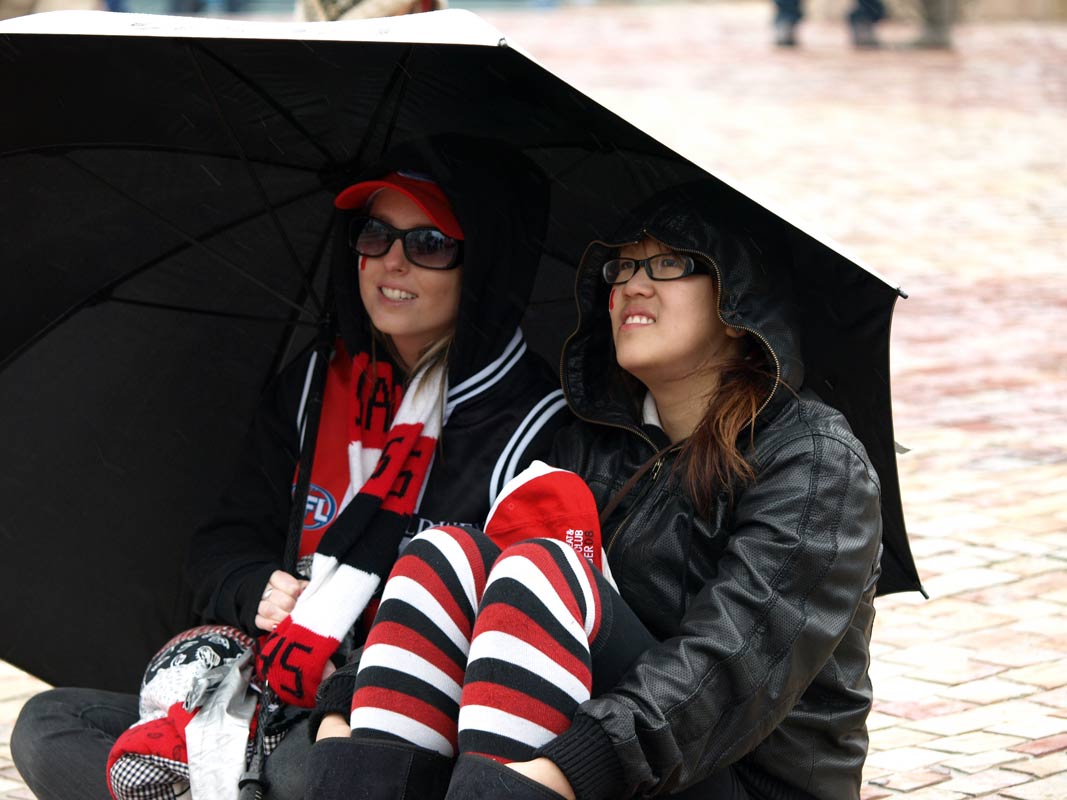
The Olympus lens got very wet in the rain, although I managed to protect the E510 as well as I could, and the resulting candid portraits were worth it – even though they were mainly of Saints supporters.

Again, all were straight jpegs from the camera, AWB, no post-processing apart from resizing for the web. All were aperture priority exposure at wide open aperture although the night shots on the stage were manual exposure.

For example:

little saint

and this one amazes me how any camera could meter the skin tones perfectly when there is such backlight combined with a black umbrella to confuse the meter – maybe they just neutralised each other out, or maybe the metering is good?

umbrella girls

Check the full photo story here and look at how nice the bokeh is with that lens …. delicious 🙂


Melbourne’s tulip festival – why I love the Olympus ZD 50-200mm lens

Written by Gary on September 25th, 2009

Last weekend I decided on a day trip in very poor weather to the nearby mountain ranges to check out Melbourne’s annual tulip festival in the Dandenong Ranges.

When I first arrived it was pouring rain, so I decided to go to nearby Olinda where one of my favorite pie shops “Pie in the sky” resides and indulged in a pie floater – a beautiful steak and mushroom pie sitting in a pea and ham soup – just the thing to warm you up on a cold Spring day!

The bad news… whilst eating my pie and soup, the rain stopped and this absolutely gorgeous light streamed through the clouds, but then disappeared by the time I was ready to leave 🙁

Now onto the tulip festival – this as I found out, reinforces how multicultural Melbourne really is – this is a Dutch festival but that Saturday was Turkish day complete with a belly dancer, but the tourists were dominated by Japanese and other Asian tourists including locals.

I decided I was going to only take one camera kit – my Olympus E510 Four Thirds camera with my much treasured Olympus ZD 50-200mm f/2.8-3.5 lens – you can see how useful this combination is, by checking out my photos taken with this here.

One aspect I do like about this lens is that it is weather resistant so a bit of rain is not going to hurt it (but I do have to protect the E510 although it has survived a wave at a beach washing over the top of it without any issues! For complete weather sealing you really need the Olympus E-3 or its successor which should be announced soon), and its big lens hood which helps to prevent rain drops hitting the front lens and ruining your images. I must admit I tend to often not use the lens hood on this when its not raining as it almost doubles the size of this already large lens and tends to intimidate people.

Now, onto a few candid pics of the day to show how nice this combo is (click on images for larger view):

Note that these are all straight jpegs from the camera, no post-processing apart from resizing for the web – Olympus cameras arguably have the best jpeg engine out there – if you don’t want to spend time processing raw image files, I would strongly advise you think carefully about buying Olympus – I would rarely use a jpeg straight from my Canon 1DMIII and I believe the general consensus is that applies to other cameras too!

A Japanese lady admiring the tulips (and taking a few pics herself):

Japanese lady

Turkish sisters posing for a family portrait amongst the tulips whilst I was some 50m away:

Turkish sisters

Horses taking kids for carriage rides:

horses

Some girls are not afraid of the mud, or perhaps are more fascinated by the row upon row of tulips:

girl

and some lovely tulips:

tulips