More Micro Four Thirds news

Written by Gary on October 3rd, 2008

from an interview with Panasonic on dpreview.com, a few more snippets of insights into the new Micro Four Thirds system which dominated Photokina 2008.

Forthcoming cameras will eventually have HD movie mode but unlike the case with dSLRs and their fixed focus, fixed aperture movie mode, these new cameras will allow continuous contrast-detect AF and exposure adjustment via adjustable aperture, thus more video camera-like in functionality.

It is unlikely that dSLRs with mirrors will be able to have live contrast-detect AF and aperture adjustments during movies without substantial re-engineering of their lenses. (This is my assumption from my readings on this matter).

Backward compatibility with contrast detect AF and older Four Thirds lenses is unlikely to be resolved EXCEPT by firmware upgrades for those lenses which are contrast-AF compatible with the E420 and later dSLRs.


Firmware upgrades Olympus E420/520

Written by Gary on October 2nd, 2008

firmware upgrades improve brightness of AF target points in viewfinder:

E520 firmware

E420 firmware


dpreview.com’s tests of 50mm lenses – Oly/Nikon/Canon/Sigma

Written by Gary on October 2nd, 2008

One of the beauties of the Olympus system is that you can adapt almost any SLR lens ever made onto it via adapters (with the notable exception of Canon amongst a few others). Note Sigma have announced a Four Thirds mount version of their lens so we can have 50mm f/1.4 in AF if we really need it – although unfortunately, its still a lens designed for full frame and not specifically for Four Thirds.

Thus it is interesting to compare a few of the available 50mm lenses:

  • Olympus ZD 50mm f/2.0 macro – see test here
  • Sigma 50mm f/1.4 EX DG HSM – see test here
  • Nikon AF-Nikkor 50mm f/1.4D – see test here
  • Canon EF 50mm f/1.4 USM – see test here

When looking at the MTF charts make sure you have chosen the APS-C or DX chart for the non-Olympus lenses, and select f/2.0 for the aperture.

If you wish to use the excellent Sigma on Four Thirds, to take into account sensor size difference, the site suggests you need to multiply the MTF results by 0.87 and ignoring data past 81% of image size as this will be cropped.

Now, I use such lenses for 2 main purposes – portraiture at f/2.0 or macro at f/5.6-8.

Only the Olympus has great macro performance but that is not surprising as its the only macro lens listed there.

So let’s summarise performance for portraiture at f/2.0:

The clear winner is easily the Olympus ZD 50mm macro – it has the advantage of being designed for a smaller image circle, and it has superb performance even at f/2.0 wide open. The corners are almost as sharp as the centre and aberrations are extremely well controlled.

So if you can afford this lens, buy it – as they say on the site – no Four Thirds dSLR owner should be without it, it is that good (apart from some annoying focus issues – hopefully Olympus will make a SWD version with a focal range limiter switch and change the manual focus to that on the 50-200mm SWD, and perhaps add a magnification indicator for macro work).

The Sigma clearly outperforms the Canon and Nikon at f/2.0 – the Canon starts to get soft a third out from centre on an APS-C camera while the Nikon starts getting soft half way from centre on a DX camera. If used on a Four Thirds, the results of these would be even worse, although you crop out some of the worse performing corners at least.

What they have not tested are the manual focus legacy lenses such as the Olympus OM 50mm f/1.4, but I would expect similar results to the Canon or Nikon.

Of course, all these lenses do allow use of f/1.4 aperture which the ZD macro does not, but at a substantial cost to sharpness (use the slider on the MTF charts to see what effect different apertures have on sharpness) and aberrations as well as CA and lens flare. The OM lens certainly appears soft with substantial purple fringing on my tests when used at f/1.4 – you really need to use it at f/2.8 for reasonable results.

Bottom line – buy the Olympus ZD 50mm f/2.0 macro if you can afford it – it’s worth every bit of the money and is good enough to work well with the Olympus EC-20 2x teleconverter


Portable portrait lighting with Olympus E510 & flash/strobe

Written by Gary on October 1st, 2008

There are several requirements for portable portrait lighting:

  • a portrait lens if you wish to blur the background
  • a key light – the main light that will light the face
  • a fill-in light – a light to fill in the shadows and thus modify contrast, hopefully without adding its own shadows
  • optionally a hair light or kicker rim light

I use a Ring Flash here, but you could use the built-in flash instead, it just give more shadows as it is further from the lens.

With the E510 we do not have the joys of wireless TTL automatic flash exposure, so we need to stick with manual flash if we are going to use more than one flash, but I prefer it that way anyway.

Of course, if you have the E520 or E3 with the R Olympus flash units you could go down the wireless TTL route as an additional option to my proposal here.

A further issue is that we can’t use the Ring Flash in TTL mode as the pre-flash prematurely fires other flashes (at least with my optical triggers), so I am resorting to full manual exposure and trial and error.

When doing complex things like this and people are involved, it is best to test things out and standardise your procedure so when the time comes, they don’t lose interest and get bored or frustrated.

Thus, in the name of standardisation, here is a setup I propose:

  • Olympus E510 with ZD 50mm f/2.0 macro + macro adapter + Olympus Ring Flash
    • the Ring Flash is handy here as it will fulfill three roles:
      • triggering the other flash(es) optically
      • providing a catchlight in the eyes (but at this distance it won’t be a beautiful ring as in the glamour magazines) – and hopefully not too much red eye as we will be under-exposing this flash
      • finally, the almost shadow-less fill-in lighting
  • a second flash with an optical trigger attached
    • I use a Metz 45CL-4 on its W (1/64th output) setting inside a Westcott Apollo umbrella softbox held ~1.5m from the subject – but you can use any flash/umbrella/bounce option you want
  • optionally, other manual flashes with optical triggers, eg a flash with a snoot attached for hair light

Now how do we set exposure for each when we don’t have a flash meter?

Let’s set the E510 to ISO 100, auto WB or daylight, manual exposure mode, 1/180th sec (the flash sync speed), f/2.5 (you could use any aperture but then you would have to adjust the flash outputs accordingly, and in case you want to use a wide aperture to blur the background, f/2.5 is a good aperture to start with).

Set the Ring Flash to manual mode and dial down the output to 1/256th second so we can see the effect of the other flashes.

Set the output of your main flash (or its distance to subject) until you get the exposure just right when checking your histogram.

Now do the same for any other flashes.

Ensure you are at the desired distance to your subject (as changing this will alter the effect of the Ring Flash).

Finally, adjust the output of the Ring Flash until you get the fill-in level to your desired aesthetics – you will probably find its between 1/256th to 1/16th when using f/2.5 and dependent on effect needed.

Write down these settings and perhaps make lengths of string so you can quickly reproduce the flash to subject distances.

Now, to tweak this a bit, you can adjust the shutter speed to longer duration to allow adjustment to ambient light exposure of the surroundings (as long as you are not in bright outdoors as this may require smaller apertures to allow a shutter speed at the flash sync).

Hope this makes sense, have fun with experimenting – if you have a macro lens with ring flash, you may as well use it for portraits as well as your macro work.


Olympus Australia special promotion – refer and get $100 x5

Written by Gary on September 30th, 2008

Olympus Australia have just announced a special promotion whereby Australian E system owners can refer up to 5 friends, and if they buy a E3, E520 or E420 then the purchaser receives a $80 camera bag (and $100 cash back if buying an E520), while you get the $100 per referral (up to 5 referrals).

see Olympus Australia friends promotion


Macrophotography – which aperture to use?

Written by Gary on September 28th, 2008

Aperture has a big role to play in how your macrophotography images come out.

With the smaller sensor on the Olympus/Panasonic Four Thirds system, there is the issue of decreasing resolution and thus image detail with small apertures as a result of the physical limitations imposed by diffraction.

At the same time we want to increase depth of field and this requires small apertures, thus creating opposing image quality effects on the aperture we choose.

So what aperture is best?

To answer this I ran some simple tests which will ONLY precisely apply to using the Olympus ZD 50mm f/2.0 macro lens combined with the excellent Olympus EC-20 2x teleconverter, however, the general principles can be applied to ANY camera system.

For simplicity, aperture f stops mentioned below are those shown in the camera – ie. f/8 is actually f/4 on a lens and multiplied by 2x to account for the 2x teleconverter. The camera automatically does this for you and records the calculated aperture in the image EXIF data.

Check out the tests of aperture versus depth of field at 1:1 macro (this should apply to ANY camera system at 1:1 macro as depth of field is a function of subject magnification and aperture and is independent of sensor size or lens focal length – at least that is my understanding of the theory).

Check out the tests of aperture vs resolution. Although these are not at 1:1 macro, the relationship of resolution vs aperture should be applicable for all focus points with this combination. Perhaps surprisingly, diffraction limitations really only started to become evident at 100% pixel peeping at f/16 which was still not much different to the best resolution at f/5.6. This is surprising because it seems to be contrary to what would be expected according to table 3 on this article which suggests on this sensor, diffraction should be limiting resolution to 2mp at f/16 when clearly the results seem to be MUCH better than that.

  • ps.. have now added some images of aperture vs resolution for the ZD 50mm macro alone at 1:2 macro, its closest focus.

  • optimum apertures for 50mm without the teleconverter at 1:2 macro seem to be f/5.6-8 while f/11-16 starts to get a bit soft

In general for optimum DOF vs resolution with the 50mm + EC-20, use:

  • f/5.6-f/8 for flat surfaces, and,
  • f/11-16 for non-flat surfaces (eg. bugs) – f/22 if DOF more important than resolution.
  • f/11 (f/5.6×2) if in doubt will give excellent compromise.
  • this suggests that the 2x effect of the teleconverter in light loss terms could possibly be ignored when factoring in diffraction issues

To avoid the shutter lag and pre-flash using the Ring Flash, you can set the Ring Flash to manual exposure and adjust as needed according to your macro combination, distance of flash to subject, aperture and ISO you select.

For simplicity, using this combination at 1:1 macro, ie. manual focus to closest focus with Ring Flash attached, you can try this setting:

  • ISO100, f/11 (f/5.6 x2), 1/180th sec, set Ring Flash to manual at about 1/4 power.

  • obviously you will need to manually adjust output if use different aperture or distance to subject. 

NB. my Ring Flash seemed to be overexposing at wide apertures so if you use these, double check the exposure with the histogram.

Finally, does the EC-20 degrade image quality?

To test this, I imaged a maple leaf at 1:2 macro magnification – at the closest focus of the ZD 50mm at f/8 alone, and at ~double this distance for the 50mm macro + EC-20 teleconverter (at f/11 – f/5.6×2) so that the image magnification was pretty much identical. I used AF for both.

These are pixel peeping 100% crops near the centre:

First, the macro lens alone:

leaf - 50mm alone

and, the macro lens + EC-20 teleconverter:

leaf with teleconverter

In terms of image detail, I must admit, I can’t see much difference although for some reason the EC20 image has more contrast which appears to give it more detail which is counter to what we would otherwise expect.

This is how good this teleconverter is – no wonder Olympus claims it is one of the sharpest ever made!

Since writing this post, dpreview.com have posted their review of the ZD 50mm f/2.0 macro which confirms how good this lens is optically – although it really needs a SWD version with focus range limiter switch – hopefully Olympus will be updating this soon.


A new portrait lens for Four Thirds dSLRs – Sigma 50mm f/1.4

Written by Gary on September 23rd, 2008

Sigma have announced a new 50mm f/1.4 lens for Four Thirds cameras.

Its wide aperture and 35mm equivalent focal length reach of 100mm should make it ideal for portraiture, perhaps even better than my favorite, the Olympus ZD 50mm f/2.0 macro.

It has 9 bladed circular diaphragm for nicely blurred backgrounds and Sigma’s HSM AF motor for quiet, fast AF.

It will be interesting to see how it performs optically on a Four Thirds as it appears to be the same design as for the full frame version which has been tested here on dpreview.com and this suggests it will not be anywhere as good optically as the Olympus ZD 50mm f/2.0 macro but does give you the option of f/1.4 with AF if you need it, albeit at less sharpness and more aberrations.


New Olympus & Panasonic Four Thirds cameras (and micro)

Written by Gary on September 22nd, 2008

Panasonic have showed a prototype of a HD video capable Four Thirds Micro camera with dedicated movie button and stereo audio microphones follow up on their recently announced G1 micro camera.

see dpreview.com announcement

Olympus have showed a prototype of a Micro Four Thirds camera which looks set to be a Canon G10 killer with a sensor ~5x in area that of a G10 (hence likely to have much better image quality) but still very compact and with the bonus of interchangeable lens capability. Please make it look a bit sexier though!

see dpreview.com announcement

Olympus have also announced a new Four Thirds dSLR will be available in 1st quarter 2009 which will be placed between the E520 and the E3 but have the excellent AF system of the E3 with its IS capability and improved dust and weather resistance.

Exciting stuff for the Four Thirds fans like me.


Nikon entry level dSLRs finally get an AF portrait lens

Written by Gary on September 22nd, 2008

My number one criticism of the entry level Nikon dSLRs such as the D40/D40x/D60 is that they are unable to AF with certain lenses and this means there were no affordable good portrait lenses available for these cameras.

Finally, Nikon has finally addressed this with an update to their AF-S 50mm f/1.4 lens – now a G version (no aperture ring), but now with a built-in silent wave AF motor so AF works on these cameras, and a circular diaphragm for nicer bokeh (quality of blurring of the out of focus areas).

On a DX Nikon dSLR, a 50mm standard lens gives an effective focal length of 75mm which is just adequate for portraiture, although I prefer more like 100-120mm in 35mm terms, hence the reason why I love the ZD 50mm f/2 macro on my Olympus with its 2x crop factor, and the EF 85mm f/1.8 on my Canon 1DMIII with its 1.3x crop factor.

see also my comparisons on bokeh in selected portrait lenses

see dpreview.com artcle on the Nikkor AF-S 50mm f/1.4G lens


Macro eyes again… this time with ZD 50-200mm lens

Written by Gary on September 22nd, 2008

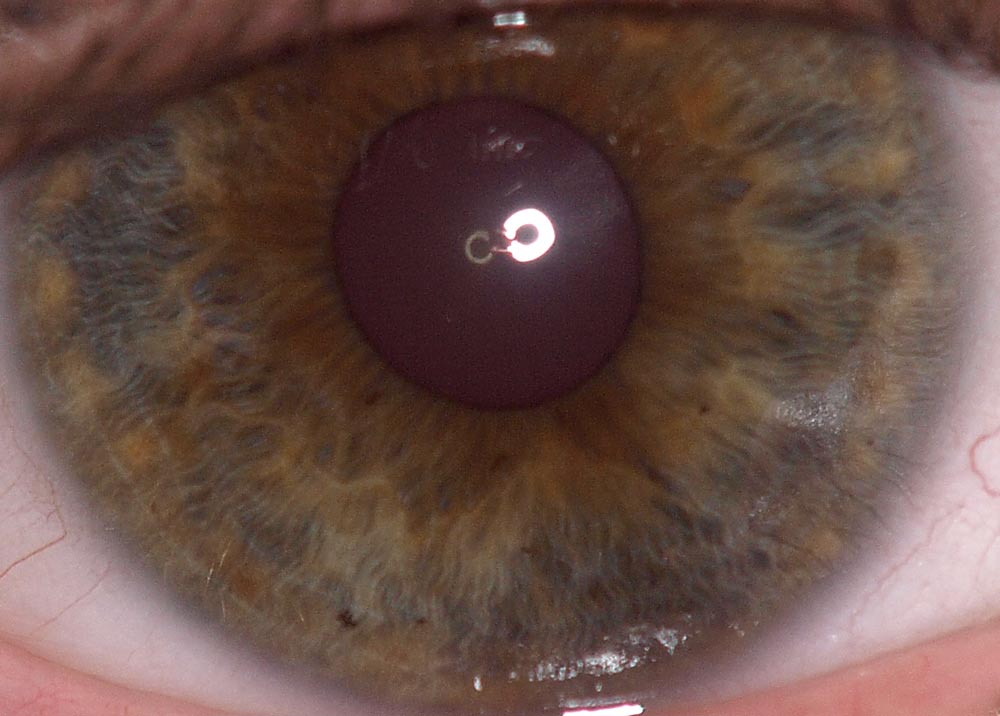
In an attempt to provide an alternative to prominent ring flash catch lights in the previous post when using a ZD 50mm macro lens with ring flash, I decided to try the ZD 50-200mm SWD which gives a much longer working distance and thus reduces the size of the catch lights significantly.

Whilst it is possible with the ZD 50-200mm alone, the magnification at its closest focus of 1.2m is about half that of the ZD 50mm macro and thus the diameter of the iris is only some 550 pixels on a 10mp camera.

ZD 50-200mm alone

Thus to get higher magnification (now we are back to about 1200 pixels for the iris diameter), I tried adding the EC-20 2x teleconverter to the ZD 50-200mm at f/11 and increasing the ISO to 400 given the greater working distance. The greater working distance means the flash is now illuminating the interior of the eye a bit causing a mild red eye appearance which I would personally prefer not to have in the images.

ZD 50-200mm with 2x TC

I could probably have got away with ISO 100 but at f/11 (f/5.6 x 2 for the TC) and 1.2m distance it is pushing the ring flash near its maximum output, and if I was serious about getting the best images, I would try ISO 100-200 and perhaps even try f/16 (f/8 x 2 for the TC).

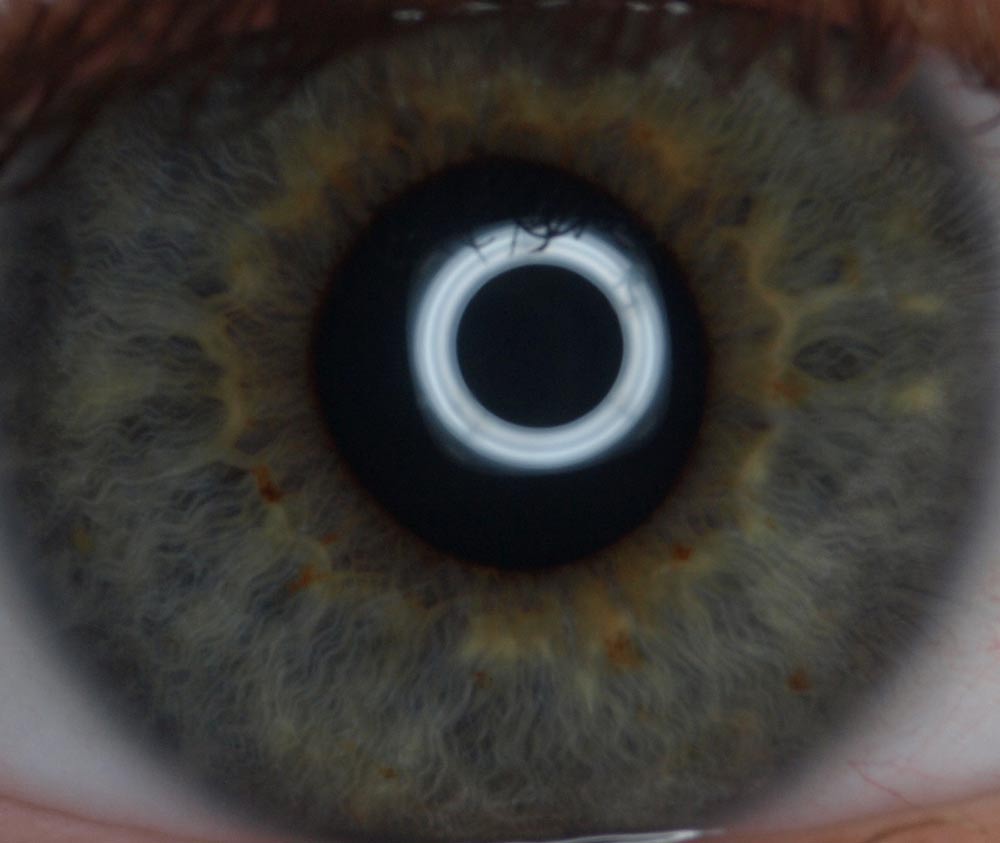
My preference for obtaining a catch light smaller than the iris opening is to use the ZD 50mm macro lens with ZD EC-20 2x TC with lens focused at 0.3-0.4m
instead of its closest focus depending on desired catchlight size:

smaller catchlight

For a complete comparison, see the rest of the images here