Canon finally produce an IS macro lens and a high end APS-C dSLR – the Canon 7D

Written by Gary on September 2nd, 2009

Olympus have always had an image stabilised macro lens by virtue of its in-body IS, Nikon has their relatively new VR micro lens, but until now, Canon did not have an image stabilised macro lens.

This has changed with the announcement of their EF 100mm f/2.8L Macro USM hybrid IS lens which has Super Spectra coatings to reduce flare, UD glass to reduce CA, circular aperture blades for nicer bokeh, and a 3 position focus limiter for even better AF performance. 1:1 macro at 0.3m focus; 67mm filter; 625g; water-resistant seals; $US1049; optional tripod mount and adapter for macro speedlights;

Now there is something for Olympus to aspire to – I have been wishing Olympus would make a Four Thirds lens similar to their superb ZD 50mm f/2.0 macro lens but with improved AF performance and a 3 position focus limiter (oh, and contrast detect AF so it can work on Micro Four Thirds in AF as well).

But perhaps more exciting for many Canon users, is their latest dSLR, the Canon 7D.

At last, Canon have produced a high end but not 1D pro-like dSLR with a APS-C cropped sensor and features to match the Nikon D300s. Up until now, Canon really has not had a dSLR that could compete with the Nikon D300 let alone the newer D300s at a similar price point and feature set.

The main features of the 7D include:

  • 18mp APS-C 1.6x cropped sensor with supposedly better noise profile, although given the photosites are now about the same size as the Four Thirds sensors, it will be interesting to see how they compare
  • weather and dust resistance
  • 8fps burst rate without need for additional battery holder
  • ISO 100-6400 expandable to 12800
  • HD movie in 1080p or 720p and can change frame rate to 24/25/30fps in 1080 mode, while 720p has 60fps/50fps(PAL), dedicated movie on/off button, and you can set aperture, shutter speed, but still no AF during video which is as expected – only the Panasonic GH-1 has that capability
  • 19 point cross-type AF sensors which work as cross-type if aperture f/5.6 or brighter
  • improved metering system
  • ability to overlay grids via transmissible LCD screen in the optical viewfinder with 100% coverage and 1.0 magnification
  • electronic level indicator
  • built-in remote flash transmitter which can control 3 groups of flashes (the ST-E2 optional transmitter could only do 2 groups)
  • 820g

So after saying in my last post there were few reasons to buy a APS-C sensor camera other than as a backup body which will give more focal length reach, the 7D certainly appears on the face of it to be a very attractive sports camera – but which lenses will be optimised for its 18mp sensor?

It makes one think, it may be time for an upgrade to the Canon 1DMIII – I can imagine a 1D MIV would have this feature set and more, but with a pro body and a APS-H 1.3x crop sensor – or perhaps Canon will decide there is no point to a 1D MIV now, and instead build the high burst rate into a 1Ds MIV?

If the high ISO performance of the 7D is really as good as they say it is, I’m not sure there will be too many people racing out to buy a 10mp 1DMIII – although I do love mine even though it has trouble with its AF.

 

Olympus announce a great entry level dSLR – the E-600

Written by Gary on September 1st, 2009

Olympus has just announced a new entry level Four Thirds dSLR which has nearly all the features of the superb E-620 that you need but at $US100 cheaper price point – which in my mind makes it the best entry level dSLR on the market – assuming you don’t need non-AF movies.

It seems the only features you miss out on compared to the E-620 are a few creative art filters (you still get 3 of the fun ones – pop art, soft focus and pin hole), illuminated buttons, and the ability to change image aspect ratio (but this was via cropping anyway, unlike the GH-1’s aspect ratio functionality).

New features include the Live thumbnail preview button which was first shown on the E-P1, and which allows you to preview the effects of various settings such as white balance on the LCD screen before taking the shot.

Thus for $US600 you get a great compact dSLR with in-body image stabilisation which will work on all lenses, and a very nice flip out, swivel LCD screen and up to 4fps burst rate, and one of the nice Olympus kit lenses, in this case, the 14-42mm f/3.5 lens which gives 35mm coverage of 28-84mm, and don’t forget, perhaps the best in-camera jpeg processing engine on the market which gives arguably the best looking jpegs straight from the camera – at the end of the day, most users of entry level dslrs will be relying on the camera to make jpegs rather than process RAW files – and this camera is one of the best for doing that (assuming Olympus hasn’t changed their TruePic III+ engine).

Finally, Olympus have some of the best lenses available specifically designed for a cropped sensor dSLR rather than forcing you to go to lenses optimised for full frame cameras for the high quality, wide aperture lenses as Canon and Nikon do.


What about the new Sony dSLRs?

Written by Gary on August 30th, 2009

I tend to ignore the Sony product line on my blog, and apologies to those who quite rightly love their cameras, it’s just that I do not use them and do not intend to for the following reasons:

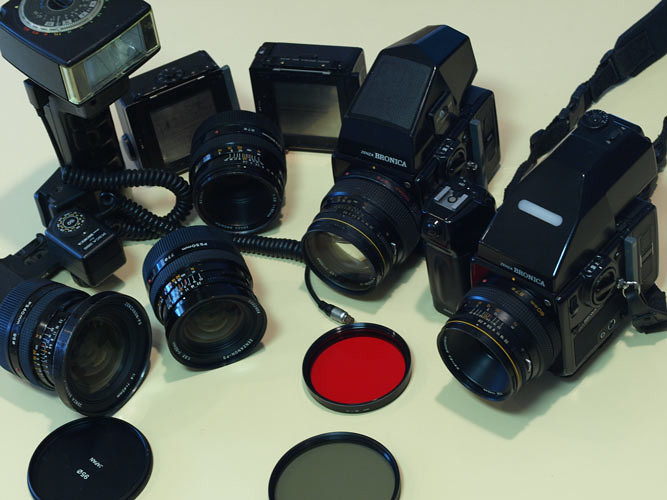
  • I have too many systems – I already own Canon, Four Thirds and Micro Four Thirds digital systems plus 35mm film, Brionica SQ 6×6 film and Mamiya TLR 6×6 film systems, so I am not keen on adding another system
  • as far as APS-C sized dSLRs go, I no longer see any real point in having them (other than as a longer focal length reach backup camera to a full frame system or for astrophotography and IR purposes) now that the image quality of Micro Four Thirds is almost on par and provides a more compact kit with the best video capability, while the Four Thirds is partly compatible with the MFT system and offers pro-quality dedicated lenses for the cropped sensors with weather-proofing if needed and sufficient AF speed for action or sports while giving the most compact telephoto reach options.
  • fast live view AF – while the Sony a550, a350 and a380 all adopt Olympus’ aborted live view AF type of technology which Olympus introduced with the innovative E330, and take it a step further by adding built-in image stabiliser, if you really want fast, usable live view AF, I think the Panasonic GH-1 and forthcoming Micro Four Thirds models would be the way to go there and will provide much more versatile options
  • lenses – unlike the Four Thirds and Micro Four Thirds, or even Canon, as a result of the longer Minolta lens flange to sensor distance on the Sony cameras, you can really only use lenses designed for Sony/Minolta on these cameras, which does take away some of the fun of experimenting
  • lenses II – whilst the Sony lenses are generally very good optically, and the Carl Zeiss lenses even better (and much more expensive), the range is not quite up there with Nikon or Canon, and there are no tilt-shift lenses yet (and I do love these).
  • proprietary flash hotshoe – whilst all camera manufacturers use proprietary pin placement on their hotshoes for TTL, flash ready, etc, unfortunately, Minolta (and thus now Sony) took the crazy step of placing the critical PC sync pin in a different position to everyone else which makes using non-Sony/Minolta flashes a real pain as it needs an adapter – this is a big negative to me
  • no live preview on full frame models – accurate manual focus really needs live preview at times, I can’t quite work out why Sony has not provided this generally standard feature yet on its full frame cameras

Having said that, the new Sony a850 dSLR will be very attractive to many given that it is some 25% cheaper than its competition and provides similar image quality (25 megapixels) at ISO up to 1600, and in addition gives you a built-in image stabiliser which will work on all lenses – something Canon or Nikon are yet to incorporate but which is important in providing the best resolution hand held.

There is much to like about the a850 if you are not interested in the video mode of the Canon 5DMII and the lens range and 3fps burst rate suits your needs and you want a big, heavy, 20+mp full frame dSLR.

See specs and opinions on Luminous-Landscape and dpreview.


Hiking in Alpine areas with your cameras – a win for the Panasonic GH-1 and Olympus E510 over the Canon 1DMIII

Written by Gary on August 29th, 2009

This week I took some time off to explore Victoria’s Alpine region in Winter and took my Panasonic GH-1, Olympus E-510 and Canon 1DMIII.

After the first very steep hill climb on which I thought I was going to have a heart attack (reminder to self – time to get a bit fitter!) carrying the Canon 1DMIII and a couple lenses as well as the Panasonic GH-1, I quickly decided that unless I was going to be shooting something that specifically required the big, heavy 1DMIII and its lenses, this kit was going to stay in the car!

The image quality and resolution of the Olympus E510 and Panasonic GH-1 are very similar at low ISO to the Canon 1DMIII, and I could easily cover the focal length range without it, while shallow depth of field and close up work could be achieved very satisfactorily with the E510 with ZD 50-200mm f/2.8-3.5 lens.

Thus my hiking kit quickly became reduced to 2 cameras each with only 1 lens giving me 28-400mm coverage in 35mm terms:

  • Panasonic GH-1 with its 14-140mm HD lens – this would give me 28-280mm coverage (although best at 28-100mm), image stabilised with useful ISO to 1600 (3200 at a push), and with HD video with AF if I needed it, but perhaps best of all, the ability to alter image aspect ratio according to scene without losing pixels (thanks to its over-sized sensor)!
  • Olympus E510 (the E620 or E30 would be better but I don’t have them) with ZD 50-200mm f/2.8-3.5 lens – a great image stabilised combo with ISO useful to 400 (maybe 800 at times), but giving great focal length reach of 100-400mm with wide aperture allowing shallow depth of field and ability to compress landscapes, capture wildlife and even do close up work to 1:2 macro if needed.

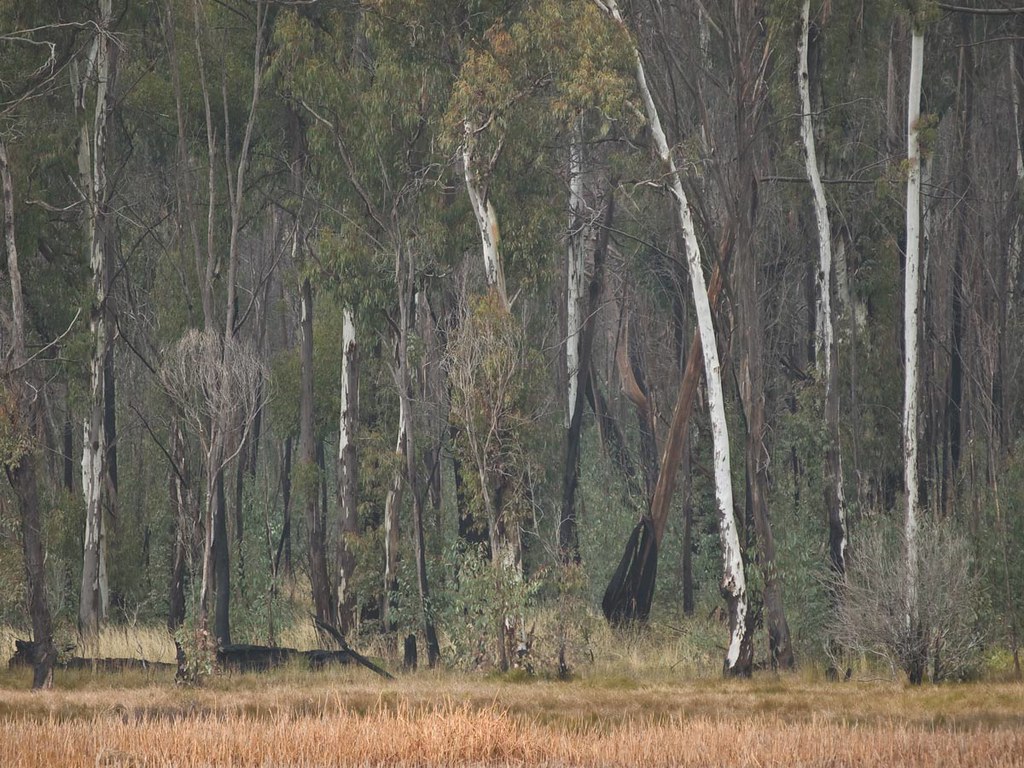
An example of the E510 with 50-200mm SWD lens – uncropped image of bushfire-affected Australian alpine forest taken across a lake in light fog conditions (cloud actually as it was only 5deg C at this altitude – which required wearing gloves) at 200mm focal length (400mm in 35mm terms).

This image shows the contrast of the white Candlebark gum trunks against the fire-scarred black trunks from the 2003 bushfire which ravaged the region 6 years ago.

Click on image for larger view.

Lake Cobbler

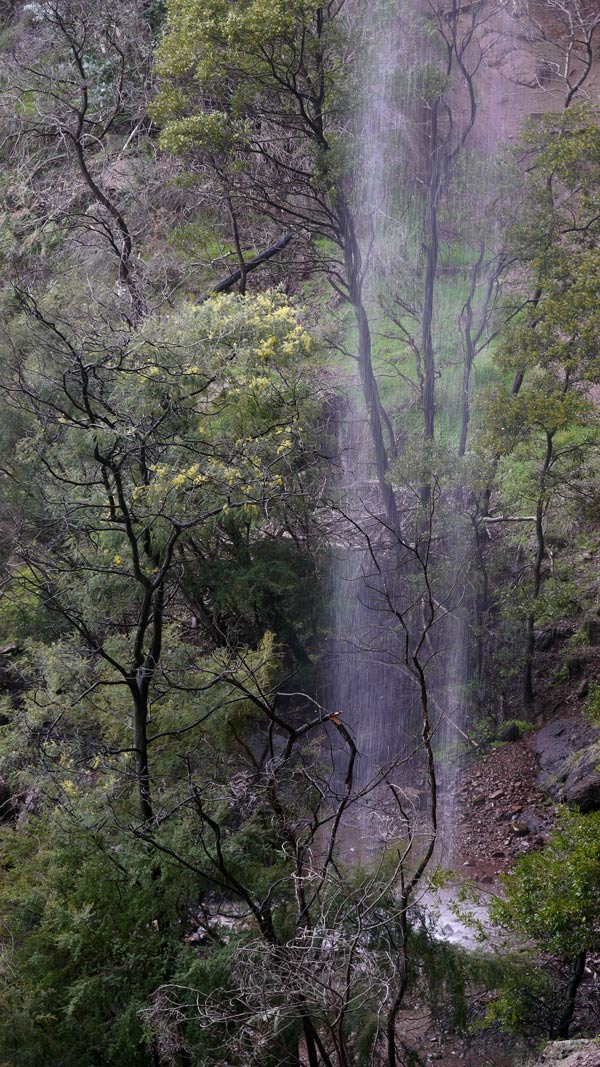
And, to demonstrate the 16:9 image aspect ratio of the Panasonic GH-1, here is the Paradise Falls, uncropped but resized for the web:

Paradise Falls

Finally, another GH-1 photo – 6 years on – not all parts of the forest show evidence of new growth – some were so devastated, they will take years to recover.

Again click on image for larger view.

Bushfire destroyed forest.

It goes to show, the best camera is the one you are willing to take with you and actually bring – size does matter – and the Micro Four Thirdsand Four Thirds cameras and their beautiful lenses definitely have a big role to play.

A few quick comparisons:

  • Panasonic GH-1 with 14-140mm OIS HD lens giving 26-280mm coverage (10% more width in 16:9 aspect ratio) + 28-560mm HD video coverage with AF = 904g
  • Canon 1DMIII + 24-105mm ISL lens giving 31-137mm coverage but only in 3:2 ratio and no video = ~1.8kg
  • Olympus E510 with ZD 50-200mm f/2.8-3.5 SWD lens gives 100-400mm coverage with IS with close focus to 1.2m for nature macros = ~1.5kg, will work very well with a 1.4x or 2x tele-extender in AF, and the lens can also be used in MF mode on the GH-1 for extended focal length HD video or 16:9 aspect ratio
  • Canon 1DMIII with EF 70-200mm f/2.8 IS L lens gives 91-260mm coverage = ~2.9kg

Here is another photographer who has create some great alpine shots using a GH-1 – check them out!


The Milky Way with the Panasonic GH-1 and Leica-D 25mm f/1.4 lens

Written by Gary on August 27th, 2009

Last night whilst on a brief holiday to the countryside, I took advantage of the darkish skies (although contaminated by the nearby light of a 1st quarter moon).

So from the camping ground in a small town in country Victoria, using only my tripod (I did not bring my motor driven equatorial tracking telescope mount), my fun little Panasonic GH-1 Micro Four Thirds camera and the superb Panasonic Leica-D 25mm f/1.4 lens, here is what one could achieve – definitely not perfect but pretty good. Focus achieved my manual focus on Jupiter (not shown in this image).

Taken in 16:9 aspect ratio at 3200 ISO, f/1.4 for 15 secs RAW file with dark frame NR turned on, and processed in Panasonic’s SilkyPix RAW software with all noise reduction turned to zero, and gamma set to 0.80, and Black level set to 100 to give the background a black sky and remove the effects of the moonlight.

No other processing other than resize and compression for web via Photoshop.

Tail of Scorpius is towards the top of this image.

Milky Way

Now if one looks closely there is the usual “horizontal banding” sensor problem in the dark areas (it will be vertical here as the image has been rotated into vertical format) which increases as one goes from ISO 800 up to 3200. In addition there is some visible star trailing due to 15 sec exposure using a 50mm equivalent focal length lens (in 35mm terms) – so don’t look too closely – this is just a demo of what can be done, but which could be considerably improved upon with a tracking mount and on a night when there is no moonlight to interfere.


Issues with the Panasonic GH-1

Written by Gary on August 22nd, 2009

The Micro Four Thirds Panasonic GH-1 is a brilliant camera, and the ONLY digital camera with interchangeable lenses that does full AF during HD video.

BUT for all its unprecedented versatility, it is not a perfect camera.

I have upgraded mine to the latest firmware (v1.1) and it seems buggy:

  • despite having the menu setting “Shoot w/o lens” set to ON all the time, I keep getting “check lens” errors some of which are transient, and sometimes I need to power off the camera to “reboot” it.
  • these messages may appear even when the 14-140mm HD lens is in place and even occur during image playback in addition to when EOS adapter is used, and always when a legacy AF-confirm adapter is used in conjunction with a Four Thirds adapter.
  • if “Shoot w/o lens” set to ON- such lens messages should never occur UNLESS the camera is aware a compatible lens IS attached and there really is a lens error.
  • in addition, the EVF occasionally inexplicably just blacks out (not just turned off as occurs when you take your eye away), which can be very annoying at critical moments.
  • I can understand the algorithms are extremely complex in this camera, and perhaps this firmware did not undergo full testing – I am sure these little bugs will be remedied soon.
  • the Canon black dot type bug – images of very bright objects (eg. bright stars and planets such as Jupiter) have areas of symmetric black on either side – not a problem for most people but annoying for adtrophotographers
  • horizontal banding which becomes evident in the shadow areas at ISO 800 and increases as you increase ISO to 3200 – this issue has also been a problem with most Olympus cameras and also even the Canon 5DMII as well as many others

Some areas where the firmware could be improved:

  • ability to assign 2x digital zoom to the function button for rapid switching for videos
  • menu option so that digital zoom setting ONLY applies during video and not during still shooting – digital zoom is useless for stills but very useful for video which is only 1-2mp anyway.
  • live histogram is dysfunctional – whilst its shape represents the contrast range of the image contents, it does not appear to shift left or right during under or over exposure, and its only utility to assist in exposure estimation is that it goes white instead of yellow when the camera deems exposure is spot on – but then you know this from the exposure scale anyway!
  • add ability to turn off auto gain control for sound level during video, and even better provide a method of adjusting sound level.
  • add the usual video functionality of zebra and focus pulling to make manual focus and exposure easier during videos.
  • add manual adjustment of flash output in manual flash mode (only seems to allow +/- 2EV compensation but why should this be available during manual flash?)
  • allow it to control remote TTL flashes such as Olympus FL-36R and Olympus FL-50R flashes.
  • option for silent mode which just uses the electronic shutter instead of the noisy mechanical shutter – and perhaps then also allow high flash sync (instead of 1/160th sec) as with the Canon G11.
  • 1080i AVCHD video codec needs improving – any camera panning or subject motion such as the moving bow of a cellist in an orchestra will result in very distracting image distortions as the codec breaks – although not evident on camera screen in playback, it is very distracting played back at full screen using the K-Lite codec pack on Win Vista. This presumably could be improved by including B frames into the codec – please? Until then, I will be sticking with 720p AVCHD or Motion Jpeg modes.
 

OK, Olympus, now you have caught everyone’s attention, it’s time for a revamp

Written by Gary on August 22nd, 2009

The Micro Four Thirds and the Olympus E-P1 and Panasonic GH-1 have caught the imagination of the photographic world and finally there is a product that even Canon and Nikon users are finding real value in and which can change their approach to photography.

Some people become so connected with a brand that they just don’t want to hear anything negative – post comments like these in an open forum and fanboys will erroneously consider you a troll – I am far from that, so I post here.

I have loved Olympus gear for well over 30 years and appreciated their different approach to design – just see here for a sample of my collection of toys, but I still want it to be the best it can, and so, here I put forward constructive comments which I am sure Olympus are fully aware of without me blogging about them.

BUT, now it’s time to get some basics improved.

First, the Four Thirds lens system:

  • although I love the Four Thirds lenses for their great optical quality, it’s time to make some changes to ensure improved compatibility with MFT cameras.
  • why not adopt the MFT lens mount pin system for all future Four Thirds cameras and lenses, and make them backwardly compatible with older Four Thirds cameras and lenses – this should be EASY and simplify production costs by creating uniformity while giving us end users greater flexibility – a win-win no-brainer!
  • revamp the ZD 50mm f/2.0 macro to give it contrast detect AF capability with MFT, and provide focus ranges (eg 1m to infinity, close focus to 1m) which will allow faster AF.
  • revamp the high end lenses to give them SWD – eg. the ZD 150mm f/2.0
  • if possible make lenses with both SWD and contrast-detect AF capability.

Revamp the flash system:

  • having used the Canon 580EX II speedlight, the Olympus flashes are MUCH easier to use with very intuitive controls instead of having to memorise weird user interfaces that the Canon has.
  • BUT, the remote TTL capability needs to allow the flashes to have MASTER as well as the current SLAVE mode – this should then allow it to work on any FT or MFT camera, not just those with pop-up flashes with remote TTL capability.
  • the macro flash system main controller needs to be made more compact while it needs to have capability of being used as a MASTER flash in remote TTL – successful macro flash often needs background lighting. In addition, the ring flash is often used as a fill-in flash for a main light.
  • in addition, the macro flashes need to have adapters to allow them to fit almost any lens.
  • market a new multi-TTL flash adapter which allows more that one wired TTL flash to be used concurrently – one sitting on the adapter in the hotshoe, while the second can be mounted on a flash handle or hand held – this will allow fill-in flash and a bounced or direct key light.
  • market a TTL-capable radio trigger system similar to the Pocket Wizard system if PW insists on not providing an Olympus-compatible system.

Micro Four Thirds cameras:

  • whilst the E-P1 is a great innovative camera, Olympus really needs to work on the speed of its contrast detect AF system to make it even more attractive. Perhaps they should do a trade with Panasonic – get Panasonic GH-1’s AF speed and give Panasonic the very nice built-in image stabiliser system which could be used on Panasonic cameras when there is no optical IS lens attached.
  • I am sure Olympus is dreaming all kinds of wonderful camera designs for the MFT system – perhaps optical range finder style models with aperture rings and focus distance on the lens, weather-proofed models, etc, but I wonder if they could be kind to me and make an infrared photography dedicated model and perhaps an astrophotography-dedicated model?
  • please make all future MFT and FT cameras compatible with aperture rings such as on the Leica-D lenses?
  • please make all future MFT cameras with an optional setting of SILENT still image mode – use the electronic shutter that is used in video mode instead of the mechanical shutter, and when using the electronic shutter, could we have a faster x-sync as well – similar to the Canon G11?
  • how about ensuring that the image aspect ratio modes work like the Panasonic and extend the width of your image rather than just trim it? – of course, you would have to use the slightly larger sensor to achieve this.
  • given that it seems MFT lenses to be super compact need to have compromises in image quality such as distortions, perhaps there should be the option on activating a more powerful lens-specific optical aberration correction software to the images in the same way Panasonic has achieved?

It was a smart move to decide against raising the megapixel count, and concentrate on image quality, and innovation, and I guess you will be forced into adding movie modes to all future dSLRs just to be up there with the rest, but now it’s time to deliver on the basics.

Mr Olympus, it’s time – time to really make it count and leverage the good will that has been generated by your quality and innovative products that are bringing back fun and versatility into photography.


Using Canon or Nikon flashes on Four Thirds/MicroFT cameras – Olympus or Panasonic

Written by Gary on August 22nd, 2009

Why would you want to use Canon or Nikon flashes on your nice Olympus or Panasonic Four Thirds or Micro Four Thirds camera when the Olympus FL-14, FL-36(R), FL-50(R) flashes are MUCH more intuitive in design and give you full TTL control and in some cases, modeling lights, super FP mode (aka HSS high sync mode if using either FL-36(R) or FL-50(R) with Olympus but not Panasonic cameras), remote TTL (on certain cameras)?

You can of course use third party flashes such as digital flashes from Metz which allow you to use adapters for TTL use with either Olympus/Panasonic, Nikon, Canon, or whatever else interchangeably. But this post assumes you have to resort to using Canon or Nikon specific flashes.

For one,  even if you have an Olympus flash, you may not have brought it with you, and for the many Canon and Nikon dSLR users who have been inspired by the Micro Four Thirds approach to photography and are migrating, they will have their Canon or Nikon flashes.

Using Canon or Nikon flashes on these cameras, you WILL LOSE a lot of features due to incompatibilities between systems – TTL exposure, remote TTL exposure, modeling lights, super FP mode (aka HSS high sync mode), and automatic speedlight zoom functionality.

You can place a Canon speedlight (eg. a 580EX II) on your pre-2015 Olympus camera hot shoe and even though it has 5 pins instead of 4 pins, it will work in manual mode, BUT the prudent will use a hot-shoe adapter just in case (see below). Note that from the Olympus OM-D E-M5 mark II camera and onwards, Olympus has added a new hot shoe pin which provides battery power to dedicated Olympus flash units and thus Canon-compatible flash units should NOT be used directly on the hot shoe or via a TTL cord without a dummy adapter which ignores the additional pins!

As an interesting aside, because of the similarities in pins, you can use the Canon Off-Camera Shoe Cord OC-E3 instead of an Olympus cord for FULL TTL and other control of your Olympus flashes when using Olympus or Panasonic cameras!

If you place the speedlight in Manual mode, and you manually adjust the flash output as desired and the zoom (just remember to set zoom to twice the focal length of your lens if you want it matched). If you happen to leave the speedlight in ETTL mode instead of manual, the speedlight will just fire off a full output flash.

For other flashes such as Nikon(but not Sony or Minolta as they have a proprietary flash shoe PC sync pin location which is perhaps THE MAIN REASON I dislike Sony/Minolta cameras – without adapters, they are not compatible with most mainstream flash systems even in manual mode), you should use a hot-shoe adapter.

MAKE SURE the flash has LOW VOLTAGE PC SYNC otherwise you may fry your camera if you directly connect it by wires! Most modern flashes have low voltage sync – beware of old flashes!

Olympus place a WARNING in their manual which states “Do not use a flash unit or other accessory TTL flash that has additional communication functions other than the specified flashes, since it may not only fail to function normally, but may also cause damage to the camera’s circuitry.”

If you are concerned that this may occur, you can buy a cheap hotshoe adapter which only permits communications via the central PC sync pin and this issue will be avoided.

Optical trigger of Canon/Nikon flashes:

  • an alternative is to use the built-in flash at a low manual output setting to trigger a remote flash which is connected to an optical sensor trigger device.
  • cheap, works well indoors as long as there are no other flashes going off, and as long as you have set your camera flash to manual, otherwise it will send pre-flashes to determine exposure  and these will prematurely trigger any remote flash.
  • this is a great option when using the Olympus macro/ring flash – but you will have to resort to full manual exposure.

Simple wireless radio trigger of remote flashes:

  • this requires a radio transmitter device to be placed in the camera hotshoe (thus negating use of a macro flash unit in the hotshoe), and a receiver device to be attached to each remote flash.
  • works very well even outdoors in sunlight or when other photographers are around (most allow selection of channels to avoid conflicts with other photographer’s wireless triggers).
  • you are usually required to be in full manual exposure mode as currently, there are no third party systems which allow radio TTL control for Olympus cameras (unlike Pocket Wizards and RadioPoppers for canon and Nikon cameras)
  • cheap Chinese models are simple to use and the newer models are generally reliable although have limited range (~10m) – see my post here for details.

Pocket Wizard FlexTT5 and MiniTT1:

  • new, expensive TTL-capable radio trigger systems designed either for Canon or Nikon cameras and speedlights
  • transmitter can be mounted on an Olympus or Panasonic camera hotshoe (and still provides for a flash to mount on top of it via its hotshoe albeit in manual sync mode only), but the transmitter must be set to non-dedicated camera mode via a computer/USB which may be an issue if you don’t have a laptop with you!
  • can potentially provide greater distance and options than the simple Chinese triggers, and of course, you get full TTL control when used with your Canon or Nikon system, along with hyper-sync and HSS functionality.
  • see my post here for more details.

RadioPopper JrX:

  • new entry level radio triggers designed for Canon or Nikon (unlike PW’s, you just set which system you are using) and instead of mounting on a hotshoe, they attach to the IR transceiver of the speedlight and just convert IR messages to radio then back to IR again.
  • when used on Olympus, Panasonic cameras with a Canon or Nikon flash, you should have radio wireless remote triggering BUT in manual exposure mode only.
  • it would appear that as long as you are using RP compatible flashes (most Canon/Nikon speedlights except SB-900 which does not have analogue quench system), you should be able to remotely set the flash outputs from the RadioPopper transmitter module.
  • see strobist post for more details on the JrX, and my earlier post on the radiopopper X system
 

The new Canon G11 vs Olympus E-P1 vs Panasonic GF-1

Written by Gary on August 21st, 2009

Canon have just announced the G11, the next in their line of well respected compact digital cameras, and given that it is almost identical in size and weight of the Olympus PEN E-P1 Micro Four Thirds camera, I thought it would be handy to do a quick comparison of the two.

Canon G11

Canon G11

Interestingly, Canon has quite wisely reduced the number of pixels from the silly 14.7 mpixels in the G10 to a much more sensible 10mp in the G11 – see my posts in Sept and Nov 2008 regarding the G10.

They both have flash hot-shoes with system-dedicated TTL capability, have 2 or 10-12 sec self-timers, optional wireless remote controls,  contrast detect AF including face detection AF, mono-aural video, a multitude of scene modes, shoot in RAW or jpeg, and use SD/SDHC memory cards, have USB 2.0 and HDMI outputs.

Olympus E-P1 with kit lens

Olympus E-P1 with kit lens

See dpreview.com for demonstration of the E-P1’s retractable lens.

But there are some VERY important differences.

The Canon G11‘s 5x zoom lens is a touch more compact and has macro to 1cm, and has the nice flip out LCD screen (and thus it may be better to compare it with the forthcoming rumoured Panasonic GF-1 in this regard), an optical viewfinder that zooms with the lens, and for outdoor flash in sunlight, it has a flash sync to 1/2000th sec presumably at full flash output which can be very handy. It has a small built-in flash (the GF-1 will have this but not the E-P1). Although no tests have been published as yet, it would be reasonable to expect that the AF on the G-11 may be faster than the E-P1 but perhaps not as fast or equivalent to the Panasonic GF-1 when it is released (assuming it uses similar AF technology as the very fast AF in the Panasonic GH-1)

The Olympus E-P1 (and Panasonic GF-1 when it comes), can be expected to have more dynamic range and much better image quality at higher ISO given its photosites are some 5x bigger, greater image detail as less diffraction limitation issues, and allows far more versatility in terms of much better ability to control depth of field, and ability to use almost any lens ever made and have them all image stabilised including very fast f/1.4 lenses, tilt-shift lenses, dedicated macro lenses, ultra-wide lenses such as 14-28mm zoom lenses, and super-telephotos. It has HD video not just VGA video, and can shoot at 3fps not just 1.1 fps.

In contrast, the G11 having a fixed lens limits you to a very useful 28-140mm focal length range at f/2.8-4.5 image stabilised which can be extended to some extent by attaching conversion lenses but these generally decrease image quality.

The G11 may better suit a significant niche of the market consisting of those who are happy to carry around a marginally smaller camera and with a more useful optical viewfinder, with built-in 5x zoom and macro and who do not need the higher image quality or versatility of the E-P1. Canon users in particular, can leverage their Canon speedlights in TTL mode on the G-11, while Olympus dSLR users can use their Olympus flash units in TTL mode on the E-P1 or GF-1.

Personally, the few areas where the G11 beats the E-P1 are not enough for me to recommend the G11 over the E-P1 or the GF-1 or the E-P2 which are more likely to be a G11 killer (or GH-1 if you don’t mind a bulkier camera), as image quality and ability to create shallow depth of field for pleasing portraits is important to me, particularly when you can combine that with the sheer fun of using almost any lens ever made.

Olympus E-P1 Canon G11
dimensions 121mm (W) x 70mm (H) x 36mm (D) (excluding lens) 112 x 76 x 48 mm
weight w/o battery 335g 355g
sensor size 18.00 x 13.50 mm, 2.43 cm² (ie. almost 6x larger!) 7.60 x 5.70 mm, 0.43 cm²
pixel density (smaller is better) 5.1 mpixels/cm² (ie. almost 5x better) 23 mpixels/cm²
pixels 12.3 million 10.0 million
ISO 100-6400 80-3200
shutter 1/4000th sec – 60 sec + BULB 1/4000th sec – 15 sec + BULB
flash modes Auto, Slow sync, rear curtain, 2nd curtain, manual levels, red-eye reduction, flash sync to 1/180th sec but in SuperFP/HSS mode to 1/4000th sec with FL-36R or FL-50R flash.
Panasonic do not currently support superFP/HSS mode and flash sync on GH-1 is 1/160th sec.
Auto, Flash On, Flash Off, Slow Sync, Red-eye reduction, Slow sync 2nd curtain, manual, face detection FE compensation, +/- 2EV
flash sync to 1/2000 sec with full output flash possible (not just HSS mode)
exposure compensation -3 to +3 EV in 1/3, 1/2, 1EV steps -2 to +2 EV in 1/3 EV steps
continuous shot burst rate 3 fps 1.1 fps
movie video modes 1280 x 720 (30 fps), 640 x 480 (30 fps) 640 x 480 @ 30 fps, 320 x 240 @ 30 fps
LCD 3″ 230,000 dots fixed

GF-1 also has a fixed LCD

2.8″ 461,000 swivel
viewfinder optional optical fixed focal length for 17mm lens – slide onto hot shoe

GF-1 has an optional EVF which attaches to the hotshoe

in-built optical zoom
lens kit lenses – 28-84mm f/3.5-5.6 and 34mm f/2.8 pancake (all in 35mm terms – divide by 2 for actual focal length)

Micro Four Thirds (including the awesome Panasonic 20mm f/1.7 pancake) PLUS almost any lens ever made via adapters, with most of the Four Thirds lenses having AF capability albeit slowly.

28-140mm f/2.8-4.5

Post-script:

Olympus has introduced another Micro Four Thirds body, the E-P2 which is similar to the E-P1 but adds the ability to use a removable electronic viewfinder placed in the hotshoe which is said to be better than the Panasonic GF-1 EVF, and the accessory port also allows for an external mic to be used. It also adds subject tracking AF in still and movie mode (but not as fast as on the Panasonic GH-1), and some image processing enhancements such as i-enhance that tweaks color, and 2 new art filter modes. These enhancements will mean that for many people, the E-P2 will be the camera to get over the E-P1, as you can now bring the camera to the eye which gives you steadier shots and also removes the problem of bright sunlight on the LCD screen. It also has leveling indicators which can be very handy.


The next Micro Four Thirds camera – the Panasonic GF-1?

Written by Gary on August 7th, 2009

It seems Panasonic MAY be announcing a new Micro Four Thirds camera in Sept 2009 which has very similar dimensions as the very popular Olympus E-P1.

Rumoured features of the GF-1:

  • no EVF but one can be added
  • popup flash
  • dedicated movie record button
  • HDMI output
  • AVCHD video capture but only at 1280x720p – although this is probably all that most people really need
  • mono mic on top of the camera
  • no image stabilisation in the camera
  • presumably will have built-in lens correction processing (E-P1 does not have this)

New Panasonic Lumix lenses for Micro Four Thirds:

  • Lumix 20mm f/1.7 pancake
  • Lumix 45mm f/2.8 macro

See these links: