The Micro Four Thirds juggernaut rolls on… some exciting cameras and lenses on the way.. will the GH3 be the best hybrid camera for video?

Written by Gary on September 4th, 2012

Micro Four Thirds is on a roll with its momentum increasing each year thanks to the demonstration that, for most people it will deliver the image quality they need, and give the most compact and extensive lens system available at a price that is reasonably affordable.

The autofocus and image stabilisation are world class beaters (except for AF on fast moving subjects – but this may be fixed in the next year or two), while low light performance is excellent with the new cameras, in particular, the brilliant Olympus OM-D E-M5.

For instance, the E-M5 autofocus is faster and more accurate for most situations and covers more of the image frame than top of the range cropped sensor dSLRs such as the Nikon D7000, not to mention the fast touch screen AF mode, the image stabilised magnified view mode for manual focus and the sheer joy of using a smaller camera system.

Their new FL-600R flash finally adds RC commander capability (previously only available from the camera’s built-in flash), video light and a flash sync of 1/250th sec when used with the E-M5.

Meanwhile they do not seem to have any significant competition from Nikon or Canon in the mirrorless market – the Nikon 1 system sensor is too small for enthusiasts wanting shallow DOF, while the Canon EOS-M camera appears to have very slow AF, and of course neither system has the range of dedicated lenses that is available to Micro Four Thirds.

New Micro Four Thirds lenses:

The Olympus 75mm f/1.8 lens is finally reaching the market place as I type and all reviews of this brilliant lens indicate it is one of the best short telephoto lenses ever made in that price range, and combined with the E-M5’s image stabilisation and eye-detect AF, it will make a fantastic portrait and fashion photography lens.

This will soon be followed by the weatherproof Olympus 60mm f/2.8 1:1 macro lens and adapter for the Olympus macro flash system – I hope they make adapters for filter threads as well so it can be attached to the 45mm f/1.8 and 75mm f/1.8 lenses and the ring flash used as a fill-in flash for portraiture. There is also a rumour of an Olympus 17mm f/1.8 lens on the drawing board.

Panasonic have not been lazing around either, their high end 12-35mm f/2.8 lens is becoming more readily available at a hefty price, and they will be releasing a 35-100mm f/2.8 high end lens – perhaps by the end of this year or early in 2013. They are rumoured to be ready to announce details of at least 2 more lenses before end of 2012, although these will not be available until 2013.

The rumour mill suggests Olympus also have a super slim 15mm f/8 almost fixed focus lens which I discussed in my last post, while Panasonic and Olympus both appear to be working on more wide aperture telephoto prime lenses – hopefully a weathersealed 150mm f/2.5 macro or similar.

The NANOHAx5(M) is a 4-5x super macro lens with 11mm working distance and macro light system for when you really want to get close up.

Zeiss will be offering very expensive cine lenses in Micro Four Thirds mount such as the Zeiss Compact Prime CP.2 135mm/T2.1.

Finally, the options for very wide aperture manual focus lenses for even shallower DOF and low light performance is increasing all the time with offerings such as:

New Micro Four Thirds cameras:

Panasonic have already announced 2 new Micro Four Thirds cameras – the Panasonic G5 and the GF5, but perhaps the really exciting news for video fanatics is the rumoured Panasonic GH-3 which is said to have the following features:

  • weatherproofed pro-styled body
  • new wide dynamic range 16mp sensor – presumably as with the GH-2 it will be oversized for native uncropped 16:9 aspect ratio images
  • incredible 50Mbps 1080 30p/25p HD video quality with ALL-I 72Mbit/s video recording (most cameras have less than 30Mb/s image quality) with Timecode which is likely to make it the best video camera of the hybrid cameras – will it also have 60p as with the G5?
  • interval shooting and slow motion. Slow Movie extension (40%, 50%, 80%) Fast 160/ 200 / 300%
  • fast AF
  • electronic shutter
  • 6fps
  • 1740k OLED EVF, Touch Monitor OLED 610k screen
  • manual focus peaking
  • physical (including XLR accessory) and wireless connection for pro videographers, including WiFi control via iOS and Android
  • optional vertical grip
  • price – perhaps $1200 body only

Meanwhile Olympus are likely to upgrade its PEN system cameras with the very nice 16mp Sony sensor which is in the Olympus OM-D E-M5.

It is thought that there may not be a successor to the Pen E-3 but that only 2 PEN models will continue derived from the E-PL3 and the E-PM1.

I would imagine we will see a E-PM2 with the super slim 15mm f/8 lens for a super compact kit.

Olympus has already indicated that they are working on a pro version of the OM-D E-M5, and are also likely to update their pro Four Thirds dSLR, the E-5, with some of the capabilities of the E-M5 – perhaps this will be called the E-7.

In addition there are rumours of a new, improved external viewfinder VF-3 for the PEN and potentially OM-D cameras.

I would expect that we will see an update of the high end flash (the FL-50R) so it also supports RC commander mode, and flash sync of 1/250th sec.

I would also hope they revamp their macro flash system to better suit Micro Four Thirds, and it would be brilliant if they follow Canon’s example and add radio remote TTL flash capability to their new flashes, but I am not holding much hope for this in the next 2 years at least. However, it may be that Phottix, which has released radio TTL systems for Canon, Nikon and soon, Sony, will also do the same for Micro Four Thirds.

Further news:

Blackmagic have announced they will make a Micro Four Thirds version of their Cinema Camera but with manual focus and manual aperture only. For $2995 for body only you get 13 stops dynamic range 2.5K sensor, 12-bit RAW, ProRes and DNxHD Formats, 23.98, 24, 25, 29.97, 30p Frame Rates, LCD Touchscreen with Metadata Entry, SDI Video Output and Thunderbolt Port, recording to removable SSD Drives, full version of DaVinci Resolve, its premier color correcting software for Mac and Windows – now that is amazing video quality and specs which will suit the pro videographers out there.


Olympus to make a tiny fixed focus 15mm f/8 lens?

Written by Gary on August 15th, 2012

43Rumours site today posted a highly probable rumour that Olympus is to announce a 15mm f/8 lens for Micro Four Thirds cameras.

There are 4 very good reasons to produce such a lens:

  • it will be extremely cheap and allow a lower cost entry point into the mirrorless camera market whilst still providing great travel photos and candid shots of kids and friends.
  • at only 9mm long, it will be the smallest lens for any mirrorless system camera or dSLR, and make the camera even more pocketable (for comparison, the small pancakes are almost 3 times as long!)
  • it obviates the need for the user to worry about focus – a major problem with beginners migrating to the larger sensor cameras with their usually narrower depth of field
  • it will allow much less shutter lag in low light, fast moving subjects or poor contrast situations thus allowing beginners to have a better chance of capturing the shot they want without having to know how to set the camera to do this.

A fixed focus 15mm f/8 lens on a 2x crop sensor effectively gives a popular 30mm field of view in 35mm full frame terms which is nice for street photography, landscapes, and potentially group shots at parties (with a flash).

Beginners get extremely frustrated when they take their brand new dSLR or mirrorless camera to a party and they are just about to capture the blowing out the candles on the birthday cake shot when someone turns all the lights out causing their camera to go berserk in trying to get autofocus, and the crucial shot is lost – this lens will solve that problem for them (although they will need to get relatively close in to the action and use a flash)!

Likewise these same people seem to like taking photos of their black cat or black pup indoors at night and wonder why the camera can’t get a good shot when it keeps moving around – well, again, this lens will solve that problem for them – as long as they use flash.

Assuming the focus is fixed at the hyperfocal distance of 1.9m for such a lens, everything will be acceptably sharp from 1m to infinity – perfect for travel and landscapes, and OK for portraits indoors using a flash which will highlight the faces whilst hiding the background in a similar way that point and shoot cameras achieve this, but with less facial distortion than with most point and shoot cameras.

However, it now seems it will have 3 fixed focus settings – reminiscent of the old Kodak Instamatic cameras,  with closest focus setting allowing close focus down to 0.3m.

I think such a cheap lens will be a winner if it means ease of use for beginners and pocketability but still good image quality.

I can imagine this lens will be fantastic for use on the smallest cameras such as the Olympus E-PM1 or E-PL3 (and its successors) and combined with their built-in image stabiliser, it will take great shots for the purposes for which it is defined.

Of course, it will not be as versatile as a 3x zoom, a 20mm f/1.7 pancake or 17mm f/2.8 pancake, but it will be even smaller than these, cheaper, and much simpler for novices to use.

Of course, one could achieve most of the above other than super compact size with a 3x zoom lens – just set focal length to 15mm, aperture to f/8 and set manual focus or lock AF to a subject at 1.9m from the camera – but applying these settings is not a trivial task for someone with zero understanding of aperture and focus – and that may just be where this lens is a big hit until they get past the initial learning curve of photographic basics.

What I would like to see Olympus do is add an extra firmware option for AF mode called “hyperfocal” where the camera determines the hyperfocal distance from the focal length and aperture and sets it automatically then displays in the viewfinder the closest distance that will be in focus and the user will know that everyuthing further away from this distance is in focus.

This would be a cool mode to use and very easy for a camera manufacturer to implement – assuming the camera “knows” how to set a lens to a given distance.


Refractive droplet macrophotography with the Olympus E-M5 – a clock inside a drop

Written by Gary on August 14th, 2012

One of the local hospitals asked me if I could create an image that relates intravenous cannulae with time so they could use in a campaign to reduce complication rates.

Here are a couple of my first cut ideas without any Photoshopping other than some cropping and resize for web.

In other words, they are essentially straight out of the camera – no tricks.

The idea shown on this post is to create an image of a clock visible within a tiny droplet coming from an iv cannula.

You will need to click on these images to get the larger view.

antique clock in a drop

Droplets refract light and will thus “contain” an image of a lit object some 30cm behind the drop (albeit an upside down one).

In the image above, I chose an antique clock as I wanted the gold and orange tones to complement the blue of the cannula, but as the clock was so detailed, I ended up having to crop it more than I would like to make it obvious it was indeed a clock inside the drop.

Realising this difficulty, I decided to try again with a simpler designed, rather plain clock that anyone would recognise even in a small image, hence the following photo:

plain clock in a drop

Equipment used:

Olympus E-M5 Micro Four Thirds camera with Olympus ZD 50mm f/2.0 macro on a tripod:

  • allows 9fps manual focus burst rates to catch the split second of the drop about to fall
  • allowed live view magnified image to constantly allow me to adjust the manual focus to deal with the changing droplet size and placement of the clock image
  • the Olympus macro lens is recognised to be one of the sharpest lenses ever made
  • ISO 200 for maximum image quality
  • shutter speed at flash sync 1/200th sec to reduce effects of ambient light
  • aperture f/8-11 to give reasonable depth of field but still allow the background image of the clock to be adequately blurred
  • manual focus – I would rarely if ever use autofocus for such close up photography!
  • manual exposure of course
  • IS = off as camera on tripod
  • no need to constantly set mirror up unlike with dSLRs as there is no mirror

Lighting:

  • off-camera flash set to 1/32nd – 1/64th output to allow rapid sequential shooting
  • any flash could have been used for this purpose as long as it can be set to manual and a small output
  • I actually used a Canon 580EXII flash mounted on a Pocket Wizard FlexTT5 radio controller which was controlled by a PocketWizard MiniTT1 mounted on the camera hot shoe with both being programmed to basic non-TTL mode.
  • you could use any cheap Chinese flash controller for this, or use a off-camera cable (Canon or Olympus) attached to your flash, or you could potentially use an on-camera flash such as the Olympus FL-50(R) and bounce it off a nearby white object.

Then it is trial and error:

  • adjusting exposure – ISO vs flash output setting (one does not wish to change aperture as this is dictating how the image will look)
  • getting the distance from droplet to background image right (to get the correct size image in the droplet)
  • getting the camera to droplet distance set for the composition and ensuring that when you use DOF preview, your background view of the actual clock will not look too distracting.
  • timing your shots for the droplet

More information of photographing droplets can be seen on my photo wiki.


The Olympus E-M5 camera in western rural Ireland

Written by Gary on August 11th, 2012

My holiday in June took me to Ireland and although the weather was too poor for us to consider squeezing in a drive down to the Ring of Kerry, we did make it up to the Connemara region which was a nice treat, even in the stormy conditions.

Connemara sunlight

I must admit the dynamic range of the Olympus E-M5 Micro Four Thirds camera has really surprised me – being much better than any digital camera I have ever used, including the Canon 1D Mark III dSLR.

Connemara

We went for a drive around the Burren region south-east of Galway, but again it was a very wet day and coincided with a bicycle race which did not make it as pleasant as I would have liked – certainly not a relaxing drive through the Irish countryside when one has to keep a close eye out for cyclists on the narrow wet winding roads.

12th century Corcomroe Abbey said to have been built c1182 for Donal Mor O’Brien, King of Munster. It ceased formerly functioning as an abbey in 1564 (contrast has been increased):

abbey

Having decided to abort our weekend drive around the Burren, we headed down to Ennis:

Ennis

More photos on my Flickr set.


A brief retrospective on camera and lens pricing – today’s cameras and lenses are ridiculously cheap compared with 1982 prices

Written by Gary on August 6th, 2012

I was prompted to search out an old photography magazine I bought in 1982 in an attempt to solve a reader’s information request.

The photography magazine contained RRP pricings of nearly every lens available at the time, plus my own notes of pricings for some Olympus OM gear I was considering purchasing to expand upon my little system.

So I thought I would share my findings to create some perspective on relative camera and lens pricings from then and until now in $AUS (although in 1982 as is the case now, $A = $US approximately)

Here are a few prices regarding Olympus OM gear in $A (1982):

  • Olympus OM-10 chrome body = $236
  • Olympus OM-1N black body = $398
  • Olympus OM-2N black body = $575
  • Olympus OM-4 black body = $848
  • Zuiko 8mm f/2.8 fisheye lens = $1,120
  • Zuiko 16mm f/3.5 fisheye = $618
  • Zuiko 18mm f/3.5 lens = $618
  • Zuiko 21mm f/3.5 lens = $369
  • Zuiko 21mm f/2.0 lens = $575
  • Zuiko 24mm f/2.8 lens = $250
  • Zuiko 24mm f/2.0 lens = $560
  • Zuiko 28mm f/3.5 lens = $158
  • Zuiko 28mm f/2.8 lens = $170
  • Zuiko 35mm f/2.0 lens = $315
  • Zuiko 35mm f/2.8 lens = $181
  • Zuiko 50mm f/1.8 lens = $90
  • Zuiko 50mm f/1.4 lens = $145
  • Zuiko 50mm f/1.2 lens = $467
  • Zuiko 50mm f/3.5 macro = $250
  • Zuiko 55mm f/1.2 lens = $286
  • Zuiko 35mm shift lens = $697
  • Zuiko 85mm f/2.0 lens = $386
  • Zuiko 100mm f/2.8 lens = $217
  • Zuiko 135mm f/2.8 lens = $250
  • Zuiko 180mm f/2.8 lens = $770
  • Zuiko 200mm f/4 lens = $250
  • Zuiko 300mm f/4.5 lens = $493
  • Zuiko 350mm f/2.8 lens = $5,500
  • Zuiko 400mm f/6.3 lens = $1,120
  • Zuiko 500mm f/8 mirror lens = $620
  • Zuiko 600mm f/6.5 lens = $1,334
  • Zuiko 1000mm f/11 lens = $1,652
  • Zuiko 35-70mm f/4 AF lens = $841

If you wanted Bronica SQ medium format lenses in 1982:

  • NB. only the professionals or the rich could afford Hasselblad cameras and lenses and the magazine did not publish their prices (“price on request”)
  • Zenzanon-S 40mm f/4 lens = $$1,175
  • Zenzanon-S 50mm f/3.5 lens = $875
  • Zenzanon-S 80mm f/2.8 standard lens = $500
  • Zenzanon-S 150mm f/3.5 lens = $895
  • Zenzanon-S 200mm f/4 lens = $875
  • Zenzanon-S 250mm f/5.6 lens = $999
  • Zenzanon-S 500mm f/8 lens = $1,850
  • note that Bronica gradually replaced the S versions from 1983 onwards with their PS versions and in the late 1990’s before they were discontinued by their new owners, Tamron, their retail pricings were generally in the $2000-$4500 range excepting the 80mm standard lens which was $1660 – see my Bronica wiki page.

But how does this compare with today’s pricings?

While 35mm film cameras are generally worth almost nothing now (most can be bought 2nd hand under $100 for a body) with notable exceptions of sought after models such as the Olympus OM-3Ti, Leica’s, etc, most of the OM lenses can be bought on Ebay in good condition at 50-75% of their original retail value in 1982, but in current dollars. In other words you can buy a OM 24mm f/2.8 lens for about $100 now.

The Bronica picture is quite different, the S lenses on Ebay usually sell for under $200 now – very cheap indeed, as it has been difficult to mate the Bronica SQ cameras with digital backs and thus demand for them is minimal.

The Bronica system does make a very cheap entry point into high quality medium format film though – hence I bought up a system in case I had the urge to do some 120 film work.

But how does the dollar in 1982 compare with the dollar in 2012, some 30 years later?

My best way of illustrating this is that a block of land in Melbourne, Australia in 1982 selling for $15,000 would now fetch $250,000 (~17x growth) after the real estate market went through 2 major boom periods (1983-1989, and 1996-2007) with 2 recessionary periods of flat /zero growth in the interim periods. In another suburb, a block of land sold for $31,000 in 1982 and now would be valued at over $700,000 that is a 23-fold increase!

I am not sure how much average salaries have gone up in that period, but I would think it would be at least 10 to 15 fold.

Now photography generally is not a great way to invest your cash, and purchasing $15,000 of camera gear in 1982 is never going to give you $250,000 30 years later, in fact, you would be lucky to get $7,000 for it if it was in excellent condition.

Let’s look at today’s camera and lens pricings:

The Olympus OM-D E-M5 black body sells for ~$1250 in 2012 – only 50% more than an OM-4 body in 1982 and it packs a LOT more functionality (although it may not last as long).

The expensive new micro Zuiko 75mm f/1.8 lens sells for $999 – only double the price of the Zuiko 85mm f/2.0 but the 75mm lens is a far better lens optically and it has the world’s fastest auto-focus where the old Zuiko was only manual focus.

The biggest downside of current technology is that it devalues current cameras so fast that cameras become almost worthless in a financial perspective (but not photographic unless it dies) within 5 years of purchase, while a similar fate also may hit the financial value of our lenses as new technologies are introduced such as new AF mechanisms.

Hopefully with Micro Four Thirds, their will be little need to update AF mechanisms for a while as the new ones are so fast already (EXCEPT for fast moving subjects – that may introduce new technologic fixes requiring new cameras and new lenses).

Canon and Nikon dSLR users may end up with a double hit in devaluation of their lenses – first new versions needed to be made over the last few years to improve optical quality to match the new sensors, and now, the issue of fast CD-AF will hang over them, and most likely require new lenses again – although Canon’s 1st attempt, their STM AF lenses do not seem to have resolved the AF speed issue as everyone had hoped.

We are so very lucky that we have all this wonderful technology available to the masses, not just the professionals, at much, much cheaper prices than what was available in 1982 when you take into account the value of the dollar changing.

Now when is the 75mm f/1.8 lens hitting the shelves in Australia???

Final moral of the story:

DO NOT BUY AN EXPENSIVE CAMERA IF YOU ARE NOT GOING TO GET ENOUGH USE OUT OF IT WITHIN THE NEXT 2-3YEARS – BAD INVESTMENT!!

BUY the cheapest camera that will do what YOU need it to do, and then save the spare cash for an upgrade in 5 years time or get a better lens which will make a difference to your photography.


Olympus E-M5 camera in the misty morning showers of Warwick

Written by Gary on August 4th, 2012

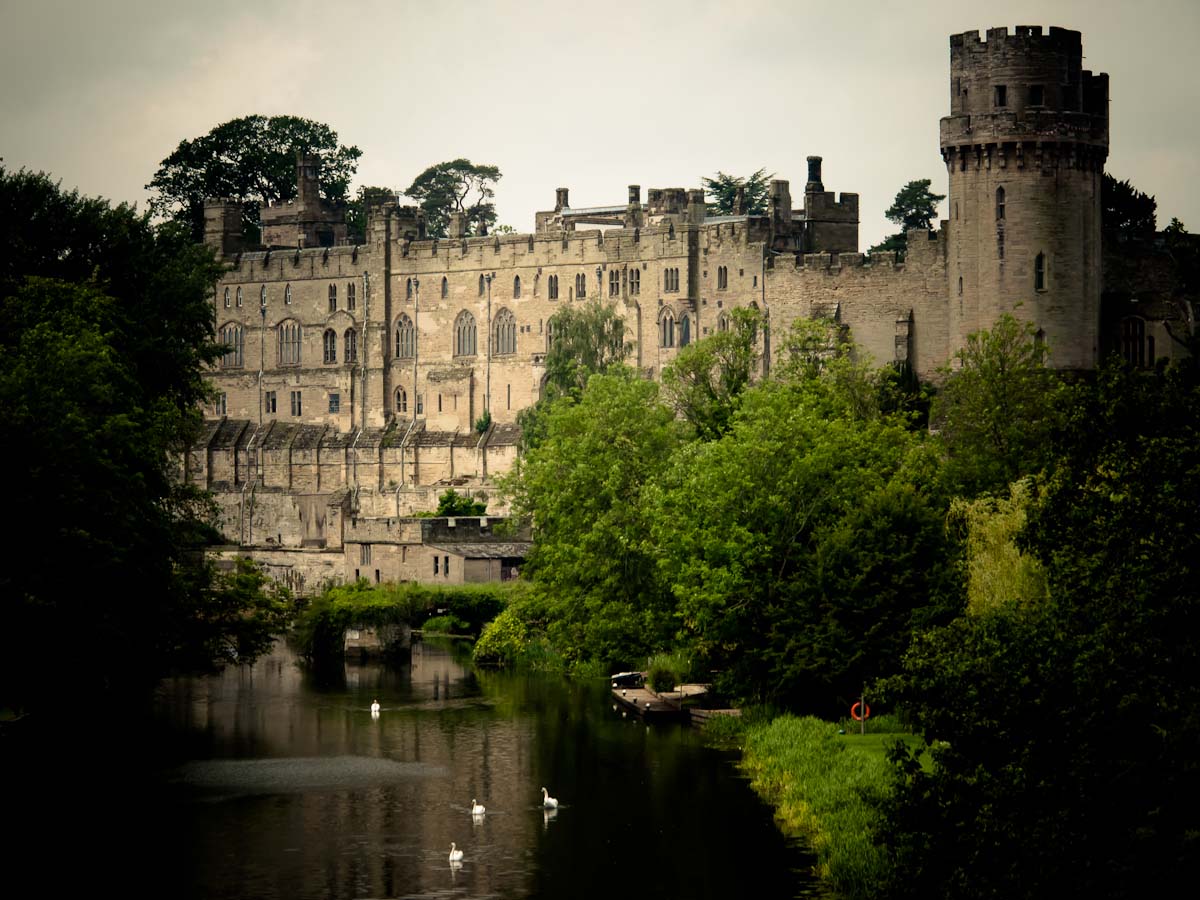
My last day in England before flying to Dublin from Birmingham Airport, took me briefly to Warwick Castle.

When we arrived there was a low mist making for extremely dull photos, so we went for a walk, and waited … until for a brief few minutes, a few rays of sunlight broke their way through the misty cloud to highlight the castle in a gentle bathe of glow, just as the swans decided to have a swim….but I think you will agree, the wait was worth it ….

Warwick Castle

and from a pretty English garden perspective:

Warwick Castle

and yes… I probably should have cropped out those leaves on the left border!

ps… I highly recommend flying out of Birmingham Airport – low stress, easy access for hire car drop off, not as busy as Heathrow yet a reasonable number of retail shops to browse whilst awaiting your flight – my only annoyance was when Aer Lingus unilaterally decided to re-schedule my pre-booked flight for 6 hours later in the day impacting my hire car plans in Ireland with no option to negotiate other than by international phone call – and I was not going to throw more money after bad – they notified me by email a fortnight after I had booked the flight but indicated that any return email would be neglected.

Next stop …. Ireland …..


Where to now for Olympus, Micro Four Thirds and Four Thirds cameras and lenses?

Written by Gary on July 30th, 2012

It certainly has been a roller-coaster 18 months at Olympus.

In 2011, it looked like it may have been all over for them as an independent camera manufacturer with all the now well documented financial upheavals which have apparently been a blight of the profit sheets for some 20 years.

Their innovative Four Thirds camera system was looking like there was zero future.

Their quite successful PEN series of Micro Four Thirds cameras still didn’t have the functionality and image quality to attract enthusiasts like myself who wanted a high end camera with a built-in viewfinder.

Their innovative waterproof, shock-proof, everything proof TOUGH cameras were losing their attractiveness due to better performing competition products which nudged in on this market, while the need for such cameras were diminishing given that most had a camera phone now.

Then all of a sudden, out of no where, they introduce, arguably, one of the best cameras ever made for the non-professional photographer, the brilliant Olympus OM-D E-M5 Micro Four Thirds camera

The E-M5  has lived up to the hype because,  for the first time in a mirrorless compact system camera, it combined almost everything most people need and want:

  • fantastic image quality even at ISO 1600 with incredibly wide dynamic range for a small sensor
  • sufficiently narrow depth of field for most purposes when using the wide aperture prime lenses
  • the fastest autofocus in any camera ever made (not to mention that it can be programmed to AF on a subject’s eye)
  • the best image stabilisation system in any camera ever made
  • a nice built-in EVF
  • weatherproofing
  • a fast flash x-sync of 1/250th second
  • great build quality
  • nice tiltable touch screen activation of fast AF and shutter release which is great for street photographers, nature photographers, astrophotographers as well as taking low level shots of your grandchild on the floor
  • 9fps burst rate (without AF or IS), 4fps with AF and IS
  • extremely customisable buttons and control wheels to allow versatility for many niche uses
  • unique optional 2 staged battery holder grip to transform the ergonomics for use of larger lenses
  • ability to use almost any lens ever made and have them image stabilised in still mode
  • image stabilised magnified view of highly accurate manual focus when you need it
  • a large number of dedicated autofocus lenses available including some very nice compact wide aperture prime lenses which really make the small sensor sing and along with the IS creates unique opportunities such as hand held half a second exposures without a tripod when using the 12mm lens, or hand held infrared photography without having to modify the camera.
  • sufficiently high quality movies for most of our needs
  • innovative new functions such as Live BULB mode

For the first time that I can recall, Olympus Australia at least, has gone all out to promote a great Olympus product, for too long the enthusiast camera world marketing has been dominated by the 2 big players – Canon and Nikon that it would seem Olympus didn’t really exist in this market.

Along with Panasonic, I think the Micro Four Thirds system will continue to dominate the mirrorless world as it gives the perfect combination of lens size and image quality for most people’s needs whilst still allowing shallow depth of field imagery when you want it, while being close to the perfect size for high end movie production.

Nikon has gone the small ladies camera route with its Nikon 1 system but with very limited ability to get narrow depth of field and limited lens range as yet, which will seriously forever limit it’s attraction to the enthusiast photographer and will perhaps struggle to compete with the likes of the Sony RX-100 fixed lens wide aperture zoom 2.7x crop shirt-pocketable compact cameras.

Canon has joined the plethora of APS-C mirrorless cameras and will be stuck with no built-in image stabilisation and larger, heavier lenses, and stragely, they do not seem to have developed super fast AF yet according to current reports of the EOS-M camera.

This leaves a brilliant opportunity for Olympus and Panasonic to really make great strides in their dominance of the compact system camera market and to bring life back into their Four Thirds system which makes a nice complimentary camera system in the interim for those wanting fast AF tracking for fast moving subjects, and this would help placate many patient long-suffering Four Thirds users frustrated by the lack of direction in recent years.

So what would I do if I was running Olympus?

  1. immediately update ALL of their PEN and current Four Thirds cameras (the E-5) with the E-M5 technology – few people want to buy older technology, particularly if it means poorer image quality
  2. update the E-M5 firmware to address the minor niggles:
    1. allow IS to work in movie mode when using legacy lenses
    2. improve the movie mode codec to further improve image quality and add 24p/25p video
    3. add a lower shutter speed limit for autoISO
    4. when LCD is inactive and EVF auto-switching is disabled, or the EVF is active, pressing PLAY should display the photo in the EVF NOT on the LCD screen!
  3. develop a solution to allow fast AF on mirrorless with the wonderful range of Four Thirds lenses – although introducing a E-5 mark II with E-M5 technology would delay the need for this
  4. re-vamp their macro flash system – there are no adapters for the flashes to allow fitting on any of the M43 lenses and they will only fit on a couple of ZD lenses – this is quite a ridiculous scenario that is easily fixed via adapters in the short term until they create a more compact system for mirrorless cameras with remote TTL capabilities
  5. work on a radio wireless TTL flash system
  6. add a few extra features to firmware such as automatic HDR mode, panoramic sweep, manual focus peaking
  7. continue development of high quality compact lenses (preferably with weatherproofing) such as a 20mm f/1.8 pancake with MSC AF and nice bokeh (to address the deficiencies of one of the best loved lenses – the very sharp Panasonic 20mm f/1.7 pancake), and a 150mm f/2.8 weatherproofed macro
  8. add a high end model with the best HD video possible, shutter speeds to 1/8000th second, silent global electronic shutter option,  and higher burst rates (eg. 40fps in 4mp of higher to allow scientific applications), perhaps a hybrid optical EVF
  9. work with a 3rd party vendor to develop weatherproofed, AF and aperture control lens adapters to allow full control of Canon EF and Nikon G lenses – now that would make it VERY interesting!

Who would have predicted such a turn around in fortunes for Olympus – it is exciting times, now all they have to do is make the most of the opportunities.


In search of the most versatile, compact, shallow depth of field short telephoto lens – will this be the new Olympus 75mm f/1.8?

Written by Gary on July 26th, 2012

For much of my photography, I have been in love with my 1.3x crop pro Canon 1D Mark III dSLR with the Canon EF 135mm f/2L lens which makes a fantastic combination for 3/4 body length fashion shots or general people shots outdoors when shot at f/2.5-3.2 to gain adequate depth of field for this subject while delivering a lovely blurred background.

In 35mm full frame terms, this then equates to 176mm shot at f/3.3-4.1.

On a 35mm full frame camera, this is easily satisfied by the traditional pro 70-200mm f/2.8 IS lens ($2,699), or adding a 1.4x teleconverter ($615) to the 135mm f/2.0L lens ($1415).

However,  these lenses are expensive, big and heavy, and to upgrade my 10 megapixel Canon 1D Mark III to a Canon 5D Mark III ($3,900) or Canon 1Dx ($7,999) is a very expensive and heavy option.

It is a pity Canon has not introduced an “affordable” full frame compact system camera in the sub $2,000 price point with built-in IS – instead we have more of the same with their EOS-M APS-C format.

A compromise may be a APS-C dSLR such as the Canon 7D combined with a Canon EF 85mm f/1.8 ($585 = 136mm f/2.9) but this lens has too much purple fringing wide open for my liking, while the 85mm f/1.2 ($2,399)  is far too expensive and AF is too slow, while the 100mm f/2.8 IS macro ($1,299 =160mm f/4.5) does not allow as shallow a depth of field as I would like. So on a 7D, the Canon 100mm f/2.0 ($499 = 160mm f/3.2) would be the closest in filling the needs and is a great value for money lens although a touch soft towards the edges wide open on a APS-C dSLR. I suspect Canon will be producing an update of this lens soon which may account for the price drop from $750.

For similar imagery on a 6×6 120 film format (crop factor of 1/1.83) compared to 35mm full frame, the lens needed would be about 300mm lens at f/6-7.5 which would be rather an unusual focal length for traditional pro film shooters (would probably require mirror lock up to reduce vibrations and a fast grainier film if shooting in the shade), although some would have used a 250mm f/5.6 lens (= 135mm f/3.0 on a 35mm full frame). Many would do most 6×6 film portraits using 150mm f/4 (= 82mm f/2.2 in 35mm full frame terms).

On a Leica S2 0.8x crop medium format dSLR, their longest lens is a 180mm f/3.5 which equates to 144mm f/2.8 in 35mm full frame terms when looking at DOF and FOV, but this would set one back over $35,000.

The Micro Four Thirds solution:

The image quality of my Olympus OM-D E-M5 is comparable, for my needs, to full frame dSLRs, and it having the fantastic image stabiliser which becomes very handy at this focal length when having to use fill-in flash at flash-sync speeds, plus the potentially incredibly fast autofocus with ability to focus on your subject’s nearest eye,  a nice alternative is to find a lens to fit these requirements, so here is a very short list for Micro Four Thirds users that will give comparable imagery:

Samyang/Rokinon 85mm f/1.4 lens:

  • value for money, this is a brilliant lens, and on a Micro Four Thirds camera gives almost identical imagery to what I am after, including buttery smooth bokeh and minimal CA
  • in my tests, it has better optical quality than either the Canon EF 85mm f/1.8 or the Nikon 85mm f/1.4D
  • at under $300 brand new, this is a bargain – BUT it is relatively heavy and it is manual focus
  • despite this, I have 2 of these lenses in different mounts, and these have been special lenses for me so far, but the manual focus is very limiting, particularly with people photography shot with shallow depth of field

Voigtlander HELIAR CLASSIC 75mm f1.8 – Leica M Mount:

  • manual focus lens which costs about $740 brand new
  • introduced in 2010
  • 52mm filter, 423g
  • nice bokeh, but straight diaphragm blades; sharp and contrasty in the centre wide open?

Canon FD 85mm f/1.2:

  • high quality manual focus lens from the 1980’s
  • very narrow DOF, nice bokeh
  • large, heavy and has straight diaphragm blades but at least it has mechanical manual focus so it can be focussed on Micro Four Thirds unlike its EF 85mm f/1.2L successor
  • $700-850 on Ebay 2nd hand

Carl Zeiss Planar T* 85mm f/1.4 lens:

  • available in Canon EF, Pentax K and Nikon F mounts
  • manual focus lens with aperture ring, DOF scale and IR marker
  • 9 rounded blades, almost distortion free, 72mm filter, only a touch of vignetting at f/1.4 at 0.6EV
  • max. sharpness at f/4, a little soft wide open on full frame but you need to stop down a Nikon 85mm 1/1.4D AF Nikkor lens to f/8 to get this sharpness
  • close focus 1m
  • heavy at 570-670g depending on mount; 77x62mm;
  • Photozone test report
  • ~$1300-1600 new

Olympus OM 90mm f/2.0 macro lens:

  • this is one of the best OM lenses one can get, and many Olympus fans swear by it for the special kind of imagery it produces
  • relatively compact size, fantastic macro performance (1:2 on full frame)
  • BUT it will cost about $900 second hand for a excellent version and it is still manual focus
  • there are also many other manual focus full frame lenses in the 75-90mm f/2.0 range including the cheaper OM 85mm f/2.0 and the ultra-expensive (~$4,900) Leica 90mm f/2 APO Summicron-M – perhaps optically the best full frame lens ever made, although even this has some coma on pinpoint light sources wide open

Olympus ZD 35-100mm f/2.0 lens:

  • this superb lens designed for Four Thirds is weatherproof and image quality is top notch and only one of a couple of zoom lenses available with a f/2.0 constant aperture throughout the range
  • BUT it is very expensive, very big and heavy, and although it has AF, AF is slow on Micro Four Thirds cameras

Olympus mZD 75mm f/1.8 lens:

  • that brings us to this new lens by Olympus which was especially designed for Micro Four Thirds with independent lens testing confirming the superb optical design and build quality
  • at a 35mm full frame equivalent field of view of a 150mm lens, the depth of field wide open is then similar to a 150mm f/3.6 lens which will be just adequate for the above requirements
  • this lens has almost no aberrations edge-to-edge even wide open and is incredibly sharp even wide open but sharper still at f/2.8
  • when combined with the E-M5 camera, it has the fastest auto focus in a telephoto lens currently available – faster than any full frame dSLR for stationary to relatively slow moving subjects
  • many have baulked at its $900 price tag, but this is one superb lens and by all accounts, well worth the price tag – just pity it isn’t weatherproofed!
  • hopefully it will be available in the next few weeks as to me, this is the lens-camera combination which will best suit the needs stated above, and will be far cheaper and easier to carry than a full frame kit.

Now all I need is for Olympus to get their act in gear and make an adapter for the Ring flash so I can use it for fill-in flash outdoors (and perhaps create a new Ring Flash with remote TTL flash capability to fire a main flash) – in the interim, I will have to use my Canon Ring Flash in full manual mode, but then, that lets me push the shutter speed up to 1/500th sec if I need to.


The Olympus E-M5 goes searching for some British sun on the south west coast of England

Written by Gary on July 26th, 2012

My 1st adventures roaming south-west England in my hire car were dominated by an unusually wet and cloudy British summer, and thus when the forecast suggested there would be sun for a day that month – but only in the Swanage region of the south coast, I decided to head down there and get some lovely much needed UV light.

Here are a few of my iPad processed shots taken with the Olympus E-M5 Micro Four Thirds camera.

Here I pushed the E-M5 almost to its hand held long exposure limits again to capture the flowing water at Durdle Door using a Hoya R72 infrared filter and hand held 1/6th second exposure with the Olympus 12mm lens which had some vignetting and toning added using Phototoaster on the iPad:


Durdle Door IR long exposure hand held

another infrared photo with lots of Phototoaster processing for fun on the iPad, this time of Corfe Castle ruins:

Corfe Castle IR

and another one of Corfe Castle but this time with a polariser filter, and no IR filter but processed in Phototoaster to add some atmosphere to this wonderful site – what would have been a great little castle in its day until the Parliamentarians spent 6 months destroying it with gunpowder:

Corfe Castle

oh… and I promised a little British sun at the beach:

Durdle Door coast


Finally…Canon announce their mirrorless system … but it does seem quite under-whelming .. after all this is late 2012 not 2008 and the game has changed

Written by Gary on July 24th, 2012

I own a number of excellent Canon pro lenses including the 17mm tilt shift, 45mm tilt-shift, 90mm tilt shift, 24-105mm f/4ISL, 85mm f/1.8, 135mm f/2.0L which are great companions for my now aging Canon 1D Mark III pro dSLR.

I have been waiting several years now for Canon to show their hand and enter the extremely popular compact mirrorless camera system market.

Luckily for me, Panasonic and Olympus have really progressed their Micro Four Thirds system into a lovely high quality and versatile compact camera system led by the brilliant Olympus OM-D E-M5 camera, 12mm f/2.0, 45mm f/1.8 and 75mm f/1.8 lenses all of which I have bought or plan to buy as soon as available (the superb 75mm lens is not on our shores yet).

Yesterday Canon finally showed their hand, and I must say even though it is clearly targeting the entry level consumer market, I felt somewhat under-whelmed by it for the price point being offered and the reportedly slow AF performance.

Their take on mirrorless compact camera system is to go the conservative route with a 1.6x crop APS-C sensor to reduce confusion amongst their users and to potentially give a 1 stop improved capacity for lower image noise at high ISO and shallower depth of field at same field of view and aperture when compared to a 2x crop system such as the Micro Four Thirds.

The massive downside though is that they are now burdened with always having to have larger, heavier lenses which defeats the whole purpose of a compact system – no matter how small you make the camera as Sony discovered, the lenses just look bigger and more awkward to use.

They will also have difficulty matching edge-to-edge optical image quality of the 2x crop sensor with lenses at wide aperture as they will always be fighting the laws of physics on this arena – aberrations increase the further you go from the centre, some at an exponential rate!

Canon perhaps have been wise at least in offering their small well built but mid-level EOS-M camera with a nice small 22mm f/2.0 STM pancake lens with the option of a reasonably compact 3x kit zoom lens as starters to their new system.

Unfortunately, the EOS-M camera seems to have little better functionality than the initial Olympus PEN cameras in 2009 which were plagued by the lack of viewfinder, the lack of built-in flash and slow AF. Most importantly now, the reportedly very slow “Hybrid AF” system Canon has borrowed from the live view function of their 650D dSLR – would seem is so far behind the Micro Four Thirds pack it is just not funny, but in Canon’s favor is that they have until the October release date to try to remedy the slow AF speed and get at least part of the way to the fast AF of Olympus, Panasonic and Nikon.

Canon users with existing EF-S or EF lenses who want to use these on the EOS-M will likely find they will focus slowly as they are not optimised for CD-AF or the “Hybrid-AF” technologies as they do not have STM AF technology built in, and apart from smaller size camera and quieter shutter there are no gains compared to using a Canon 650D dSLR but they would lose:

  • ergonomics to handle the larger lenses
  • built-in viewfinder
  • fast phase detect AF
  • built-in flash
  • marginally faster 5fps burst rate (4.3fps on EOS-M although burst rate with pancake lens in AF tracking mode is only 1.2fps!)
  • articulated, swivel LCD screen
  • remote control
  • +/- 5EV exposure compensation (only +/- 3EV on the EOS-M)

Those wishing to use their EF or EF-S lenses on a mirrorless camera would find much justification in choosing an Olympus OM-D E-M5 camera instead, because, even though you lose AF altogether, at the slow AF speeds available on the EOS-M, you may as well use manual focus anyway, and loss of aperture control is usually not a big deal as you tend to want to use these lenses for a specific purpose at a given aperture anyway, and the Olympus gives you some enormous benefits over the 650D or the EOS-M including:

  • optional battery holder makes ergonomics of using these heavy lenses more practical
  • “5 stop 5-axis” built-in image stabilisation
    • allows much easier, faster and more accurate manual focus using magnified view with IS enabled
    • converts ALL lenses into image stabilised lenses even tilt-shift and prime lenses for still images (this is not yet available for movie mode but I expect this will come sooon)
    • allows slow shutter speeds hand held using wide angle lenses for flowing water shots without having to lug a tripod around, or from positions where tripods would be impossible
    • allows hand held infrared photography at low ISO without resorting to costly modification of the camera
    • allows use of long prime telephoto lenses or the 90mm tilt shift lens hand held with fill-in flash at x-sync – great for fashion shoots
  • quiet shutter capable of 9fps burst rates (4fps with IS on)
  • high build quality with weatherproofing of the body
  • built-in high quality viewfinder means
    • you hold the camera to your eye to improve stability
    • you don’t need your reading glasses to operate the camera or review images – try chimping your shots to see if you had accurate focus on an LCD screen without your reading glasses!
    • you have access to magnified view for manual focus, live histogram, full camera settings control and electronic horizon levels all within the EVF
    • you can see the image in bright sunlight
    • you can be more discrete in low light environments such as concerts and weddings without having a distracting bright image show up on your LCD screen
  • tiltable touch screen for easier high and low angle shots as well as tripod mounted and astrophotography work
  • Live BULB mode which can change the way you work in low light and open up new options such as iPhone lighting, fire twirling, moving subjects – seeing the image build up in long exposures can make a difference, plus it makes you more efficient for astrophotography – if you made an error just terminate exposure when you notice it on screen.
  • ability to use the fastest AF currently available on any camera with the lovely 45mm f/1.8 and 75mm f/1.8 lenses
  • ability to have fast AF on the closest eye of your subject – fantastic for portraits and fashion shoots – no more focus then recompose, and far more accurate and faster focusing (when using the dedicated lenses)
  • ability to use any of the 30-40 Micro Four Thirds lenses – the biggest range of dedicated AF lenses in the mirrorless market
  • ability to use the superb quality but slow focusing Four Thirds lenses
  • high quality jpegs straight from the camera – the best colors and among the best dynamic range jpegs you can get in cameras under $10,000
  • high quality 30″x 40″ prints almost indistinguishable in image quality to current full frame dSLR cameras (if depth of field is not part of the comparison)
  • greater hand holdable telephoto reach thanks to the 2x crop factor, complimenting a full frame dSLR very nicely indeed
  • greater depth of field at low ISO when shooting hand held shots at night for urban landscapes or at dusk for normal landscapes or waterfalls when you really want everything sharp!

Of course, if high quality video is your main thing, and you want a mirrorless camera, then one can’t really go past the Panasonic GH-2 or its forthcoming replacement, the GH-3.

I will await pricing on the newly announced Kipon EOS-Micro Four Thirds lens adapter with full electronic control of aperture as I just can’t see the Canon mirrorless camera system without built-in image stabilisation being the future, but for many it may be a useful tool.

Canon it would seem has been worrying that introducing a mirrorless camera system would consume their profitable dSLR sales – well on this initial offering, I don’t think they have much to fear!

As an entry-level camera for users who ONLY want to use a pancake lens or 3x zoom, and have no interest in adding fast AF wide aperture lenses in the near future, then the EOS-M with pancake lens does offer some reasonable competition to the likes of Olympus E-P3, E-PL3, E-PM1, Panasonic GF3, GF5, GX-1 as it does offer good video, a touch screen, great build quality, hot shoe and perhaps better image quality, and if the pancake lens proves to be sharp with nice bokeh, then the $899 may be very reasonable price point.

It is essentially the same price as an Olympus E-P3 with its 3x zoom kit lens but the E-P3 has fast AF, optional EVF, pop-up flash and built-in IS while the EOS-M has a higher resolution larger sensor and LCD screen, and 24fps HD video.

I would be hoping that Canon follow this up with some real killer cameras with features similar to the Olympus E-M5 and lenses but if history repeats, I would not be too optimistic on the high quality lens front, after all, there is only one reasonably high end EF-S lens to support their cropped sensor dSLRs and they have been around for over 10 years now.

NOTE to Canon – you MUST have fast AF to appeal to almost anyone in 2012 – even if you only have 2 dedicated lenses, no EVF option and no IS built-in.

Seems I am far from alone on my opinion on the EOS-M strategy – just Google the web for a multitude of similar opinions such as Kirk Tuck‘s.