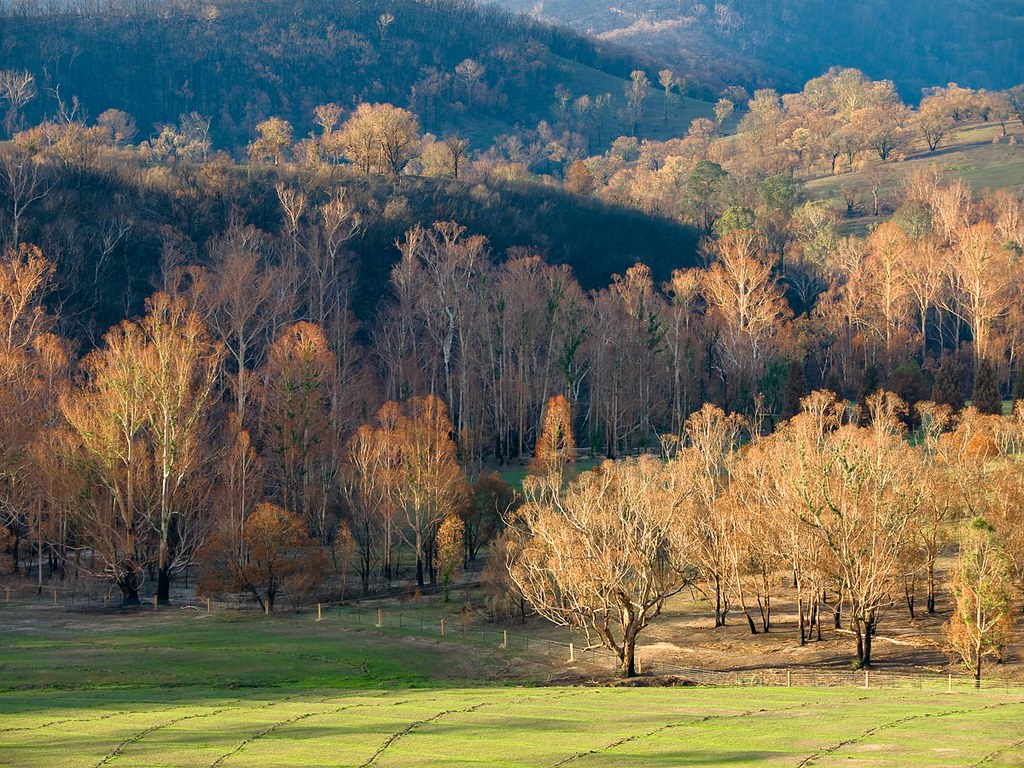
The Victorian goldfields of the 1850’s gold rush in infrared – Canon 1D Mark III with Olympus OM 21mm

Written by Gary on February 19th, 2011

IR goldfields

Click image for larger view.

Hoya R72 filter. ISO 200, 8sec exposure and I think it was about f/8.

No modification to image other than convert to B&W and minor levels adjustment.

Note that this OM 21mm f/3.5, unlike the other less wide angle OM lenses, creates a radial CA-like effect visible at high contrast edges such as at the tops of the trees. This OM lens is a beautiful compact ultra wide but alas is not so suitable for IR work.


A day trip to the Victorian countryside – digital infrared landscape – Canon 1D Mark III with OM 100mm f/2.8 lens

Written by Gary on February 19th, 2011

IR landcsape

Click image for larger view.

Hoya R72 filter. ISO 800, 1.6sec exposure and I think it was about f/8.

No modification to image other than convert to B&W and minor levels adjustment.

I even left in the stuck hot pixels of my Canon 1D Mark III to remind Canon that perhaps they could take the lead of Olympus and add a pixel mapping functionality to their cameras to eradicate this issue.

Interestingly, other IR images with this 100mm f/2.8 lens showed a rectangular central hotspot which presumably arises from light bouncing off the rear lens element and a shadow being cast by the camera’s mirror box as I can’t explain it any other way. This central rectangular hot spot is subtly visible to the right of this image as a lightening of the sky.


Evolution of dSLRs Part II – the Canon x0D series

Written by Gary on February 17th, 2011

Canon has taken a quite conservative approach to evolving their dSLR range, adopting features of other manufacturers such as Live View,  Sensor Dust Reduction, In-Camera RAW development, Art Filters, flip out LCD – all of which were in Olympus dSLRs long before Canon decided they were in fact a good idea.

The precursors to this series were among the first CMOS dSLRs which changed digital photography by bringing in the power of the SLR albeit without dedicated lenses for the 1.6x crop factor, these were:

  • Canon D30, a 3mpixel camera introduced in 2000
  • Canon D60, a 6.3 mpixel camera introduced in 2002

In March 2003, Canon announced the start of a new series – the 6.3mp 10D – derived from the pro 1D series and with magnesium bodies instead of plastic as with the D30 and D60, and the entry  level xx0D series. The body is redesigned from the D60, and adds 10x playback magnification, orientation sensor, brighter LCD, Kelvin-selectable WB, WB bracketing, improved manufacturing of the D60 sensor increasing ISO to 1600 and 3200 via custom function, autoISO, scene modes, 7 point AF, removal of AF asist lamp and replaced with functionality from the flash, ability to register an AF point, improved AIservo AF, improved metering algorithm, a safety shift Tv/Av option, the new DIGIC image processor, ability to select AdobeRGB or sRGB workspace, +/- 2 steps of adjustment for image parameters, direct print support to Canon printers, FAT32 support allowing CF cards greater than 2Gb, improved shutter release lag, a dedicated flash-off scene mode, 12 menu languages instead of 4, and a smaller battery charger.

Common features of most of these cameras include:

  • 1.6x crop factor compared to 35mm full frame cameras
  • ability to use Canon EF-S lenses as well as Canon EF lenses
  • magnesium alloy design with partial environmental seals in 40D onwards BUT the 60D has reverted to plastic design but you do get a flip out LCD!
  • pentaprism optical viewfinder but only shows ~95% of the actual image area.
  • a shutter speed range of 30sec to 1/8000th sec (I am not sure why they did not make it 60sec as the longest timed shutter as this would make it much more useful for astrophotography in particular).
  • 6 white balance positions plus manual setting plus Kelvin setting
  • pop-up flash of GN 13m (ISO 100)
  • flash sync 1/250th sec instead of 1/200th as on the xx0D range
  • PC sync port on pre-50D only (not present on xx0D range and not on the 60D)
  • E-TTLII compatibility EXCEPT the 10D which is only E-TTL
  • exposure compensation limited to +/- 2 EV EXCEPT the 60D which at last has a decent range and is +/- 5EV
  • 35 area metering EXCEPT the 60D which has 63 areas iFCL
  • N3 remote connector instead of the lower end E3 connector
  • no infrared remote control on models prior to 60D
  • wireless TTL control on 60D only
  • 60D also loses prior model functionality of joystick, multi-flash support, details in status LCD, AF microadjust, multiple custom modes, buttons.
  • orientation sensor
  • the models with Live View, like all dSLRs but unlike mirrorless cameras such as micro four Thirds, have a clunky, cumbersome implementation with very slow AF
  • a status LCD information screen at top of camera
  • at least two command dials
  • 2 or 10sec self timer
  • timelapse recording via USB cable, TC-80N3 remote controller and a PC
  • USB 2.0 except 10D which only had USB 1.1 and thus much slower image transfers to computer
  • histogram on playback – luminance or RGB for models starting at 30D
  • none have built-in image stabiliser as do Olympus and Sony cameras, but rely on lenses having optical image stabilisation
  • none have lens AF microadjustment to ensure accurate AF calibration except for the 50D
  • all weigh about 770g with battery

To make the following table easier to read I have deleted the initial model, the 6.3mp 10D which was introduced in 2003.

Comparison feature sets
Feature 20D 30D 40D 50D 60D
year introduced Nov 2004 April 2006 Oct 2007 Oct 2008 Nov 2010
megapixels 8.2 8.2 10.1 15.1 17.9
pixel density (MP/cm²) 2.4 2.4 3.1 4.5 5.4
max ISO (in brackets max. boost) 1600 (3200) 1600 (3200) 1600 (3200) 3200 (12800) 3200 (12800)
AF points 9 9 9, all cross 9, all cross 9, all cross
Live view magnified manual focus No No Yes
Yes, CDAF (slow) Yes, CDAF(slow)
Built-in image stabiliser No No No No No
Sensor dust removal system No No Yes Yes Yes
Flip out, swivel LCD No No No No Yes
LCD resolution 1.8″ 118K 2.5″ 230K 3″ 230K 3″ 920K 3″ 1,040K
Video recording No No No 1080i 20fps, 720p 30fps 1080i 30/25/24fps, 720p 60/50fps
external microphone socket No No No No Yes
Burst rate 5.0 5.0/3.0 6.5/3.0 6.3/3.0 5.3
Max. RAW in burst 6 11 12? 9? 16
memory card CF CF CF CF SD/SDHC /SDXC
mirror lock up custom custom custom custom custom
HDMI out for TV playback No No No Yes Yes
GPS No No No No No
spot metering No Yes 3.5% Yes 3.8% Yes 3.8% Yes
custom functions 18 19 24 25 12
lens AF microadjustment for accurate AF No No No Yes No
highlight tone mode No No Yes 3 levels 3 levels?
image parameters basic picture styles picture styles picture styles picture styles, ambience color, art filters, in-camera RAW development
Noise reduction options On/Off On/Off On/Off 4 levels 4 levels?
in-camera jpeg lens correction No No No vignetting profiles vignetting profiles, distortion and CA correction

Interestingly, with the 60D, Canon has lowered the usual specs of this series to provide differential to their new higher end APS-C series which started with the 7D.

Nevertheless, it does offer a good solution for enthusiasts who might also want to do HD video, although the HD video capabilities and ease of use will not match mirrorless cameras such as the Panasonic GH series. To offset this, the phase contrast AF is much better for AF on fast moving subjects than the AF in current mirrorless cameras.


Evolution of the dSLR part 1 – the Canon xx0D series

Written by Gary on February 17th, 2011

Canon has taken a quite conservative approach to evolving their dSLR range, adopting features of other manufacturers such as Live View, and Sensor Dust Reduction – both of which were in Olympus dSLRs before Canon decided they were in fact a good idea. Likewise flip out LCD is yet to make it into this budget range although Canon has just added it to the mid-level 60D.

Common features of all of these cameras include:

  • 1.6x crop factor compared to 35mm full frame cameras
  • ability to use Canon EF-S lenses as well as Canon EF lenses
  • plastic budget design with no environmental seals to protect from moisture or dust
  • tunnel-vision-like pentamirror design which I feel is not as good as the current EVF’s in mirrorless cameras such as the Panasonic GH series and is no where near as nice to use as pentaprism designs in the more expensive dSLRs. This design generally only shows ~95% of the actual image area.
  • a shutter speed range of 30sec to 1/4000th sec (I am not sure why they did not make it 60sec as the longest timed shutter as this would make it much more useful for astrophotography in particular).
  • 6 white balance positions plus manual setting although no Kelvin setting
  • pop-up flash of GN 12m (ISO 100) for the earlier models and 13m for the later models
  • flash sync 1/200th sec
  • E-TTLII compatibility EXCEPT the 300D which is only E-TTL
  • exposure compensation limited to +/- 2 EV EXCEPT the 550D which at last has a decent range and is +/- 5EV
  • 35 area metering EXCEPT the 550D which has 63 areas iFCL
  • E3 remote connector instead of the higher end N3 connector
  • infrared remote control
  • orientation sensor
  • the models with Live View, like all dSLRs but unlike mirrorless cameras such as micro four Thirds, have a clunky, cumbersome implementation with very slow AF
  • no status LCD information screen at top of camera as with higher end models
  • only one command dial
  • 2 or 10sec self timer, except 300D which only had 10sec timer but the infrared gave a 2sec delay; 450D onwards allows multi-shots in self timer mode;
  • USB 2.0 except 300D which only had USB 1.0 and thus much slower image transfers to computer
  • histogram on playback – luminance or RGB for models starting at 400D
  • none have built-in image stabiliser as do Olympus and Sony cameras, but rely on lenses having optical image stabilisation
  • none have lens AF microadjustment to ensure accurate AF calibration
  • all weigh about 530g with battery, except the 300D which was 645g

To make the following table easier to read I have deleted the initial model, the 6.3mp 300D which was a cut down version of the 10D and introduced in 2003. The 350D had a multitude of functional enhancements over the 300D.

Comparison feature sets
Feature 350D 400D 450D 500D 550D
year introduced Feb 2005 Aug 2006 Jan 2008 Mar 2009 Feb 2010
megapixels 8.0 10.1 12.2 15.1 18.0
pixel density (MP/cm²) 2.4 3.1 3.7 4.5 5.4
max ISO (in brackets max. boost) 1600 1600 1600 3200 (12800) 6400 (12800)
AF points 7 9 9,centre cross 9,centre cross 9, centre cross
Live view magnified manual focus No No Yes, CDAF (slow)
Yes, CDAF (slow),face Yes, CDAF(slow), face
Built-in image stabiliser No No No No No
Sensor dust removal system No Yes Yes Yes Yes
Flip out, swivel LCD No No No No No
LCD resolution 1.8″ 115K 2.5″ 230K 3″ 230K 3″ 920K 3″ 1,040K
Video recording No No No 1080i 20fps, 720p 30fps 1080i 30/25/24fps, 720p 60/50fps
external microphone socket No No No No Yes
Burst rate 2.8 3.0 3.5 3.4 3.7
Max. RAW in burst 4 10 6 6
memory card CF CF SD/SDHC SD/SDHC SD/SDHC /SDXC
mirror lock up custom custom custom, on 2sec timer custom, on 2sec timer custom, on 2sec timer
HDMI out for TV playback No No No Yes Yes
GPS No No No No No
spot metering No No Yes 4% Yes Yes
custom functions 9 11 13 12
lens AF microadjustment for accurate AF No No No No No
highlight tone mode No No Yes 3 levels 3 levels?
image parameters basic picture styles picture styles picture styles picture styles
Noise reduction options On/Off On/Off On/Off 4 levels 4 levels?
in-camera jpeg lens correction No No No vignetting profiles vignetting profiles

I would think the next model will at last get a flip out LCD, but after that there are few advantages other than phase contrast AF which will sway people away from the surge in popularity of the smaller, quieter, more video-friendly mirrorless cameras such as Micro Four Thirds which will inevitably dominate this niche of the marketplace, as Olympus has already realised and has thus slowed development of entry level dSLRs.

Where can Canon or Nikon go with dSLRs now that they have matured to have adequate resolution (10mpixels is plenty for most of us – my Canon 1D Mark III is “only” 10mp but will produce 20″x30″ prints), high ISO is adequate for most (I still rarely use higher than ISO 800), 1080i and 720p movie is adequate for most of us as long as there is other video support features, phase contrast AF seems to have had little improvement in speed recently, perhaps we have reached its peak for the time being, the current LCD screens are adequate.

The main areas to improve are dynamic range, contrast detect AF speed in live view, improved live view functionality, built-in variable ND filter for video work, more video functions, perhaps a IR blocking filter which can be switched with a 720nm filter for IR work, built-in image stabiliser, faster flash sync, and better EF-S lenses as the current ones are no match for a 18mp sensor.

But all these are possible or at least more easy to implement with mirrorless cameras and thus the future technologic progress is much more likely to be with mirrorless cameras than with dSLRs.


Fascinating mug shots of Australian criminals taken by Sydney police in the 1920’s

Written by Gary on February 8th, 2011

see this blog for some interesting pics!

you can buy the book from Amazon.


Tourism Victoria is offering a chance to win a free photographic holiday to the Grampians – entries close 1st March 2011

Written by Gary on February 8th, 2011

If you are interested in putting your name down in a free lottery draw, you and your partner may win a holiday to Victoria’s magnificent Grampians region including a full day landscape/nature photography lessons and tour with Nikon ambassador, Mark Watson, which includes free loan of Nikon equipment.

The 5 day holiday prize organised by Tourism Victoria includes flights, accommodation, meal and other benefits up to a value of $A9,997.

Details and entry form can be found here.


Carl Zeiss lens group joins Micro Four Thirds standard

Written by Gary on February 8th, 2011

Rapidly following on from the announcement that Schneider lens group has joined Micro Four Thirds, Olympus has posted an announcement that Carl Zeiss AG has joined the Micro Four Thirds standard.

Micro Four Thirds now has all of the top 3 European lens makers on board:

  • Leica through the Panasonic partnership
  • Carl Zeiss
  • Schneider

Plus you have the Asian manufacturers either officially supporting the standard or via 3rd party AF adapters:

  • Panasonic
  • Olympus
  • Sigma
  • Voigtlander (Cosina) – Cosina also manufactures manual focus SLR lenses for Carl Zeiss with Nikon (ZF), Pentax (ZK), Canon EOS (ZE), and M42 screw mounts (ZS).
  • Canon EF and EF-S via the Birger Engineering AF adapter – and yes, that means you could in theory use the newly announced Canon EF 200-400mm f/4 IS L with 1.4x telextender on your Panasonic GH-1 or GH-2 and not only gain AF, aperture control and optical IS, but get telephoto reach of a 400-800mm f/4 lens with switchable option of 1.4x mode to give reach of a 560-1120mm f/5.6 – of course you would need to mount the lens on a nice sturdy tripod, but it would add a nice extra option to its use on a Canon 1D Mark IV or a Canon 1Ds Mark III.

And if that is not enough, you can adapt almost any other lens ever made in manual focus and stop down aperture mode via the appropriate adapter.


More exciting news for Micro Four Thirds as Schneider-Kreuznach joins the standard

Written by Gary on February 5th, 2011

Schneider-Kreuznach announced this week that it has joined the Micro Four Thirds System Standard Group – see this pdf for details.

The Schneider group specialises in producing high-performance photographic and cinema lenses, and “are working intensively to develop lenses for Micro Four Thirds”.

This is more great news which comes on from my last photography post where we can now buy an adapter which allows AF, aperture control and optical IS with Canon EF and EF-S lenses on the bigger Micro Four Thirds cameras such as the Panasonic GH-1 and GH-2.


Cairns advised to evacuate as massive Cyclone Yasi builds strength and likely to cause severe local damage, and widespread flooding down to flood-stricken Victoria

Written by Gary on February 1st, 2011

Areas of Victoria’s north west are still on major flood alerts as flood waters slowly pass down the Murray River region near Swan Hill at 2km per day.

Queensland is recovering from their recent once in a hundred year floods and it is still raining courtesy of the recent small cyclone which has now become a monsoonal depression over inland Queensland.

Now northern Queensland is bracing itself for a 700km diameter monster cyclone – Cyclone Yasi – almost as big as Queensland itself, and expected to be twice as large as the last devasting cyclone, Cyclone Larry, which hit in March 2006 as a category 4 cyclone, the most powerful to cross the Qld coastline in a century. The areas most likely to be hit hardest by rain, wind and storm surges is the area between Cairns and Innisfail, with possible direct path including Townsville.

The Queensland Premier has just announced evacuation of all patients from Cairns private and public hospitals – the first ever evacuation of a regional hospital in the State’s history.

See Youtube video of the potential path and likely effects on rainfall throughout eastern Australia:


Micro Four Thirds adapter to allow aperture control, AF and optical IS with Canon EF lenses – now that is exciting news!

Written by Gary on January 24th, 2011

Birger Engineering have announced that their new Canon EOS/EF adapter for the Panasonic AF100 Micro Four Thirds camcorder will also work fully on the Micro Four Thirds cameras with larger power supplies such as the Panasonic GH-1 and Panasonic GH-2.

Birger state that it will be available from 14th Feb 2011 and price will be $US700.

This means that those like me who own nice Canon L lenses can also use them on their GH-1 with full aperture control, auto-focus and optical image stabilisation – all powered via the Micro Four Thirds mount pins.

Now that is very cool – of course, you will still be using them at 2x crop factor, but it will value add to users of both systems substantially!

Of course, don’t expect such an adapter to be cheap, and I suspect the autofocus will not be fast as these Canon lenses are not optimised for contrast detect AF, but every little bit helps, and having aperture control at last will be a real boon!

Just imagine using a Canon 50mm f/1.2 L lens – at 100mm equivalent focal length in 35mm terms, this would make a great portrait lens on a GH-1 or GH-2!

Or perhaps, you are into nature photography and the Canon 100mm f/2.8 L IS macro lens would be heaven – and you get the benefits of optical image stabilisation!

Or even the Canon 300mm f/4L IS to give hand held, image stabilised telephoto reach of a 600mm lens yet at f/4 aperture for fast shutter speeds – fantastic for slow moving subjects or where you can pre-focus.

Already, the Canon 90mm tilt shift lens being manual focus is a much easier lens to use on mirrorless cameras such as Micro Four Thirds as manual focus on a tilted image plane is best done in magnified live view which is quite cumbersome on a dSLR, but now we will also gain aperture control – just brilliant!

Now, I wonder if face recognition AF will work with these lenses as some of these lenses have very shallow depth of field and on a dSLR, it can be quite difficult to keep the focus on the face when the face is not in the centre of the image, or on your selected AF point.

Hopefully, the Panasonic flash TTL exposures will work as the camera should now have the aperture value – the GH-1 did not expose TTL flash well at all when used with legacy lenses where the camera could not determine the aperture.

See the announcement here on eoshd.com.