New Pocket Wizard “Zone Controller” to make remote flash even easier

Written by Gary on June 17th, 2009

LPA Design has announced a new accessory for their new remote radio wireless TTL flash system which I have previously written blogs on – the FlexTT5 and MiniTT1 – a simple to use Zone Controller.

Pocket wizard zone controller

Pocket wizard zone controller sitting on a FlexTT5

Now unfortunately, the FlexTT5 and MiniTT1 still has not reached Australian shores so I have not been able to try one, let alone buy them for my Canon system, but I am very keen to do so as they add some nice functionality, not the least, high speed sync at full flash output.

The main problem with this new system is that to change the settings, you need a laptop, and to set zone output levels, you need a flash like the Canon 580EXII sitting on top of one.

The new accessory, the Zone Controller helps make life easier by sitting in the hotshoe of a camera-mounted FlexTT5 or MiniTT1 unit, and then each of 3 zones of remote flash units can be easily controlled with 3 main modes:

Auto:

  • this allows you to dial in a flash compensation value in 1/3rd stop increments to +/- 3EV and in addition, takes into account the camera’s FEC setting which will apply to all 3 zones.

Manual:

  • this allows you to dial in a manual power output of each flash down to 1/64th power.

Off:

  • not surprisingly, this means that zone is not triggered.

For simplicity, there are 3 thumb dials to control the level for each zone and a switch for each zone to set the mode.

If you want to have a flash on camera, then a 580EXII on a FlexTT5 or MiniTT1 will probably suit your needs better than the Zone Controller, but for other purposes, the Zone Controller will be very nice indeed.

It is expected to be available in the US for Canon systems in August/September 2009.


The revolutionary Olympus E-P1 micro four thirds digital camera is launched

Written by Gary on June 16th, 2009

As rumored, the Olympus E-P1 officially launched today will likely be the start of a new style of high quality, interchangable lens, thin, pocketable digital cameras based on the famous Olympus Pen film cameras which I discussed in my last blog.

Why the excitement?

Unlike the recent rather ho-hum dSLR offerings by both Canon and Nikon – ah yes more pixels we don’t need, in same old form factors and still no built-in CCD-shift image stabilisation, and gimicky attempts at video (no AF during video), the new Micro Four Thirds cameras (GH-1 and E-P1) are truly exciting cameras and much smaller and with much quieter shutters making them more versatile and portable.

Don’t get me wrong, I have a large Canon pro system, but its just that Canon and Nikon don’t seem to have much vision for lateral thinking like the Four Thirds teams have, or perhaps Four Thirds have got the right format size after all and Canon and Nikon will not be able to compete for this genre camera?

Not everyone will like the necessary compromises Olympus had to make in order to add most of the functionality of its much larger E-620 dSLR, into a thin pocketable camera (jacket pocket).

In particular, they may miss a through the lens optical view finder or an electronic viewfinder or EVF (as the Panasonic G1 and GH-1 have), but they will be able to attach an optical viewfinder into the hotshoe which will be great when using the 17mm f/2.8 pancake lens, but not so useful for zoom lenses.

But to the others that have waited a few decades for a digital like the Olympus Pen, this camera may almost be heaven for them, and, unlike the GH-1, is more reasonably priced at $US899 including the 17mm f/2.8 lens and optical viewfinder.

The EP-1 takes many of the best features of a dSLR and places them in a much quieter, slimmer package similar to a Canon G10 but with far greater versatility and image quality.

The differentiating benefits over the Panasonic G1 and GH-1 are:

  • slim, retro styling in metal body allowing it to be placed in a jacket pocket
  • built-in CCD-shift image stabiliser that will work on all lenses and apparently also in video mode, and said to be up to 4 stops effectiveness
  • Olympus art filters which apparently will function in video capture mode as well
  • 3fps burst mode

The above benefits will be compelling to many people, but there are also some features of the Panasonic GH-1 which will be compelling for other users (including me – although I do really WANT the built in IS):

  • electronic viewfinder – I’m not a big fan of EVF’s but they are better than nothing and the camera becomes more stable when used up to your face, and unlike the Olympus optical viewfinder, you will get access to the information you need, including AF confirmation.
  • swivel LCD – well, guess I am getting spoilt by the swivel LCD on Olympus dSLRs, and now the Panasonic G1 and GH-1 which is really useful for certain situations.
  • HD video – 1080 not just 720p as with the Olympus EP-1, and with AF with HD-capable lenses (at present, only the Lumix 14-140mm lens).
  • microphone input – this is critical for good videos as the in-camera mic captures all the noises in tehe camera including user’s use of controls including manual focus ring.
  • built-in flash
  • additional auto exposure modes

Shared features of Panasonic GH-1 and Olympus E-P1 include:

  • more detailed 12mp images (compared to E620/E30/E3/etc) due to weaker anti-aliasing filter and new image processor to address removal of potential resulting moire artefact
  • large sensor size – 5x larger than a Canon G10 and thus lower noise at higher ISO, and shallower depth of field.
  • selectable aspect ratios 4:3, 3:2, 16:9
  • micro four thirds mount making them the most adaptable of all cameras – see this blog – you can use the following lenses: MFT, FT, OM, Leica M, Leica R, Leica Visoflex, Carl Zeiss Contax, Pentax, Minolta MC/MD, M42, Voigtlander, Olympus Pen, Rollei 35, Topcon, Canon FD, PL super 35 motion picture lenses, Nikon F, Canon EOS (at wide open aperture as there is no aperture ring on these) and Lens Baby in FT, Nikon or EOS mount, PLUS almost any other lens you can think of which will cover the image circle including telescopes and microscopes!
  • what’s more, you can via the EOS-MFT adapter use any lens you can fit on an EOS camera including Hasselblad, Pentacon 6/Kiev 60, Pentax 67, macro reverse rings, M39, Mamiya 645.
  • full manual control including ISO 100-6400, although most would want to stick below ISO 1600
  • face recognition contrast detection AF
  • sensor dust removal system
  • spot metering as well as centre weighted and 49-zone multi-pattern metering
  • shutter speeds 60sec – 1/4000th sec plus BULB via remote controller (IR for Olympus, cable for GH-1)
  • flash sync 1/180th sec
  • exposure compensation +/- 3.0 EV
  • 3 frame exposure bracketing
  • 3″ LCD with 230,000 pixels and 100% frame coverage, 7x-10x magnified image for manual focus assist
  • multi-exposures
  • self-timer
  • no need for mirror lock up as no mirror thus quieter shutter with less vibrations to blur the image
  • full white balance control
  • AF lock button so you don’t need to keep finger half-pressed on shutter
  • in-camera optical distortion correction
  • mini-HDMI out
  • SD/SDHC memory cards
  • electronic level gauge to assist in ensuring camera is level
  • auto-gradation adjustment to improve high contrast scenes
  • compatibility with Four Thirds flash system
  • i-auto mode that detects which scene mode to use automatically
  • the smaller lenses means smaller, much less expensive filters can be used
  • the smaller, lighter cameras means much smaller, lighter, tripod heads can be used

More details on dpreview.com and John Foster has a hands on preview here well worth the read.

If you must have an  electronic viewfinder and you can’t afford the GH-1, and don’t need video,  then the Panasonic G-1 is a fantastic option at a much better price point than the GH-1.

Now, could I also have an E-P1 with its IR filter removed and replaced by an IR pass filter for infrared photography?


A look at the famous Olympus Pen and their lenses which are ideal for the Micro Four Thirds cameras

Written by Gary on June 13th, 2009

Olympus is celebrating 50yrs since they first introduced their unique interchangeable lens half-frame 35mm SLR system with a digital version, the soon to be announced (June 16th 2009) Olympus E-P1 Micro Four Thirds digital camera with interchangeable lenses.

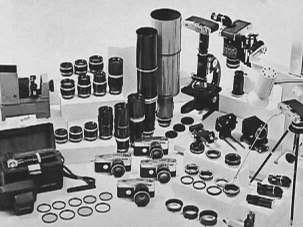
A photo of the Pen FT with 38mm f/1.8 lens hosted on wikepedia:

Pen FT

A photo of the Pen system from cameraquest.com:

Olympus Pen system

What was so good about the Olympus Pen half-frame SLRs?

In short, they were among the most pleasurable cameras to shoot and are ranked amongst the most favorite cameras of all time.

Leica users swallowed them up in droves (more than 17 million of the cameras were sold worldwide), because unlike the rangefinder design of the Leicas, the Pen cameras were of similar style but used a super compact mirror SLR design which allowed it not to look like a SLR as it did not have the characteristic pentaprism hump on the top.

The Pen cameras were beautifully designed with an exceptionally clean aesthetic design with a high quality finish and easy to use levers and dials.

The Pen also allowed flash sync all the way to 1/500th sec whereas all 35mm SLR cameras of the era only had flash sync to 1/60th sec.

BUT perhaps most importantly, the half-frame film size (18x24mm with 1.4x crop factor compared to 35mm diagonal) meant that Olympus could design Leica-like compact, sharp, manual focus lenses with minimal aberrations as they could get away with a much smaller image circle – as with Super 35mm moving picture format (the PL lenses) and much the same as with Four Thirds and Micro Four Thirds digital cameras.

The short lens flange to film distance has meant that these Pen lenses could only be used on the Pen cameras – until now – adapters will be made soon which will allow them to be used on any Micro Four Thirds digital camera – so it is not surprising that Olympus has returned to its wonderful designs in producing its first Micro Four Thirds digital camera – the E-P1 – although it will not have a mirror-based optical viewfinder but an LCD screen and optional EVF/optical viewfinders to sit in the hotshoe.

Furthermore, because of the short lens flange to film distance, as with Micro Four Thirds, lens adapters were made for the Olympus Pen series for a range of lenses including Nikon, Canon, Exacta, and pentax screw mount lenses and Olympus OM lenses – making this method, the ONLY way to get 1/500th sec flash sync with these lenses. An adapter was also made for Leica 39mm but this did not allow focus at infinity.

Interestingly, being half a 35mm frame, the frame was oriented vertically so all your images were in portrait orientation and you needed to rotate the camera for a landscape orientation – obviously, this is NOT the case with the Micro Four Thirds cameras at present.

The Pen lenses included:

  • wide angle lenses:
    • 20mm f/3.5
    • 25mm f/4
    • 25mm f/2.8
  • normal lenses:
    • 38mm f/1.8
    • 40mm f/1.4
    • 42mm f/1.2
    • 38mm f/2.8 pancake style
    • 38mm f/3.5 macro
  • portrait lenses:
    • 60mm f/1.5
    • 70mm f/2
    • 100mm f/3.5
  • zoom lenses:
    • 50-90mm f/3.5
    • 100-200mm f/5
  • telephoto lenses:
    • 150mm f/4
    • 250mm f/5
    • 400mm f/6.3 mirror
    • 800mm f/8 mirror


More information on the Pen series:

The E-P1 will be about the same size as the very popular Canon G10 BUT the E-P1 sensor will be 5x larger meaning much better image quality, shallower depth of field and the EP-1 allows almost any lens to be used on it – to me, E-P1 and its successors will be THE jacket pocketable high image quality digital camera.

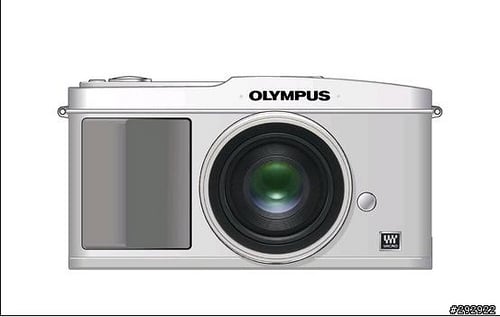
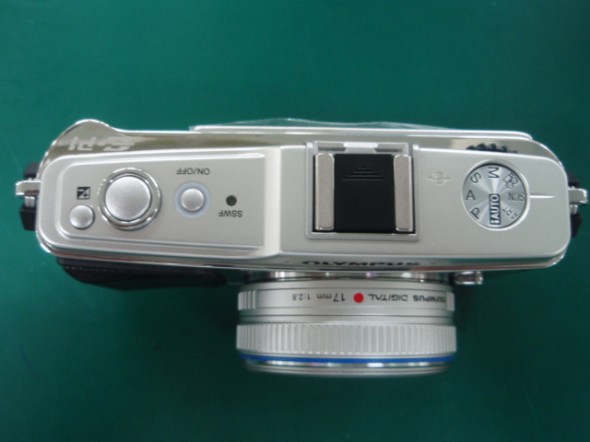
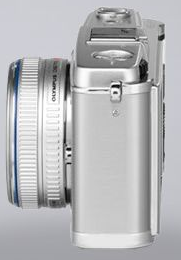
And some images of the soon to be announced Olympus E-P1 MFT digital (taken from a Canon users forum – they were impressed!):

front view
top view
side view


Micro Four Thirds – the ultimate compact tilt/shift digital?

Written by Gary on June 13th, 2009

The new Micro Four Thirds (MFT) system is quite unique in that the lens flange to sensor distance has been shortened considerably by removing the mirror.

Not only does this mean one will NEVER to need worry about doing mirror lock up to reduce camera vibrations, but it means a spacing adapter is needed to mount traditional 35mm format lenses.

NOW, requiring a spacing adapter means, that, in theory, it should not be hard for someone to engineer this adapter to be a tilt/shift adapter which could thus convert EVERY 35mm format lens ever made into an image stabilised tilt-shift lens when used in this manner, albeit with a 2x sensor crop factor, so a 21mm OM lens will in effect become a 42mm tilt-shift lens, and a 50mm macro lens becomes a 100mm macro tilt shift lens.

For image stabilisation, you would need an appropriate Olympus body of course.

And, you can take HD video using the Panasonic GH-1.

The smaller sensor is ideal here as it is much smaller than the image circle of a 35mm format lens, and thus when that lens is tilted or shifted, it will still cover the sensor area.

You could even potentially use such an adapter to tilt shift Four Thirds lenses such as the ZD 7-14mm lens, but their smaller image circle may limit this application.

See ideas for such an adapter here.

Some are considering taking this further and making adapters for view camera systems, but then it would not be compact, and a full frame dSLR might make more sense for such large cumbersome systems.

Until such an adapter is made, we still have a few tilt-shift options NOW:

  • traditional tilt-shift lenses made for 35mm SLRs via adapters already available:
    • Canon EOS TS-E 17mm, 24mm, 45mm and 90mm lenses via EOS-MFT adapter BUT these must be used wide open aperture as they do not have aperture rings – so great for emphasising subjects and blurring out distractions but not so good for maximising DOF
    • Nikon F tilt shift lenses via Nikon F to EOS or Nikon F to Four Thirds adapter – can control aperture as they have an aperture ring
    • Olympus OM 24mm and 35mm shift lenses via OM to Four thirds adapter – can control aperture but no tilt mechanism, only shift
  • lens baby soft focus lenses in either Canon EOS or Nikon F mounts via adapters as above, although this is not a true tilt-shift lens
  • the Zoerk system – tilt/swing or panoramic shift adapters to allow medium format (eg. Mamiya, Hasselblad, Pentax6x7) or preferably enlarger lenses (eg. 80mm f/4 APO Rodagon) to be mounted on various SLR adapters including Nikon F, Canon EF, Olympus OM, Mamiya 645, Hasselblad, Pentax 645, T2, etc so you could use these on Four Thirds or MFT bodies via the appropriate adapters, but the Zoerk system is not cheap! More info here.
 

Which wide aperture lenses for the Panasonic GH-1?

Written by Gary on June 12th, 2009

I am buying the wonderful little Panasonic GH-1 Micro Four Thirds video-enabled interchangeable lens digital camera, but due to the recent release of this new format, neither Panasonic nor Olympus have brought wide aperture lenses to the market as yet.

The supplied Lumix kit lens is a 14-140mm f/3.5-5.6 image stabilised lens uniquely designed for HD video.

Panasonic have shown a 20mm f/1.7 pancake lens which would be really nice but when and if will it become available? Presumably it will be a consumer level lens and not as sharp wide open as the Leica D 25mm f/1.4, but a lot cheaper.

Given the Panasonic G1 appears to have a less aggressive anti-aliasing filter than the Four Thirds cameras to date, it is apparently able to give more detail when used with the pro lenses although presumably at risk of more moire artifacts which may require trying a different raw development software (eg. Panasonic’s Silkypix rather than Lightroom) to correct. The landscape photographers are loving the G1 with ZD 7-14mm or ZD 14-35mm f/2.0 lenses for the added detail, while the MF assist and grid lines help setting up the shot. We can assume that the GH-1 will give similar results.

The Leica D 25mm f/1.4 for Four Thirds and Micro Four Thirds:
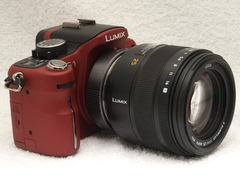
Leica D 25mm f/1.4 lens on the G1

The ONLY current wide aperture lens that will give AFS contrast detect AF on MFT is the relatively expensive ($US800 – twice the price of the Sigma 30mm f/1.4) and heavy (510g), Four Thirds lens, the excellent Leica D 25mm f/1.4 which has imperceptible barrel distortion (0.09% – cw Sigma 30mm f/1.4 lens which as 0.78%), and excellent sharpness and contrast wide open with exceedingly smooth bokeh (see here) but a touch of corner vignetting – see here.

Depth of field and field of view (effective focal length) for the same subject magnification will be similar to a 50mm f/2.8 lens on a 35mm full frame camera, thus it is not quite as effective a portrait lens as the ZD 50mm f/2.0 macro but it will AF, and the extra stop of aperture means it can work in lower light conditions hand held.

In addition, it can be used on an Olympus Four Thirds camera with image stabiliser for even lower light conditions (ie. ignoring DOF effects, it becomes in effect, a unique image stabilised AF 50mm f/1.4 lens in 35mm terms) but the aperture ring becomes non-functional as the camera body will be the mechanism to control aperture.

So what to do in the meantime if we can’t afford $US800?

Their are Four Thirds lenses which, via the adapter, would be optimised for the sensor, provide full aperture control, but unless they are the new contrast-detect AF ones, will not AF on the GH-1, and further more, unless they are HD-capable (which none of them are yet), they will not AF during HD videos.

Fortunately, the Panasonic G1 and GH-1 both have a really nice feature that when in MF mode and there is a MFT or FT lens attached which as focus by wire (ie. the non-SWD lenses but not Sigma ones), then as soon as you turn the MF ring, the live view MF magnification is activated automatically and can be changed from 5x to 10x using the front dial – one of the best implementations of live preview MF assistance.

The obvious choice from the Four Thirds lens line up is the brilliantly sharp, but in need of AF revamp, Olympus ZD 50mm f/2.0 macro which provides 1:2 macro (or 1:1 macro with EC-20 2x teleconverter).
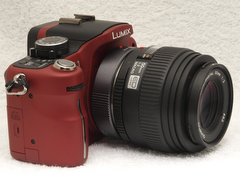
Olympus ZD 50mm f/2.0 macro on a G1

This lens you can be sure will give excellent image quality even at f/2.0, BUT you will need to manually focus it – not a problem for macro work as MF is best for that but it would be an issue for moving subjects.

Other current Four Thirds lenses will have the same limitations, for example, the Sigma 25mm f/1.8 macro, and the 35mm-format-designed Sigma 30mm f/1.4 .

If we are probably going to have to resort to manual focus what about using a manual focus lens?

Experience with using legacy MF lenses on the Four Thirds sensors tends to show that the wider the aperture lens (eg. f/1.2 rather than f/1.4), the more purple fringing and internal flare one gets, even stopped down.

Tests generally confirm Olympus’ advice that when using legacy MF lenses, they should generally be used stopped down 1-2 stops to improve sharpness and reduce purple fringing. Of course, the can be used wide open to get a more dreamy, less contrasty and less sharp effect with narrower depth of field, but in addition, apertures faster than f/2.0 tend to require exposure compensation as auto-exposure tends to be inaccurate and require a certain compensation for a given lens and aperture.

Thus whilst, on paper, the new Voigtlander 50mm f/1.1 Nokton lens for Leica M mount with its 10 bladed aperture and modern design sounds like an ideal fit for the GH-1 in the absence of an AF wide aperture portrait lens, I have concerns that it may not perform as well as one would like wide open on these sensors.

HOWEVER, the reason for using legacy lenses on the GH-1 is NOT for their sharpness as it is hard to beat the ZD lenses, but for the different “look” each one can provide.

See a forum thread showing examples of different legacy 50mm lenses on the Panasonic G1 here. The bokeh on the Cooke Kinetal 50mm f1.8 looks nice to me – just like an oil painting! The Olympus Pen G.Zuiko 40mm f/1.4 also seems to be a favorite.

See this blog comparing legacy 50mm lenses on MFT. The cheap Olympus OM 50mm f/1.8 (NB. many believe this lens paradoxically is better than the OM f/1.4 on FT cameras) easily beats the Canon FD 50mm f/1.8.

Another option is a 35mm AF wide aperture lens to be used via an adapter in manual focus and manual aperture on the GH-1, but which could still be used on your 35mm cameras and thus lower your risk that the results on the GH-1 may not be to your liking.

Given that I have a Canon 1DMIII, the natural choice for me would be the Canon EOS EF lenses via an EOS to MFT adapter, BUT unfortunately, given the electronics of these lenses, you will be forced to shoot them wide open, so they had better perform well wide open if you want to use them.

The Canon 50mm f/1.8 II lens is a cheap and nasty build quality from Canon with nasty MF control but good optics from f/2.8 onwards – this lens is NOT really going to fit the bill – you would be better off buying a Olympus OM f/1.4 lens for about the same price and you will get better optics, better build and a usable aperture control.

The Canon 50mm f/1.4 USM lens is a much better build that the f/1.8 II, and gives better results wide open with better bokeh, but still has build issues with the potential for relatively minor knocks to damage the AF mechanism – see here, but it is a great performer for the price – see comparisons with the f/1.8 II here.

The extremely expensive, heavier, Canon 50mm f/1.2L USM lens is better built again than the Canon f/1.4, is sharper at f/1.4-2.0 but not as sharp from f/2.8-4 (see here), has much improved internal lens flare control and bokeh, and of course the f/1.2 allows shallower DOF and use in lower light conditions, although AF in low light on Canon cameras with this lens is not as good as one would like.

In general, the f/1.2 is only worth the money if you need the flare control and bokeh wide open and you really need f/1.2 – I have concerns that purple fringing and softness may be a problem on the GH-1 at f/1.2 and you won’t be able to stop it down to improve it.

Canon have also released a mark II version of their 24mm f/1.4L lens which would theoretically be usable on the GH-1 at wide open aperture only but costs ~$A2500. The Canon 24mm f/1.4L may struggle to deliver the same image performance on the GH-1 given it does not have telecentric design and is not designed for the 2x crop sensor. Having said that, it should be a beautiful lens on the Canon 1DMIII or a full frame Canon.

If you have Nikon, then as long as you don’t get a G version lens, you will still have aperture control.

Here’s hoping that Olympus and Panasonic get their act in gear and produce some nice wide aperture Four Thirds lenses compatible with MFT contrast-detect AF, and HD video.

Now wouldn’t a 17mm f/1.4 lens be nice for urban use at night?

Of course to achieve this they may need to add the extra coupling pins the MFT system has to the FT system to enable fastest AF performance – better they do it sooner rather than later unless they have something else up their sleeves.

You might be interested in these Micro Four Thirds forums:


Check out some of these combos:

Soviet Union Fed 50mm/F3.5 Collapsible (Leica Elmar look-a-like from the late fifties):
Soviet collapsible

Canon FD 55mm f/1.2 (from http://cjeastwd.blogspot.com/2009/06/manual-aperture-control.html):
Canon FD 55mm f/1.2


Panasonic GH-1 coming soon, I’m buying one

Written by Gary on June 7th, 2009

I was tossing up whether I should add a Canon 5DMII full frame to my camera collection to supplement my Canon 1DMIII and provide some extra resolution and wide angle coverage, plus a bit of crippled video functionality, or get the tiny fully-video-enabled, incredibly versatile Panasonic GH-1.

The GH-1 won!

At the end of the day, the camera you have with you will take better photos EVERY time than the camera you didn’t bring because it was too big and heavy!

It is small enough to not be too intrusive at social events or for travel while still having excellent image quality and ability to have a relatively noise-free ISO 100-800 range unlike smaller point and shoot cameras.

Whilst the Canon 5DMII is a great camera, it is still a big, heavy camera which requires you to carry big, heavy lenses, and for 90% of most people’s photography at ISO 100-400, most people will not notice that much difference in image quality between a GH-1 and the 5DMII, at least for prints up to 11″ x 14″ and perhaps larger.

I was a little concerned that the 14-140mm 10x zoom lens that comes with the GH-1 and is unique in being optimised for real time contrast detect AF during video with almost silent AF motors, may not cut it optically, particularly when I have been spoilt by the excellent Olympus lenses for Four Thirds.

But this Micro Four Thirds kit seems to have produced brilliant image results for a 10x zoom – see imaging-resource.com’s tests.

Whilst the electronic viewfinder (EVF) will not be everyone’s cup of tea, it does have some benefits – for example, live histogram, and automatic brightness adjustment for low light situations which together with the short lens flange distance, makes these cameras, THE MOST ADAPTABLE interchangeable lens cameras ever made.

Not only can you fit Micro Four Thirds lenses and via the Four Thirds adapter, the Four Thirds lenses, and via Four Thirds adapters all the legacy lenses such as Nikon F, Leica R, Contax, Carl Zeiss, Canon EOS (albeit fully open aperture only on the EOS), but now for the first time, there is an almost affordable digital camera that can use Leica M, Voigtlander, Canon FD/FL (and focus at infinity without optical devices), and when adapters become available, Olympus Pen, and virtually any other 35mm rangefinder interchangeable lens you care to think of. You can see results of using it with Zeiss PL video lenses here. “When you put on full frame slr lenses from Canon or Nikon onto the Gh1 you get a 2x magnification factor as the four third sensor is about half the size of a full frame SLR sensor. But with the PL lenses you get about a 16-17% increase in focal length as movie 35mm size is much smaller than a full frame SLR 35mm”.

When using these legacy manual focus lenses, you need to manually stop down the aperture which in most cameras will make the viewfinder very dim, but not with these EVF’s.

Furthermore, you will be able to take HD video in manual focus with any of these lenses – so that includes some unique fun lenses which I intend to add to my arsenal which will have important uses in my employment by being able to selectively blur details in videos without me having to do this in post-processing:

  • Leica 25mm f/1.4 for Four Thirds has contrast-detect AFS on the GH-1 via FT adapter
  • I was going to get the new Voigtlander 50mm f/1.1 Nokton in Leica M mount via Leica to MicroFourThirds adapter
    • OK, I could have gone for the larger, heavier, more expensive ($US1700 vs $US1149) Canon EF 50mm f/1.2L which would AF on my Canon, albeit relatively slowly, but that is 545g instead of 428g and takes a 72mm filter instead of 58mm, and I would not be able to stop it down on the GH-1 – it would be interesting to see how the optics compare wide open!
    • Given the purely mechanical design of the Voigtlander, it would be more likely to be fully functional in 10-20 years than the Canon
    • my heart is with the Voigtlander, but I decided the Leica 25mm f/1.4 would be just what the GH-1 needs and it will work beautifully on my Olympus E-510 as well.
  • the new LensBaby series in Canon EF mount (via EOS to MicroFourThirds adapter)
  • Canon EF TSE 17mm tilt shift lens via EOS adapter

If you can’t do something creative with these, then there is something wrong!

In addition, you will see some nice results of video using the Olympus 50-200mm ZD lens and the Olympus ZD 7-14mm lens with the GH-1 on Youtube.

How good is it for video?

“This is a consumer camera with some incredible features…it’s not a Canon 5dmk2 killer but it has features that every Canon 5dmk2 users are salivating for. 24p (25p in UK), full manual controls whilst shooting (no need for exposure lock) and amazing ,whilst shooting, autofocus features.” – Philip Bloom (note: Canon has since released firmware that adds manual control).

It has the BEST AF video performance of any interchangeable lens digital camera – far better than that on dSLRs such as Nikon D90 or Canon 5DMII, and given my other cameras, a camera with good video performance is important to me at this time.

It has most of the features serious videographers need and which are missing on most consumer level camcorders:

  • ability to change lenses to almost any lens and even if one uses manual focus, this is often preferred by the serious videographers anyway
  • full control over camera settings – eg aperture, shutter speed, ISO, color characteristics – you can change the shutter and iris manually WHILST filming, no exposure lock needed.
  • ability to use 1/50th sec shutter speed to reduce annoying flicker from flourescent lights
  • good low light performance – better than most consumer camcorders – “The camera performed well…it’s not bad in low light. Nowhere near as good as the Canon 5dmk2 but better than just about any video camera that I have used.” – Philip Bloom
  • an optimum sensor size which allows good depth of field for wide angle shots and narrow depth of field for portraits (when used with an appropriate lens eg. 50mm f/2), while still giving good results at ISO up to 800. In fact the sensor size is very similar to shooting on a standard 35mm film motion picture camera (which has frames 22mmx12mm which is only a tad larger than the Four Thirds sensor size of 18.8mmx10.6mm – so lens field of view on each will be close). It is also comparable in size to the much more expensive pro Red One S35 sensor which is a tad larger again at 24.9mmx18.7mm, while it is much bigger than the Scarlet 2/3″ sensor which is 10.1mmx5.35mm – see comparative size chart here
  • It has an autofocus that works pretty well whilst recording, both in centre frame mode and using facial recognition mode – you can set it to AF on a subject and it will track that subject even if there are foreground objects moving around – very nice indeed! What’s more, if you select a subject to focus on, not only will it track that subject but optimise exposure for it when using auto mode.
  • unlike dSLRs, you can look through the viewfinder whilst recording allowing for more steady hand held shots
  • unlike the Canon 5DMII, it has a fold out LCD screen for ground level or over head shots as well as self-portrait/family shots, and unlike the useless design on the new nikon D5000 it will be visible on a tripod
  • an external microphone capability to avoid in-camera noise from adjusting settings. While the built in mic is way better than both the Canon and Nikon ones, good sound recoding is better with an external mic.
  • skew on fast pans no worse than consumer camcorders although not as good as a pro camcorder worth 8x its price. Rolling shutter skews is much better in 720/60p mode than in 1080/24p, and is better than that on Nikon D90.
  • you can get some slow motion video by shooting 720p at 50fps then reconform to 25fps in cinema tools – see here
  • image stabiliser – albeit an optical one not CCD-shift
  • sensor that detects when you are using the viewfinder and turns off the LCD saving on battery
  • optimised kit lens for silent, fast contrast-detect AF – the first of its kind, and I’m sure many more to follow from Panasonic and perhaps Olympus
  • “The image out of the camera is utterly terrific, so clean and noise free. Also very sharp. It’s a dream to use operational wise and the auto functions make it even better. I am never a fan of auto but when running and gunning it can be useful.” – Philip Bloom
  • you can use the Genus matte box with an adapter to accomodate the zoom of the kit lens – see here
  • when shooting in 16:9 aspect the “S” size jpeg is a perfect 1920×1080- and the quality is amazing! This is really good news because it sets up a perfect workflow for shooting timelapse for HD delivery, the 16:9 1080p stills can be imported strait into Quicktime pro and you dont even have to resize or re-crop to get HD time-lapse footage. Thats really a time saver!
  • it has a 2x or 4x in-camera crop mode. When using the 2x crop mode your effective sensor size is about the same as 16mm film or 2/3″, that means by using an adapter you can use all of the old super fast 16mm zooms- and ultra wide c-mount film and security lenses at the sensor crop they were designed for. To better explain this, in addition to the sensor 2x crop factor compared to 35mm film lenses, as HD video is only ~2 megapixels per frame and the sensor can do 12 megapixels, the camera allows you to select a further 2x or 4x crop in HD video – presumably without loss of resolution. This means then that when using the Voigtlander 50mm f/1.1 lens, it will have focal length reach in 35mm terms of 100mm lens when used for still images, and either 100mm, 200mm or 400mm when used for HD video depending on the in-camera crop mode you select! Now imagine using it for planetary photography through a telescope with a 2x Olympus ZD EC-20 teleconverter and 4x in-camera crop in motion jpeg (unfortunately, only in 720p video though, not HD as I dont think you could stack AVCHD video frames – pity it doesn’t do live HDMI out for this application which would be better) then doing a stack of the sharpest 100 or so images as is the usual method for digital planetary photography.

NOW, before you take my recommendations, it MAY not suit YOUR needs:

If you don’t need video or 10x zoom, you may be better off with the smaller lens on the much cheaper Panasonic G1 which will be even easier to carry around.

ONE user found an issue with AF inaccuracy which may be an issue although it may be only with an early batch or may require a firmware upgrade to fix – but don’t rely on it, my Canon 1DMIII still does not AF as it should! If you plan to do AF close up work a lot (eg. self-portraits), maybe check your camera does not have this problem

There is currently no AF 1:1 macro lens, true portrait lens or low light wide aperture lens designed for Micro Four Thirds and there are still many Micro Four Thirds lenses needing to be made, but one would expect a number will be available within the next 12 months. So a BIG issue at present but one which I would expect to be resolved soon.

Whilst its contrast-detect AF system is probably the fastest yet made, it is still no match for moving subjects – mind you, even expensive dSLRs can have trouble with consistent results with moving subjects.

If you plan on a lot of low light or action photography requiring high ISO, fast burst rates or fast motion AF, then you may want to consider a much bigger dSLR designed for such work such as a Canon 1DMIIn.

If you don’t like EVF or looking at the LCD screen on the back then get a true dSLR with optical viewfinder – maybe consider the Olympus E620 or Nikon D90.

If you are looking for professional quality AF performance in your videos then you will still need a professional video camera. BUT it seems the video quality is better than the Canon HV-20 digital camcorder and you get better control over depth of field to boot.

Be aware that moving the manual focus ring of a lens during video may produce clicking noises, but then added noises will happen changing settings of most cameras.

The video codecs may not be to your needs – seems Panasonic may have kept them at prosumer level to avoid cannibalizing their pro video cameras – you have choice of 23mbps 720/30p motion jpeg which is said to be better for moving scenes such as panning the camera and also has better AF performance apparantly, or the more compressed, smaller files AVCHD codec which seems to give better video for rather static scenes but can be more difficult to edit as it requires special software.
To shoot full HD, you need to use AVCHD codec at 1080/60i (interpolated from 24fps sensor output) and this has a relatively low bit rate at just 17mbps (instead of the preferred 24mbps) in the GH-1 so it won’t stand up to any heavy grading in post processing. You can also shoot AVCHD at 720/60p at 9, 13 or 17 mbps compression.
Furthermore, this camera does not process b-frames (nor does the Canon 5DMII) which may account for lower quality with dynamic scenes – perhaps the programmers ran out of time to incorporate them or the computing power of the camera is not adequate to achieve it or it may be a marketing decision – perhaps a firmware update may remedy this.

Only Micro Four Thirds and Four Thirds lenses designated as being capable of contrast detect AF will auto focus when used with the GH-1 – see compatibility chart and even then, AF tracking will be slower, AF noisier and AF not possible in HD mode UNLESS it is a HD-compatible lens such as the 14-140mm kit lens.

It currently does not allow HDMI output during recording, only mini HDMI socket for playback, and European PAL versions are limited to 30min recording for tax reasons (the Australian PAL version will do up to 2Gb in motion jpeg – 23min in VGA, and AVCHD HD modes are limited only by card size, so 32Gb could do 4 hours at 17mbps) – but then the Canon 5DMII is limited to 12min on HD, and the Nikon D90 to 5min.

In addition to using an external microphone, you may wish to consider an audio input adapter to control volume levels such as Beachtek DXA-2S or DXA-6A phantom power adapter.

No in-built CCD-shift image stabiliser – you will have to wait for an Olympus model for that, and that should be coming soon – but will it do HD video as well as the GH-1 does?

The first Olympus MFT camera (the E-P1) seems to be an Olympus Pen styled camera with a 17mm f/2.8 lens, 720p art filter enabled stereo video and separate optical viewfinder – see here. See the rumours here.

For some comparison, here are dpreview.com’s comments on the latest Canon with movie mode – the Canon 500D:

  • “Unlike the EOS 5D Mark II the 500D comes with a dedicated movie mode. Turn the mode dial to the corresponding position and press the record button on the camera rear to start or stop recording. Once in video mode you get access to movie settings such as recording size or AF mode by pressing the MENU button.”
  • “Auto focus during movie recording works in the same way that it does in normal live view mode, meaning that if it is activated in live view mode, it is available during movie recording (press the AF-ON button to focus). Since all sounds are recorded during movie recording, and any in-camera sound is magnified (including the aperture changing), using AF with the internal mic is not recommended, neither is using in-lens IS. You’ll also pick up the clicks of the control dial if you change exposure compensation while recording. Unlike a conventional camcorder there’s no continuous focus option, and to be honest the focus is so slow that you would never use it whilst filming. “
  • Like the Nikon D90 and the EOS 5D Mark II the EOS 500D can suffer from distortion caused by its rolling shutter. The readout of the sensor means movies are created with a rolling shutter (horizontal lines of the image are scanned, one after another, rather than the whole scene being grabbed in one go). The upshot is that verticals can be skewed if the camera (or the subject) moves too fast – the top of the image has been recorded earlier than the bottom, so moving vertical lines can be rendered as diagonals. It’s not quite as bad as on the Nikon D90 and you need to pan pretty quickly to notice the effect.”
  • THUS, no external mic means no useful audio recording, no usable real time AF, noisy lenses, HD mode only 20fps, minimal manual controls in movie mode, 12min max. video in HD (4Gb limit) – makes the 500D movie experience a bit gimmicky and definitely NOT in the same league as the Panasonic GH-1.
 

Apple iPod Nano 4th generation – a few gripes

Written by Gary on May 23rd, 2009

OK, I know it has little to do with photography, except that photography is often a solo activity and listening to music can put you in a mood that suits.

After years of resisting buying an Apple product (I despise their customer service principles – in particular, the one the stops you getting your money back on a clearly faulty product as I had experiences with my daughter’s iPod in the past), I finally plunged in and bought the 4th generation Apple iPod Nano 8Gb model.

Very nice, although there seemed to be some interference by announcements at train stations.

BUT, I have a big gripe with it – there are only 2 settings for shuffle (random selection) mode – all songs or album.

Now I like my classic music and have them in a different playlist to my other music – but why can’t we shuffle within a single selected playlist???

I was at the footy last night, and it was not conducive to a good listening experience when the shuffle selected my Beethoven and Mozart.

Now, the online manual says that when you set Settings-Shuffle to album, it should shuffle your selected album OR playlist. But when you start playing a playlist, it plays them sequentially, not in random order, and if you go back to the main menu and select SHUFFLE, it then shuffles ALL SONGS not just your current selected play list.

Lastly, it would seem you can’t re-charge it via USB connection to a computer and listen to it at the same time. To play songs on it, you must eject the iPod but even though still connected to USB, it no longer re-charges.

If anyone can enlighten me I would be pleased to hear from you.


Olympus E620 vs Nikon D90 high ISO tests

Written by Gary on May 21st, 2009

After reading the initial blog at neutralday.com, I was expecting the Nikon D90 to be much better than the Olympus E-620, and was ready to accept this given the excellent reports of the D90’s image quality and the fact it has a slightly larger sensor and so should have less noise at high ISO.

However, on viewing the comparison images, I must admit I struggled to see much difference between the two at ISO 1600 and below even though NR was turned OFF, and in fact, it could be argued that the Olympus images looked better.

Nevertheless, the results certainly surprised me as the E-620 high ISO performance even with NR OFF seems better than my E-510 and certainly very usable.

At ISO 3200, the E-620 clearly has more noise than the D90 but I think it is still usable at that ISO.

Given the excellent lens range and the CCD-shift IS that the Olympus has, the “low noise at high ISO” was one of the very few reasons for people to prefer the Nikon over the Olympus.

Now I am not so sure the difference is that important, but I do know what is important to me – Olympus’s edge to edge sharpness – unlike the Nikon lenses which tend to be sharp mainly in the middle – unfortunately I usually compose my portraits with the subject’s eyes at the intersections of the thirds – well away from the middle.


new Pentax K-7 dSLR with some interesting new features

Written by Gary on May 21st, 2009

Although I don’t follow Pentax closely, their new K-7 dSLR has some interesting features which Olympus fans might like to see in their cameras given they are both based on similar CCD-shift IS technology and Live View technologies.

Firstly, the K-7 is a 14.6mp, APS-C sensor with weatherproofed body, CCD-shift image stabiliser of 2.5-4 stops, 100% field of view viewfinder, 5.2 fps burst rate, 11 point (9 cross-type) AF, 920,000 dot 3″ fixed LCD, face detection contrast AF in live preview and comes with the now almost standard movie mode at 1280×720 pixels at 30fps but no live AF although it does have an external mic input at least.

Now, a few rather innovative features:

  • continuous shooting in live view mode with mirror locked up via an innovative diaphragm-control mechanism – but have they finally made a near silent live view capture mode?
  • HDR (high dynamic range) function to create one composite image with an extra-wide gradation range from three images with different exposures
  • Digital level function for easy checking of the image’s levels as with Olympus E620 presumably
  • Innovative CCD-shift mechanism for ensuring sensor is level horizontally (within limits) AND the ability for minute angle adjustment (in the direction of up/down, right/left and clockwise/counterclockwise), helping to compose the image exactly the way the photographer wants.
  • Attachment of copyright credits on recorded images

see more at dpreview.com


Kodak’s new Ektar 100 colour negative film – finest grain available

Written by Gary on May 10th, 2009

Film is not quite dead.

Kodak has announced a new colour negative film which will also be available in 120 film size as of April 2009 – the Kodak Ektar 100.

It is said to have ultra-vivid colour, exceptional sharpness, extraordinary enlargement capability and is ideal for scanning.

Recommended particularly for nature, travel and outdoor photography but also for fashion and product photography.

Will have to see how well it goes with my Bronica SQ system, Mamiya C330F TLR and my newest 120 film camera acquisition – an almost mint c1939 Carl Zeiss Ikon 521/16(B) 120 film camera:

Zeiss Ikon

This camera is really only useful for landscape shots (with sun behind you, or for creative flare shots) as you have to guess the focus distance for closer shots, accurate composition is not easy in that viewfinder, there is no flash sync, there is no coatings on the lens to reduce flare and the lens works best at f/8-16.

But it is a nice coat-pocketable 120 film camera which should take some nice shots and may be suitable for infrared work via a hand holdable Hoya R72 filter and manually adjusting the focus to suit.