Melbourne’s annual Open House weekend – Victoria’s State Library

Written by Gary on July 30th, 2013

I went into the city to photograph Melbourne’s very popular annual weekend – Open House Melbourne – where major buildings in Melbourne are open to the public and their cameras – a great time for photographers to find new material – if they can put up with the queues.

Unfortunately, this year I ran out of time to view the buildings apart from the wonderful State Library, so here are a few of the library which is well worth a visit.

These are all taken with the Micro Four Thirds kit using the wonderful Olympus E-M5 camera.

The library’s dome taken with the lovely inexpensive Samyang 7.5mm fisheye lens (click on image to view larger size):

the dome

The following were taken using the highly praised Panasonic 20mm f/1.7 pancake lens hand held:

2nd edition of Machiavelli’s The Prince:
Machiavelli's The Prince

the library ceiling


Melbourne street protesters marching against PM Rudd’s new asylum seeker policy

Written by Gary on July 29th, 2013

The recently re-instated Prime Minister of Australia, Kevin Rudd has introduced a new policy on the off-shore processing of asylum seekers coming to Australia in the run up to what appears to be a hotly contest election in the next month or two.

This policy is seen as inhumane and unjust by many, particularly, Rudd’s Labor Party core voters – those with a socialist philosophy, including unionists and the Greens – so it was interesting to see their strong feelings on this very complex matter as they staged a protest march through the streets of Melbourne this weekend, although I was in the city to photograph Melbourne’s very popular annual weekend – Open House Melbourne – where major buildings in Melbourne are open to the public and their cameras – a great time for photographers to find new material – if they can put up with the queues.

Unfortunately, this year I ran out of time to view the buildings apart from the wonderful State Library, so here are a few of the protest march which started outside the library, these are all taken with the Micro Four Thirds kit – the wonderful Olympus E-M5 camera and Olympus mZD 75mm f/1.8 lens:


protest marchers

protest marchers

protest marchers

protest marchers


Broome, Western Australia – a starting place to discover the history of the world

Written by Gary on July 26th, 2013

I recently posted a quick blog on my recent very brief trip to Broome, on the far north-west coast line of Western Australia.

Broome is famous for its pearling industry and its tourist resort at Cable Beach where the climate is usually beautiful in the Australian winter, with lovely sunsets and the camel rides along the beach.

For astronomers, it boasts almost no light pollution and 300 clear nights a year – and in Winter (eg. June), those clear nights are not too cold, and there are not too many nasty mosquitoes around then either, so it makes for awesome star gazing indeed.

For most people though it is a place to refuel and re-charge before heading back into the deserts or up north-east into the tropical regions of the Kimberleys.

What few are aware of though is that within 2000km of Broome, there are a range of geologically fascinating regions which offer rather unique insights into how our world developed and how life evolved.

One of the reasons that there is so much geologic remnants for most of the geologic ages in this region is that it has been relatively undisturbed by disruptive geologic events, particularly in the last 450 million years.

So let’s take a bit of a geologic journey to help understand our world a little better.

If one heads 1,800km south to Shark Bay near Canarvon, one can see living Stromatolites – rock-like structures along the coast which are actually slowly formed by a multitude of layers made up of limestone created by microbial mats of “blue-green algae” or properly known as cyanobacterium. This is one of the few places in the world where these are still growing and these microbes have an enormous significance to the evolution of life and climate on earth.

At Marble Bar which is regarded as the hottest place in Australia and is near Port Hedland and the iron ore mines, and some 700km south of Broome, one can find the earliest fossils of living creatures in the world – yes, there are fossils 3,500 million years old consisting of remnants of Stromatolites and these blue green algae.

Why are these “algae” so important to the evolution of the earth?

The earth formed some 4,500 million years ago as asteroids of iron, ice, dry ice, methane, ammonia, etc collided and formed an ever larger body, while the heat from the collision formed the molten core of what was to become earth, and what is still responsible for volcanic activity today. Eventually the outer crust of the new earth cooled sufficiently to allow the steam to fall back as rain and create some oceans which had high levels of dissolved metals, particularly iron, and high levels of sulphur and carbon dioxide, but little oxygen.

Further bombardment of asteroids and comets to around 3,800 million years ago (the “Late Heavy Bombardment”), appear to have contributed the water to make up around half of the ocean’s water that we have today.

There was no ozone layer to protect any newly evolving life forms from the intense UV radiation, so it appears the 1st life forms to evolve were sulphur-dependent, anaerobic (not using oxygen), bacteria which evolved at the depths of the oceans protected from the UV radiation.

The next life forms to evolve were the “blue-green algae” or cyanobacteria which were amongst the first photosynthetic bacteria, and these were to bloom and dominate the oceans for some 2000 million years, forming these Stromatolites, and in the process consuming carbon dioxide and releasing free oxygen.

With each cycle of blooming, the released free oxygen oxidised the dissolved metals nearby in the ocean such that ferrous iron was converted to insoluble ferric oxide which was deposited in layers in the sediment.

These layers of iron oxide deposits can be seen in the banded sandstone of the Bungle Bungles in Purnululu NP some 900km east of Broome.

And of course, this cyanobacterium oxygenation of the oceans, is what created the massive iron ore deposits which are being mined in the Pilbara regions of Australia near Port Hedland.

2,400 million years ago, this culminated in the Great Oxygenation Event (GEO), as the levels of dissolved metals in the oceans had been exhausted, and the oxygen was now free to escape to the atmosphere and  to also form the important ozone layer.

The build up of oxygen was associated with fall in carbon dioxide and methane in the atmosphere creating a “reverse-greenhouse gas” scenario which cooled the earth dramatically and to the extent that earth became a giant snow ball by 700 million years ago.

Release of greenhouse gases from volcanic activity resulted in a thawing of earth and by 630 million years ago, set the stage for the evolution of Ediacaran fauna (named after the Ediacara Hills of South Australia),- fossils of which can also be found in the Broome region. Hence ended the reign of the blue green algae as now they not only had a “toxic” ocean full of oxygen, but now they also had animal predators to contend with.

Around 550 million years ago, the Halls Creek fault system formed which caused folding of the King Leopold Range to the NE of Broome, this area had been created by volcanic activity resulting from tectonic plate movement around 1,900 million years ago, and Cambrian fauna evolved (mainly trilobites from 540 million years ago and onwards).

450 million years ago a giant Devonian coral reef formed on the three sides of the King Leopold Range and coincided with the evolution of fish.

300 million years ago, sea levels fell with a new ice age of the Permian period, burying the coral reefs, forming limestone which later became exposed with uplift of the plate resulting in the Limestone Ranges and their beautiful gorges and waterfalls in Western kimberleys, 400km east and NE of Broome.

250 million years ago, it is thought a Near Earth Object (NEO) such as a asteroid or comet, wiped out most life forms, ushering in the Triassic and Jurassic period of mammals and dinosaurs. One of the candidate impact sites for this event is the Bedout High underwater crater NW of Broome.

The Broome sandstones contain fossils and footprints of dinosaurs from these times. To protect these sites, they are not accessible by the public, apart from the most well known, 3-toed dinosaur footprints on the rocks on the coast of Broome which can only be seen at low tide on a Spring Tide.

300,000 yrs ago, a large meteor caused the Wolfe Creek Meteorite Crater some 800km east of Broome and is the 2nd most obvious crater in the world after Barringer Crater in Arizona.

A fascinating region indeed.

What does this teach us?

Species do become extinct, and often quite rapidly – either from climate change, new predators, or catastrophic events such as impact from asteroids.

More than 50% of our atmospheric oxygen is created by oceanic photosynthetic organisms (phytoplankton) – and perhaps their reduction in numbers by 40% since 1950 due to acidification and warming of the oceans is a potential for concern.

To an alien, the human race could well be seen as a plague on earth, rapidly using up the resources it and most other life forms need, and replacing it with toxic chemicals which not only deplete the ozone layer but threaten global warming and potentially catastrophic climate change such that we may end up like the blue green algae – suddenly finding ourselves in a toxic environment of our own creation with resources consumed, without a food supply, without oil, without fresh clean water, and facing new predators (eg. antibiotic-resistant microbes, new viruses) to take us down.

Apparently 95% of the peoples in India are already colonised by super-bugs resistant to almost all the antibiotics currently available, while global travel has the ability to spread pandemics far quicker than ever before – although the Black Death / Bubonic Plague did make a good effort of knocking us off – it only reduced the population by 30%, no where near enough to prevent the population explosion of the past 50 years.

It is estimated 30% of species will be extinct by 2030 and 50% by 2100.

hmmm… no point worrying about all this though because not enough people really care enough to stop it from happening, and there is no point worrying about things you cannot change.


The new Canon EOS 70D dSLR and ramifications of its new sensor technology for the future of camera development

Written by Gary on July 2nd, 2013

Those who read this blog will know I am a big fan of mirrorless cameras and believe that they will be the future for most photographers.

Mirrorless cameras such as Micro Four Thirds have several important advantages over current dSLRs:

  • they can be made smaller as they do not need the mirror, nor the pentaprism
  • they are quieter to shoot as there is no mirror bouncing around, and also have far less camera shake at high magnification photography
  • the lenses can be redesigned with shorter sensor to lens flange distances making for simpler wide angle designs and smaller, lighter lenses
  • the shorter sensor to lens mount flange distance allows a greater range of legacy lenses to be usable
  • AF for relatively stationary subjects is extremely fast, accurate and one can even automatically AF on a given eye (using Olympus cameras) almost anywhere in the frame
  • no need for AF microadjustment calibrations
  • use of an electronic viewfinder instead of optical allows more information to be visible without taking your eye from the camera such as live histogram, etc., and allow live magnification with image stabilisation, as well as live boost of low light situations for improved visability (particularly handy for astrophotography and when using legacy lenses stopped down)
  • the electronic viewfinders continue to improve in viewing quality and refresh rates

BUT the current mirrorless cameras have one major flaw – limited or no ability to AF on fast moving subjects, limited tracking AF capability and very slow AF when used with non-CDAF lenses.

Olympus in particular is working hard to develop new mirrorless cameras which address the above issues and also allow fast AF with Four Thirds lenses.

Of all the manufacturers, Canon appeared to have been twiddling their thumbs on this front, even their mirrorless camera – the EOS-M was not taken seriously given that it’s contrast detect AF was so slow compared with the competition, and no new competitive technology had been created since 2009 – 4 long years allowing Nikon to take the advantage in dSLR markets and Olympus, Panasonic and Sony to take the strong lead in the mirrorless sector.

Now, with their announcement of a revolutionary new “dual-pixel” sensor in their Canon EOS 70D dSLR which promises to not only provide contrast detect AF as with traditional mirrorless cameras but also the most capable and fast on-sensor phase detect AF system yet made. If their claims are true, one should be able to use most of the EF lenses and have fast AF with tracking and even face recognition with these lenses anywhere within 80% of the image area in Live View mode.

This is awesome news if the claims are proven and will again give Canon an edge, particularly when they introduce this technology in the mirrorless cameras.

BUT it may be a double-edge sword for Canon who have relied upon its dSLR sales to date.

If this sensor is as good as they state, I for one would want to be using the Live View Face Detect AF with my Canon EF 135mm f/2.0L lens for portraits as the shallow depth of field of this lens makes accurate AF on the eyes difficult with the current optical viewfinder.

Unfortunately with the 70D and other similar optical dSLRs, to use Live View means holding the camera away from your face and looking at the rear LCD screen. This is NOT a good method, particularly when using a telephoto lens when camera shake will potentially ruin your image, not to mention the ergonomics of holding a heavy lens in this manner.

If most people find that this new AF has substantial advantages over the old optical AF system as I suspect may be the case, then they would be best advised to buy a mirrorless version rather than a dSLR version, because there are now almost no reasons to have a mirror in your camera.

It will be very interesting to see how good this new AF system is, and, what will Olympus in partnership with Sony come up with in Micro Four Thirds cameras to compete with it.

Fascinating times.

Now if only Canon will make me a weatherproof, full frame mirrorless with an EVF built-in using such a sensor (even better if they add in-camera image stabilisation as Olympus do) !

Post Script:

It seems that reports on the pre-production model indicate that the AF is NOT as fast for static subjects compared with the current Micro Four Thirds cameras, and the Live View phase contrast is not as good as the optical phase contrast – the question will be – is it good enough for most of us, or just another compromise – time will tell, but at least the AF in movie mode seems to be nice and organic.


Balmy Winter sunset BBQs and camel rides on the beach in Broome, WA

Written by Gary on June 18th, 2013

Winter in Melbourne, Australia is a cool affair with maximum temperatures around 12-14deg C, lovely for bushwalking but hardly warming for the soul needing a bit of Winter UV light and warmth.

Time to have a break in the Australian tropics, and Cable Beach at Broome in Western Australia is a lovely spot to just relax and enjoy the wonderful climate there this time of year.

Whilst Broome brags that they have some 300 nights a year of clear sky and being remote, is a great place for astronomy, this time of year the weather tends to range from an overnight low of around 17degC to a lovely high of 28-30degC during the day with clear blue skies and lovely sunsets looking across the Indian Ocean.

The water is warm and relatively safe for swimming at this time of year.

Travelling light with my Micro Four Thirds camera kit consisting of my Olympus OM-D E-M5 camera, Olympus 75mm f/1.8 lens, Panasonic 20mm f/1.7 pancake lens, Samyang 7.5mm fisheye lens and I was ready for most things, in particular, the sunsets on the beach:

First, a welcome to a beach BBQ at sunset – who could resist the temptation of a refreshing glass or two of champagne on a gorgeous evening with no nasty insects around to bother you (yes, that is one of the benefits of Winter – not so many insects) – these 1st two were taken with the Panasonic 20mm f/1.7 lens:

welcome drinks

An awesome buffet spread and you will note in the background are some of the telescopes set up by Greg from AstroTours to give us all a tour of the heavens and some lovely views of Saturn and one of my favorite sights, the Omega Centauri globular cluster:


BBQ and telescopes

No trip to Cable Beach could be complete without some shots of the camel rides at sunset (taken with the 75mm lens):


camel rides


camel rides


camel rides

and some of us could not resist getting the iPhone out to tell the world how gorgeous this was (note, for fun, I added a painterly effect in Lightroom for this one):


iPhone


Olympus announces a couple of very cool PEN Micro Four Third cameras – the E-PL5 and E-P5

Written by Gary on May 14th, 2013

The Micro Four Thirds juggernaut continues along with Olympus bringing the fantastic image quality and many of the features of the extremely popular Olympus E-M5 to the more compact PEN series.

With the improved image quality, image stabilisation, super fast AF for static subjects, the cool touch AF tiltable LCD screen and the option of adding on one of the best EVF’s available, the E-P5 and it’s lower end “Lite” version, the E-PL5 finally come of age as awesome, fun compact tools for the advanced photographer and beginner alike.

Both these cameras utilise the same excellent 16mp sensor as is in the E-M5 which is widely praised for its wide dynamic range and relatively low noise levels for such a small sensor – so image quality is not an issue for most users.

Both have the fun features of the E-M5 such as the unique Live BULB and Timed BULB modes, the very fast touch a subject on the screen and almost instantaneous AF and shutter release.

The features of the E-PL5 can be seen on my wiki page here.

The E-P5 deserves more attention and praise for what it brings to the PEN family, and I have gone into much more detail on my wiki page for it here.

E-P5

E-P5 top
Olympus E-P5, Full Hardware Review + WiFi / iPhone Demo by Blunty

It adopts most of the features of the awesome Olympus OM-D E-M5 camera except for weatherproofing, built-in EVF and grip supports

Plus it adds in the newer features of the Olympus E-PL5 PEN Lite camera such as:

  • ISO LOW of 100
  • focus peaking
  • small target AF
  • new Lens IS priority option which allows you to automatically disable the sensor-based IS if a Panasonic lens with OIS is being used
  • intervalometer
  • fully compatible with the new Olympus VF-4 add-on viewfinder which is the BEST EVF currently available for any camera
  • new ART filter “Watercolour”

then a few new tricks of it’s own such as:

  • 1/8000th sec shutter
  • new tilting 1037k dots (3:2) LCD touch screen
  • WiFi Live View remote control and image tethering via smartphone apps
  • automatic panning detection for the IS
  • live histogram for the Live BULB mode
  • fast shutter release mode with a lag of just 44ms
  • MyMode setting on the exposure mode dial plus user can store specific setups for each of the PASM modes such as changing S mode to a sports mode with AF tracking and burst mode (a welcome addition indeed)
  • HDR bracketing mode
  • 2×2 settings mode switch – option of user configurable mode 1 or mode 2 dial assignments
  • Olympus’s Photo Story feature – allows you to generate multi-image composites like the pages of a photo book, in a wide variety of themes

This camera has such amazing versatility, build quality, styling and image quality in such a small camera that it will be a must have for many photographers.
Furthermore, it is now super easy to set up and control via WiFi from a smartphone such as an iPhone and see the live image and even trigger AF and the shutter by pressing on a subject on the phone’s touchscreen – awesome indeed!

See my wiki page for more thoughts on it including a few gotchas and issues.

Now for Olympus to bring out their much anticipated high end mirrorless camera with fast AF for the Four Thirds lenses and moving subjects – hopefully this will come before the end of 2013.


Comet C/2011 L4 PANSTARRS with Olympus E-M5 and 75mm f/1.8 lens – time to get your camera out on the 12th March for crescent moon and comet image!

Written by Gary on March 11th, 2013

2013 is shaping up as a great year for astrophotographers with a few comets around to have fun with although none as aesthetically beautiful as the awesome Comet McNaught of 2007.

I recently posted an shot of comet Lemmon as it passed the Tucanae globular cluster and the Small Magellanic Cloud galaxy here.

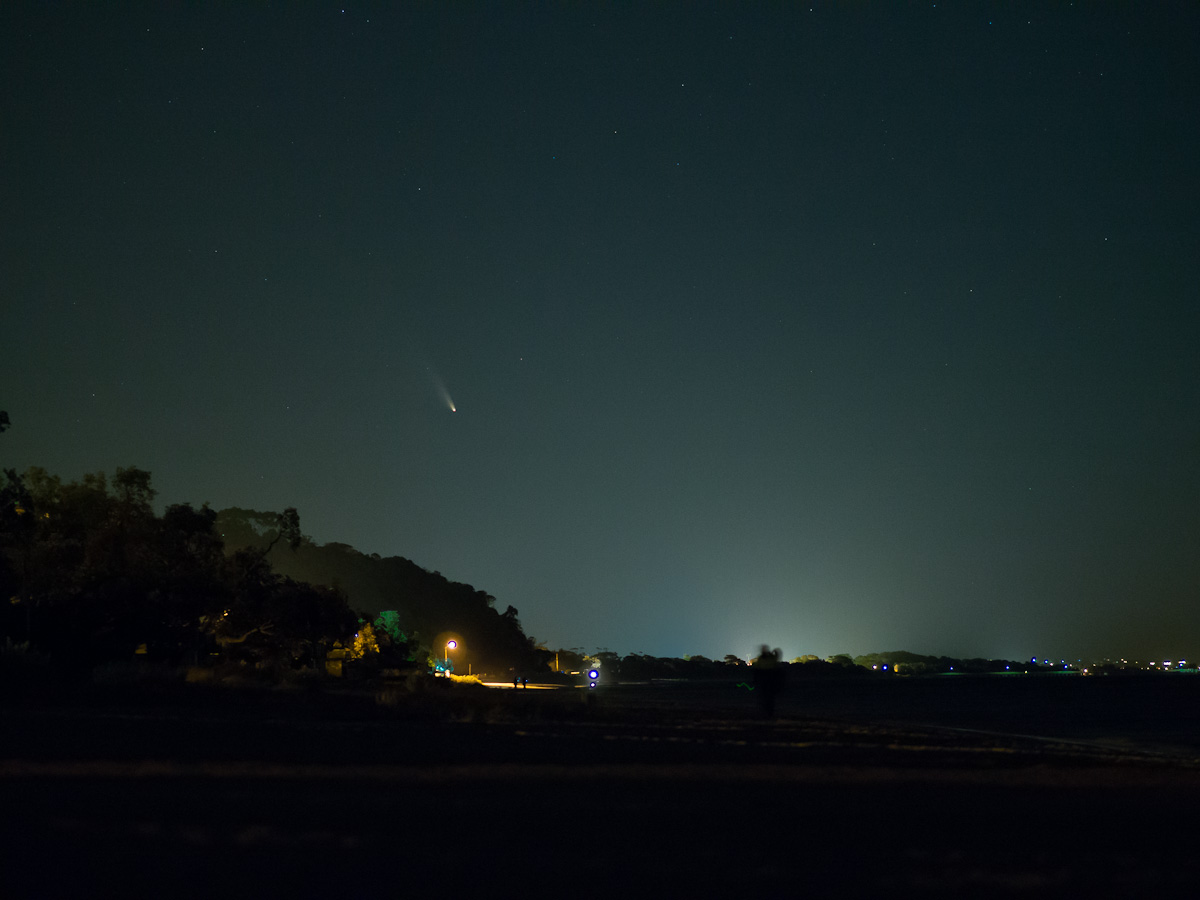
On the 2nd of March 2013, I drove down to one of Melbourne’s bayside beaches to get a shot of Comet C/2011 L4 PANSTARRS comet just after sunset using the Olympus E-M5 Micro Four Thirds camera with Olympus 75mm f/1.8 lens mounted on a tripod.

Unfortunately I miscalculated where the comet would set in relation to the beach and highway traffic headlights became problematic, nevertheless I think it is a lovely shot with the Dromana beach on a balmy warm night as a couple enjoyed the romantic ambience oblivious to the comet.

ISO 3200, f/1.8, 1 second exposure:

comet

Tomorrow night (12th March 2013) at sunset for those in Europe, America and Africa, they should get a lovely opportunity to photograph a thin crescent moon next to the comet just after sunset – unfortunately in Australia, the moon is too close to the sun at sunset and will set before the comet becomes visible in the twilight, although we may get a chance the following night on the 13th March if clouds do not obscure the view.


Dusk seascapes between storms using the Olympus E-M5 camera hand held

Written by Gary on March 5th, 2013

Last week I went on a camping holiday to the remote Croajingalong National Park in far eastern Victoria some 7 hours drive from Melbourne.

The trip was mainly a reconnaissance style trip rather than a photography trip as we wanted to quickly get to as many locations as possible to explore.

This necessitated very light travel without tripods – a perfect scenario for taking Micro Four Thirds cameras and lenses.

Most of the lighting for the trip was not conducive to good photographs so I was not too heart broken with not having the time to really do landscape and nature photography they way I would like to.

Nevertheless, the Olympus E-M5 camera with its image stabilisation and fast prime lenses made relatively long hand held shots after sunset in thick storm clouds possible.

For example, the following shots were taken between storms well after sunset on a wonderful beach near Mallacoota using the Olympus 12mm f/2.0 lens without any optical filters:

Beautiful rock formation textures and colours (best seen viewed large by clicking on the image), ISO 200, 1/10th sec, f/3.2:

Mallacoota

Capturing some spiky wave action to mimic the spiky leaves on the top of the rock formation, ISO 400, 1/3rd sec at f/2.2 (I was in a bit of a rush with this shot as the waves were coming in at me so the long exposure shot is not as sharp as I would have liked, but better than any other camera could manage hand held at 1/3rd sec):

Mallacoota

And if anyone is interested in visiting this wonderful part of the world, here is a shot of the beach area in Mallacoota township adjacent to a very large caravan and camping park – highly recommend it for those who want to get away for some peace and quiet yet still want to explore the wilderness cold temperate rainforests with its large goanna lizards, tall eucalypt and fern forests, go fishing, sunbaking, or even hire a boat on the estuaries – there is something for everyone – but don’t tell anyone it is a paradise as it might become a car park!

Mallacoota


Handheld night street photography with Olympus E-M5 and Panasonic 20mm pancake lens – Melbourne’s “White Night” event

Written by Gary on March 3rd, 2013

On a warm balmy summer night, Melbourne hosted its 2nd “White Night” event of all night long cultural activities which attracted unprecedented crowds surpassing even New Year’s Eve crowds.

In such crowds a tripod is just asking for trouble, and a kit zoom lens is not going to suffice.

Many of the attractions were projected images on Melbourne’s buildings and what better way to capture these in dense crowds than to use the Olympus E-M5 Micro Four Thirds camera hand held with a tiny Panasonic 20mm f/1.7 pancake lens which of course is effectively image stabilised thanks to the E-M5 making it an awesome compact night street photography combination.

These were all taken at ISO 800, mostly at shutter speeds 1/10th-1/50th sec and at f/1.7 (except the last one which was f/2.8).

The night begins:

the night begins

Birrarung Marr art installation:
Birrarung Marr art installation

The band plays under Flinders St railway station clocks:

the band plays under Flinders St railway station clocks

Projected buildings:
projected buildings

projected buildings

projected buildings

Projected love messages on the Yarra River:
projected love messages on the Yarra River


Samsung Series 7 slate tablet with Windows 8 – can it replace ALL your computers and iPads?

Written by Gary on February 23rd, 2013

I have given up waiting on the Microsoft Surface Pro and my preferred device, the new Kupa X15 slate which is due in April and jumped in and bought the Samsung Series 7 slate tablet device (model XE700T1C-A02AU) with Windows 8 and docking keyboard.

These devices possibly have what it takes to replace all your computers and iPads for most people and combine them into one light, compact device which all the family can use but still give you the full power of a desktop computer – well almost.

These devices bring to portable computing what the Olympus OM-D E-M5 bought to the compact camera world – at last all the pieces being in place to reduce compromises to a tolerable level.

I have owned a Toshiba tablet PC for years but the touch interface was clunky due to the software and also because you could not use your fingers like you can on an iPad, plus it was heavy and took ages to boot up.

I own an Apple iPad but although light, fast to boot and nice interface, it is compromise city when it comes to most computing needs for many reasons which I won’t go into here, and it is unlikely these issues will be resolved in the near future – it is unlikely I will ever buy another, although the small size of the iPad Mini may have its niche use.

What do we get with the Samsung Series 7 slate?

  • Windows 8 Home 64bit
    • almost full Windows capabilities
    • fast boot up
    • backup to Microsoft’s SkyDrive
    • multiple users as with any Windows machine (yes Apple, unlike your iPad, I can have multiple user accounts)
    • supports most Windows software that has worked since Windows XP
    • supports new “Metro” apps designed for touch screen use, and these are quite nice although much more limited in variety when compared with iOS apps and you need to access these from the Microsoft “store”
    • new search feature is very powerful and fast
    • new “Charms” functionality is quite useful once you get used to it
    • can log on using a PIN instead of a Windows password – but unlike iOS, no mechanism to automatically delete the device after 10 failed attempts to log on – something I would like!
  • a very nice, although a little too wide, touch screen 11.6″ FHD LED Display (1920 x 1080) which is awesome to play videos, display photos, and use “Metro” apps
  • Intel® i5 3317U (1.70 GHz, 3 MB L3 Cache) processor with Ivy Bridge chipset and Intel® HD Graphics 4000 processor
  • 4Gb DDR3 RAM
  • 128Gb SDD drive with over 90Gb free with Windows 8 64bit Home version pre-installed
  • USB 3.0 port which is critical as this then allows rapid use of external drives for accessing your 1Tb of photos
  • microSD card reader – I wish they used SD card for compatibility with cameras, but I bought a USB 3.0 card reader to get around this, and it is very fast indeed
  • micro HDMI video out port
  • most importantly, a high quality dockable keyboard with mouse trackpad  (this also adds 2 extra USB 2.0 ports – perhaps handy if you need to use a wired network access for work environments – just buy a USB network adapter)
  • Bluetooth v4.0 so you can add a bluetooth mouse (this is critical for me for serious work as I hate laptop keyboard trackpads)
  • WiFi a/b/g/n and WiDi support
  • SIM card
  • 2.0 megapixel Webcam (front), 5.0 megapixel Webcam (rear)
  • headphone/mic port
  • rotation lock button
  • S pen for using like a Wacom device
  • Ambient Light Sensor
  • Accelerometer Sensor
  • Compass Sensor
  • Gyro Sensor
  • some nice Samsung apps
  • hardware BIOS support for Absolute Data’s remote device wiping and location services although this requires an annual subscription fee – but probably worth it if you have sensitive details on the device such as your account passwords, family photos, etc
  • all this an it is only 304 x 189.4 x 11.9mm (11.97″ x 7.46″ x 0.47″) and weighs only 0.888Kg (1.96lbs)

Issues:

  • does not support hardware encryption technologies and does not come with BitLocker so you may wish to rely upon Truecrypt although this excellent free open source software does not fully support Windows 8 as yet – the main issue with using Truecrypt volumes is that in Windows 8, Microsoft has decided somehow that when you use apps it doesn’t need to really close them down fully and release file access – Truecrypt will then ask you if you wish to force file access to be released when you wish to dismount the Truecrypt drive – this seems to be OK.
  • probably not powerful enough for the serious gamers out there but for everything else such as full Office use, programming suites, Lightroom, Photoshop, etc it should be fine
  • Windows 8 metro mail app does not support POP mail accounts – you will need to do a workaround such as use a gmail account to access your POP mail account – see here
  • metro apps generally only have access to the user’s libraries – documents, pictures, videos but click on the desktop app and immediately you are back into normal Windows 7-like desktop app interface albeit without the Start button, but Samsung do supply an app to simulate this.
  • desktop apps designed for Windows 7 and earlier generally are not well suited to use without a keyboard and mouse as the font and clickable spaces are too small for your finger but there are several workarounds:
    • use a keyboard and mouse +/- external screen
    • use the magnifying option – just press Windows button + volume button to activate and the whole screen is magnified which is very handy (you do need to activate this function in Settings)
    • use the S pen as a touch device
  • metro photo app is nice for viewing and sharing photos in your pictures folder but cannot access photos elsewhere on your drive – however the Windows desktop app Photo Gallery is actually very nice to use for this purpose
  • the 16:9 aspect ratio of the screen is not well suited for most desktop application tasks as there is not much height to play with
    • in desktop mode, consider moving the taskbar to the left side instead of the bottom to give more room, and set it to autohide – although autohide does not always seem to result in it being hidden which is a problem with maximised apps
  • the 11″ 16:9 screen is a bit heavy and stressful on your left arm when holding it for long periods
  • the keyboard docking is a little temperamental and my version seems to need a bit of encouragement to get contact between the device and keyboard contacts
  • Samsung advise that the device should be turned off when ever docking or undocking the keyboard
  • 128Gb drive is a touch small, but thankfully the microSD card reader and USB 3.0 port allow various mechanisms to provide much more storage which is rapidly accessible, and perhaps more secure as it is not left on the device – sure beats what is possible with the Apple iPad!
  • no network port – you will need to buy a USB network device if you need this
  • seems to be issues with app store – updating 31 apps seems to have stalled as still running after 24hrs and it just says “downloading” without obvious progress despite a reboot .. the only way I managed to fix this is to run this app from Microsoft which analyses your system and repairs it – http://download.microsoft.com/download/F/2/4/F24D0C03-4181-4E5B-A23B-5C3A6B5974E3/apps.diagcab

Conclusion thus far:

So far, I have been very impressed with both Windows 8 and the Samsung device, perhaps because I had prepared myself to really hate Windows 8 given all the bad press and how Microsoft is essentially forcing users to change the way they are used to doing things.

I have managed to install all my legacy Windows software I need including MS Office, and Embarcadero’s Delphi XE programming tool.

Fortunately, you can resort to Windows 7 way of doing things for most functions.

Unless Apple radically re-architecture iOS I cannot see much future for the Apple iPad now that devices such as these will service both the desktop user’s needs as well as the traveller’s portable device needs and provide rapid access to external USB drives.

I think there will be a place for a smaller version of this device to allow longer single hand holding capability, preferably in 4:3 format instead of 16:9 to take the leverage strain off your arm.