Olympus E-30 pre-production review

Written by Gary on December 8th, 2008

John Foster has published a detailed review of the forth-coming Olympus E-30 – see here.

It’s unique features (many shared with the bigger, more expensive, weatherproof E-3) are sure to make it a much sought after camera, particularly taking into allowance the availability of some of the best lenses ever made and all with image stabilisation provided by the camera.

March 2009 in depth review:

Khen Lim’s excellent, detailed review


The walk-a-round camera kit

Written by Gary on December 7th, 2008

Camera equipment is always a compromise on price, quality, weight, size and versatility.

When it comes to going out in the city with no fixed goal in search of photographic opportunities or ideas, I personally prefer the 2 camera approach – one with a wide angle zoom and one with a telephoto zoom. Sometimes I will take a 3rd special interest lens such as a ultra-wide, a tilt-shift, or a 1:1 macro with ring flash.

Each camera and lens should weigh less than 2kg in total to make it comfortable – a Canon 1DMIII with EF 70-200mm f/2.8 IS L lens weighing a total of over 3kg is NOT my idea of a walk-a-round kit!

What about a single super-zoom?

Although you can get superzooms with 15x zoom lenses on small sensor digital cameras, generally I am not prepared to sacrifice the image quality as a result of the tiny sensors and 15x zooms.

Of interest, is a new super-zoom from Tamron for Canon and Nikon cropped sensor cameras which has just been reviewed by dpreview.com here. This Tamron AF 18-270mm f/3.5-6.3 Di II VC LD Aspherical (IF) MACRO lens provides a remarkable 28-420mm coverage on a Canon APS-C dSLR with image stabilisation and up to 0.29x macro, all in a relatively light 560g lens.

Whilst it promises to be a very useful lens for the Canon/Nikon cropped sensor users, it is not perfect – suffers from barrel and pincushion distortions as well as CA, AF is slow and thus not ideal for action shots, and the macro images are quite soft.

You can get better performamce with other long zooms but you sacrifice range with most giving a 28-200mm range – which is adequate for a large percentage of situations, may leave you a bit short.

The Micro Four Thirds system may be best placed to address the super zoom AND provide high optical quality as aberrations can be much better controlled in lenses designed for smaller image circles.

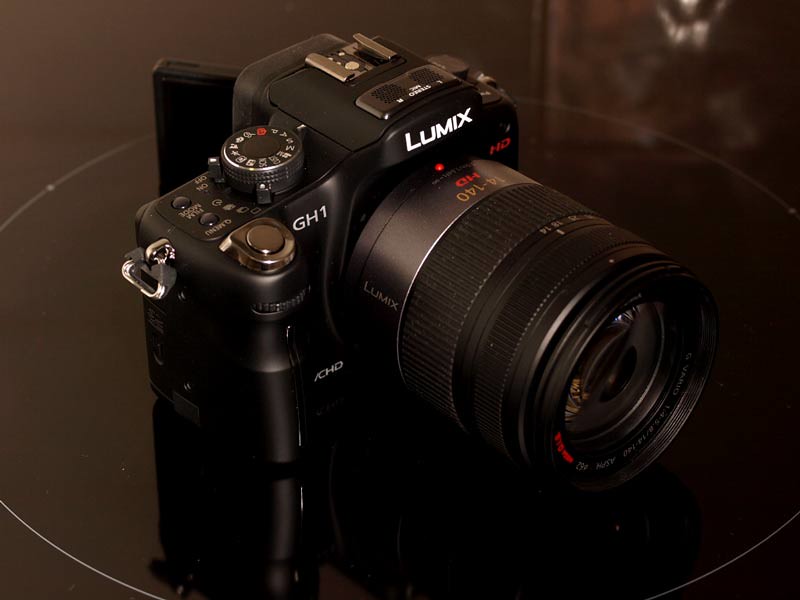
It will be interesting to see how the Panasonic 14-140mm f/4-5.6 OIS lens (which gives 28-280mm with image stabiliser) performs – of course, one would not be expecting a contrast detect AF system to be the tool of choice for action shots but it may be the BEST walkaround camera kit for those needing the lightest, smallest kit with high image quality and a 10x zoom range.

In the meantime – the two camera kit:

The options I prefer have been a cropped IS sensor telephoto zoom combined with either a ultra-wide zoom or wide-standard zoom, or a full frame or near full frame dSLR.

Olympus E510 with ZD 50-200mm SWD giving image stabilised 100-400mm f/2.8-3.5 in 35mm terms at less than ~1.7kg which can be further extended with either a 1.4x or 2x teleconverter, and it gives reasonable macro performance at 1.2m working distance.

  • see the lens comparison table here which compares this lens against comparable angle of view zoom lenses from Canon or Nikon
  • the Olympus E-30 with its much improved AF for action shots may be the best option instead of the E-510 but it is heavier and more expensive

Olympus E330 (perhaps now I would prefer an E3 or E30 instead) with ZD 7-14mm (ie. 14-28mm ultrawide zoom) or the 14-42mm kit lens or, if I had one, the excellent ZD 12-60mm SWD lens which gives 24-120mm coverage.

  • when using a ultra-wide angle, a flip out live LCD is EXTREMELY handy, and the E-30 (and E-3) will have this and IS so I can hand hold a 14mm eq., focal length at 0.5sec for creative effects


Canon 1DMIII with EF 24-105mm f/4 ISL lens
– given that I don’t have a ZD 12-60mm lens, I use this kit in conjunction with either the 50-200mm Olympus kit or the 7-14mm Olympus kit even though the 1DMIII is very heavy as a walk-around camera. As a walk-a-round kit, my preference would be the lighter Canon 5DMII with perhaps the heavier 24-70mm f/2.8 as I am not a big fan of the image quality of the 24-105 and the f/4 aperture is a bit limiting in controlling background blurring, while the 5DMII allows the full 24mm wide angle and one can bump up the ISO to partly address the lack of IS.

  • given that there seem to be few lenses to match the sensor resolution of the Canon 5DMII, my ideal lens to mate with it at present would be the new EF 24mm f/1.4 MII which should give far better image quality than the 24-70 or 24-105 lenses and give you a nice wide aperture when you need it – the geometric distortion of the 24-105mm at wide angle makes it very frustrating
  • when shallow DOF is needed, a EF 85mm f/1.8 (or f/1.2L if you have it), or 135mm f/2.0L are nice alternative lenses, and if you are really wanting to be creative, then the EF 45mm or 90mm tilt-shift lenses
  • alternatively, the Nikon D700 would rate highly on my list if I had Nikon
 

Partly cloudy, showers – great weather for urban photography

Written by Gary on December 7th, 2008

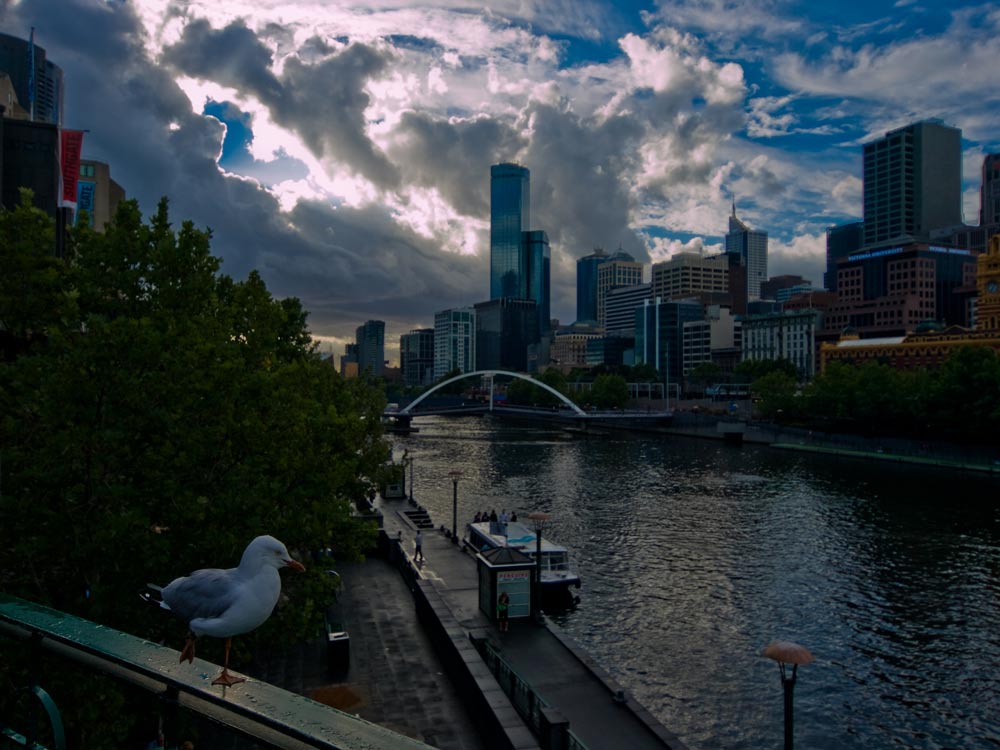
Yesterday was one of my preferred days for urban photography so I headed into Melbourne on the train as usual with my little hiking backpack with Olympus E510 + ZD 7-14mm lens and Canon 1DMIII with EF 24-105mm IS L lens and a Lee 0.6 neutral gradient filter for the Canon.

I prefer to select only 2 cameras and 2 or perhaps 3 lenses for a given trip and then target shots that will suit those cameras. Given the weight of the Canon kit, I decided to leave my beautiful Olympus ZD 50-200mm at home – with regret as it turned out as there was a Homeless World Cup 2008 soccer event on in the city which that lens would have been perfect for.

Here are a few shots from the day (click on then for larger views):

After a brief shower which temporariliy made the day stand still, some nice reflections of St Paul’s church from Flinders St railway station using the Olympus E510 with ZD 7-14mm to give a 14mm rectilinear ultrawide image in 35mm terms (Can’t achieve this with any lens on the 1.3x crop factor of the Canon 1DMIII).

St Paul's

and same outfit with a bit of sky drama:

seagull

and as the sky got darker and more menacing, this time with the Canon kit:

boat


A celestial smiley face to bring cheer and good luck

Written by Gary on December 2nd, 2008

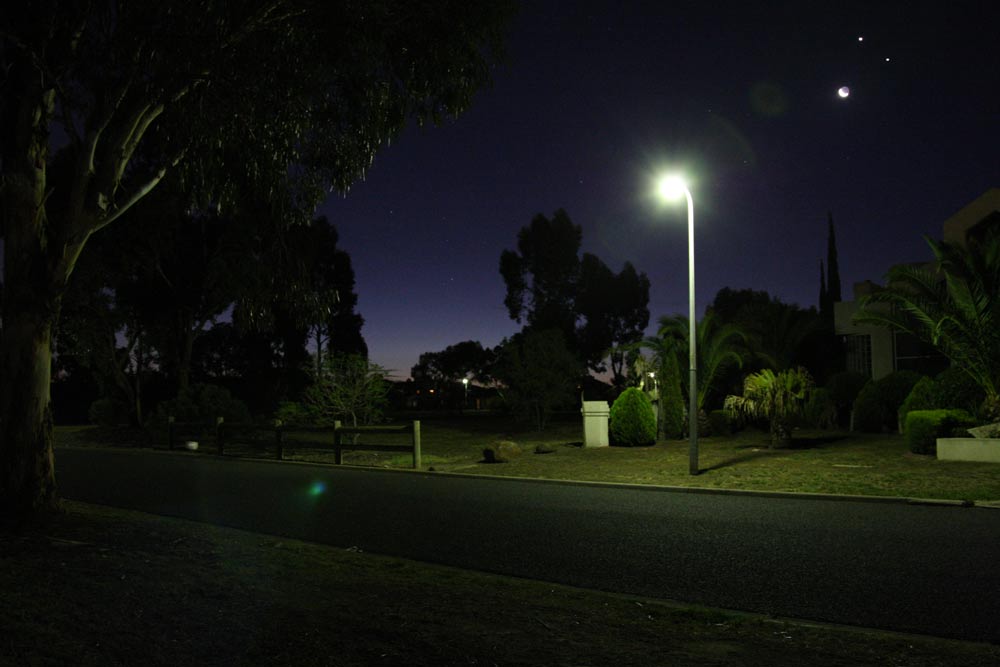
It’s Dec 1st, 2008 and tonight we had the pleasure of a conjunction of the crescent moon, Jupiter and Venus making a smiley face in the evening sky.

This alignment of the crescent moon, Jupiter and Venus apparently will not occur again until 2052, although the next time Venus and Jupiter have a close conjunction is in May 2011 and March 2012 so for those that missed it, here is what it looked like from Melbourne, Australia.

I took the opportunity to play with my Canon 1DMIII with EF 24-105mm L lens from my letterbox.

moon, jupiter, venus

For the tech heads, I removed the UV filter to minimise lens flare from the street light and the settings used were 24mm focal length, f/4, 3200ISO, 0.5sec exposure.

No post-processing, just resizing and compression for the web. Click on the image for a 1000 pixel wide view.

I also tried with an Olympus OM 21mm and 24mm lens but whilst both gave excellent results, they did have a more pronounced lens flare.

Of course, I could have moved over to the park and avoided the street light but I felt this added interest and lit up the foreground nicely.

And just for the Olympus guys… here is a shot with the Olympus E510 with ZD 50-200mm SWD lens at 50mm which I have cropped just a little and applied a blue monotone tint in PS but no other PS other than resize and compress for the web.

Olympus - moon.

This image was taken at f/4.5, ISO 400 at 6 secs exposure with antishock set to 5 secs (mirror lockup). I purposely over-exposed the moon to bring out foreground detail.

The ZD 50-200mm at 200mm giving 400mm eq. focal length reach in 35mm terms actually took a very nicely cropped shot just of the moon, venus and jupiter, but lacked the contextual interest of the foreground.

Those in Europe should be lucky enough to see the moon occult Venus in a similar way to the following occultations I imaged of Jupiter and Mars a few years ago.

“The last time London was treated to such a favorably placed Venus occultation was back on October 7, 1961. And after 2008, there will not be another similarly favorable Venus occultation for the United Kingdom until January 10, 2032.”

I captured an uncommon event in 2005 when Jupiter was occulted by the moon:

jupiter occultation

and.. an even rarer event, a grazing occultation with Mars when Mars was almost at its closest to Earth in 2003 in tens of thousands of years – hence bigger and brighter than usual.

mars occultation

More of my astrophotography can be found here:

More information on this event can be found at space.com.

Other blogs to cover this event:

And, if you are in America, the moon has moved to the other side of Venus and Jupiter resulting in a sad face, which I guess is representative of the state of affairs over there 🙂

see:

and compares with past events:

and don’t miss this image of a sequence of shots at the same time each day for a full month in New Delhi showing Jupiter marching towards Venus using an 18mm lens. Three days of photography are missing because of clouds and haze in the evening, 12th, 16th and 30 November. The crescent moon starts at the bottom on 1st November, goes just at the edge of (behind) the building, and upwards, and returns in the scene on 1st December to form the now famous Celestial Smiley!

  • The octagonal building in foreground has a bit of astronomical history, Humayun – a mughal emperor in India, was an astronomer, one evening he was trying to locate Venus in the evening dusk when he heard the muezzin’s call for evening prayers, he rushed and fell down the stairs to his death (a few days later). The octagonal building was the library of Humayun.
  • Several DSLR cameras were used, Canon 450D, Canon 1000D, Nikon D80, Nikon D70. The images were first scaled (in photoshop) bringing them equal to a Canon 450D, as most of the photos were taken with this camera. Alignment (Translate, Rotate, Scale) was done in Images Plus, and composite was constructed using Startrails software.
 

Micro Four Thirds Panasonic G1 impresses with high image quality in compact package

Written by Gary on November 30th, 2008

The first camera in the Micro Four Thirds system – the Panasonic G1 has impressed.

This review on luminous-landscape.com demonstrates how compact the kit is and suggests the image quality is very high with the two Micro Four Thirds lenses tested, and perhaps just as importantly, the contrast-detect AF was almost as fast as normal dSLR AF while the EVF quality seems to be the best available.

It also sports a nice flip out live preview LCD which can be rotated for self-portraits / family shots as well as rotated to protect the LCD screen when not in use.

See the video at the bottom of the review page to realise just how small the G1 is compared to a Nikon D90 or Canon 450D/Xsi.

The lenses currently available are both optical image stabilised:

  • 14-45mm f/3.5-5.6 OIS giving 28-90mm field of view
  • 45-200mm f/4-5.6 OIS giving an ultra compact 90-400mm field of view lens

Forthcoming lenses that have been announced thus far (presumably available in 2009) include:

  • 14-140mm f/4-f.5.6 OIS
    • should be a great walk-around lens giving 28-280mm 10x zoom coverage at reasonable aperture and with image stabilisation, thus should be attractive option to many
  • 7-14mm f/4
    • this is exciting as the current Olympus 7-14mm is extremely expensive due to the need for special optical design to overcome the lens to sensor distance imposed by the mirror which is eradicated by the Micro Four Thirds, so hopefully we will get a much more affordable high image quality 7-14mm lens (ie. 14-28mm ultra wide angle zoom)
  • 20mm f/1.7
    • this is also an exciting lens as it would potentially be a great street photography lens in the Leica rangefinder style giving 40mm field of view with a nice wide aperture
  • of course, Olympus should be announcing their range soon too, although I would be expecting Olympus to use sensor-based image stabilisation in their Micro cameras and add movie modes

another user’s review

addendum Jan 2009:
dpreview.com’s in-depth review of the G1 gives the camera a thumbs up with highly recommended for its compact size, high quality jpegs out of the camera with lots of detail, reasonable image noise performance to ISO 1600, high quality EVF and tiltable LCD screen, fast contrast detect AF as good as entry-level dSLRs and with very effective AF tracking and very usable manual focus mode.

Their main concerns were the current limited choice of contrast detect AF compatible lenses, EVF not easy to use in low light, sensor can be more readily touched with clumsy fingers when changing lenses, no movie mode, battery life, relatively noisy shutter for a non-dSLR (yep, I want a silent camera please so I can use it in classical music concerts, lectures, etc without disrupting everyone!).


Nikon leak – new 24.5mp full frame – Nikon D3X

Written by Gary on November 29th, 2008

Nikon itself appears to have leaked information on another full frame dSLR – the Nikon D3X which appears to be primarily a Nikon D3 with a 24.5mp sensor to match the Canon 5DMII and Canon 1DsMIII.

Details here.

post script:
dpreview.com’s coverage here


AF confirm lens adapters – Olympus/Nikon/Canon/Leica/etc

Written by Gary on November 28th, 2008

I have just received an AF confirm lens adapter for Olympus OM lens onto Four Thirds (Olympus/Panasonic) dSLR bodies from RJ Camera Accessories Ebay store.

I am using this on my Olympus E-510 but it should work the same on other Olympus cameras and he supplies other models for other model cameras.

It seems reasonably well built and certainly seems to fit more solidly than my last Chinese-made OM adapter.

The great thing about this adapter is that when you are manually focusing (as you have to do with legacy lenses on dSLR bodies), you get a AF confirmation light and if in S-AF or C-AF mode, you also get a very useful audible beep when subject is in focus which allows you to concentrate a little less on focus and watch the subject and composition.

When I first put it on, it didn’t seem to work but after removing it and replacing it and half-writing a letter back to the supplier, it suddenly started working.

If it is working properly, when the viewfinder data becomes active by half-pressing the shutter, the aperture defaults to f/2.8 and focal length to 50mm irrespective of which lens or aperture you have on. He states the adapter can be programmed to change these – I’m waiting to find out how (ps.. he emailed me same day with detailed instructions on how to program it) – it will not effect image quality, only EXIF data, although you can adjust back-focus setting.

When in an AF mode on the camera, you half-press the shutter while manually adjusting focus on the lens and when subject comes into focus, the green focus confirmation light in the viewfinder comes on and stays on (not blinking) and the camera will beep.

When in manual focus mode on the camera, you don’t get a beep (unless you set manual mode to m:3 – my favorite setting and use the AFL button to “focus confirm”) but focus confirmation light seems to work without half-pressing shutter (although you do need to half press the shutter to activate viewfinder data which stays active for a few seconds).

The AF confirmation works in apertures down to f/8 inclusive (amazingly, it even worked down to f/16 in low light on contrasty carpet pattern).

This has made using my Olympus OM 200mm f/4 lens that much more usable on the E510 as I can now quite quickly accurately focus even in relatively low light (indoors on a heavy cloudy day) and with the image stabiliser set (to 200mm) use shutter speeds down to 1/50th sec hand held (1/30th sec at a push if you are really steady) which is not bad for a 400mm equivalent focal length magnification. The nice thing about this lens is that it is very light and compact for a 400mm reach and it is very usable leaving the aperture at f/5.6 instead of wide open at f/4.

Here is a previous blog showing how good the Om 200mm lens is on the E510 hand held when a car caught on fire in a main shopping strip.

Now you could use the beautiful ZD 50-200mm lens instead and get sharper images and AF but it is quite a big, heavy intimidating lens when used at 200mm.

Alternatively, you could use the very compact, light ZD 40-150mm kit lens for perhaps better image quality but it only gives 300mm reach not 400mm and widest aperture is f/5.6 which can be limiting.

Another option is the much loved ZD 70-300mm lens which gives even more reach but AF is said to be a bit slow at the long end and images are not quite as sharp – but what other camera allows a compact, light 600mm equivalent focal length hand held at f/5.6 with IS in the camera?

Now if only Olympus would make a compact, light, high quality ZD 200mm f/2.8-4 lens I probably would not bother with the OM lens or any other lens on the Olympus cameras given the optical resolution of the ZD lenses far surpasses any lens made for 35mm film cameras that I am aware of.

Post script:

In actual use, it is still difficult with moving targets, the beep on AF confirm is difficult to hear in noisy environments and you need to turn the focus ring slowly and watch the viewfinder AF confirm light which detracts from composing and timing your shot.

For static subjects where you have time, the AF confirm makes a BIG difference.


In-camera creative filters and more – the Olympus E-30 dSLR

Written by Gary on November 27th, 2008

The forthcoming Olympus E-30 promises to be a nice creative dSLR which will not only suit those who don’t like using Photoshop or Lightroom to post-process but should give the photographer and perhaps subject, inspiration to experiment.

Olympus dSLRs are renown for excellent jpegs straight from the camera which minimise need for post-processing – unlike many other cameras – and these creative filters may further remove the need to sit behind a computer and give you more time experimenting in the field.

See here for examples of in-camera creative effects including a nice soft focus and a vignetted pin hole camera effect seem very useful.

Of course, the E30 has other creative abilities not available on many other cameras such as flip out live preview LCD which can be useful for self portraits (aided by face detection AF) and difficult positions where you can’t get your eye behind the camera, and of course it has in-built image stabilisation (up to 5 stops) providing IS even for super wide angle lenses allowing hand held exposures even down to 0.5sec at 14mm focal length in 35mm terms.

Another new feature is the multi-exposure mode allowing up to 4 photos to be overlaid in-camera, and if you are bored you can even select 4 RAW images and play with superimposing these in the camera.

To further reduce the need for post-processing, you can choose one of the nine image aspect ratios before shooting such as 16:9 for wide cinematic style images.

And its 5fps shutter speed combined with an excellent AF system should enable reasonable functionality for most sports – although live preview mode may still not be fast enough for AF for action shots.


Its not all about megapixels either – Canon G10 shows Canon perhaps did lose the plot

Written by Gary on November 25th, 2008

In September, I wrote a blog suggesting Canon had lost the plot with the megapixel race, in particular with produce a 15mp G10 point and shoot.

Today, dpreview.com published their review of the Canon G10 and although a great camera to use and producing good images at base ISO of 80, as I suspected, image quality deteriorates rapidly as ISO increases which is exacerbated by a rather slow lens in aperture terms.

Canon could have made a camera with much more versatility (ability to use higher ISO with reasonable image quality) had it stuck with 7-10 megapixels rather than just suck in gullible non-photographers who would think that more pixels must mean better image quality.

Seems dpreview.com suggests the more conservative and cheaper Panasonic LX-3 produces better image quality at higher ISO than the G10, and with a faster lens to boot.

The G10 will also be outperformed by similarly priced entry level dSLRs although these are much bigger, and it will be interesting to see how the forthcoming Micro Four Thirds bodies with their much bigger sensor but still compact cameras further erodes the G10 market.


It’s not all about low noise at high ISO

Written by Gary on November 23rd, 2008

Low noise at high ISO is very important for many photographic applications such as astrophotography, low light work and action photography.

If this is THE MOST important factor for you, then check out the new website DxOMark.com which tests various dSLR sensors for dynamic range, signal to noise ratios and thus performance in low light.

But low noise at high ISO is NOT everything in photography.

Indeed, it is unlikely that noise levels in a photo are a prime determinant of what makes a great photo – the best photos in the world would still be great photos even if there were increased noise levels.

Having a camera in your possession when a photographic opportunity presents itself is MUCH more important than low noise – hence the role of smaller, lighter, compact cameras.

And if you like taking photos in the wet then the Olympus E-3 and its pro weather-sealed lenses are perhaps the most weather sealed dSLRs out there as evidenced by these swimming pool shots which I don’t think people would dare do with any other current dSLR camera without a water-proof housing.

There are many other factors which contribute to a great photo – just search the web for great photos – it is rare that the camera itself really contributed substantially to the photo if it was not for the creative eye and expertise of the person using the camera.

I went to a photographic exhibition of the late Australian social documentary photographer, Rennie Ellis who apparently mainly used simple Pentax and Nikon 35mm film cameras. The cameras themselves are practically irrelevant – it is his style, his ability to relate to people, being where the opportunities were and his ability to see these opportunities which make the photo. Low noise at high ISO had NOTHING to do with his fantastic imagery which grows in value with time.

For instance, the image of former Australian deputy prime minister, Jim Cairns at Confest, French Island, 1980 with a nude sunbaker (hence not shown here), and this image of Barry Humphries (aka Dame Edna Everidge) who he found painting at a beach.

Barry Humphries

If you are in Melbourne, don’t miss his free exhibition at the Ian Potter Gallery, NGV, in Federation Square.

ohh.. and if you still don’t believe the most important thing is the eye behind the camera rather than the camera, read Ken Rockwell’s blog